/pic5375624.jpg)


/pic5375624.jpg)





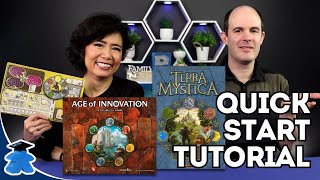





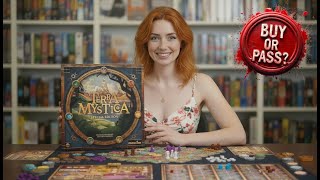















Terra Mystica Deep Dive
What the Community Thinks About Terra Mystica
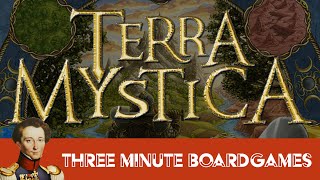
Reviewers agree on one thing before anything else: Terra Mystica is a heavyweight Euro game, and it wants to be treated like one. 3 Minute Board Games introduces it as "one of the classic heavyweight games" built "for people who want something complex and challenging," while Nights Around a Table calls it flatly "a game that was very complex," noting it climbed the BoardGameGeek rankings because it offers "very little luck." No Pun Included goes further, describing it as the game that "made me fall in love with board games" and crediting it with showing how a design can be "devilishly complicated" at every step while still handing players real choices.
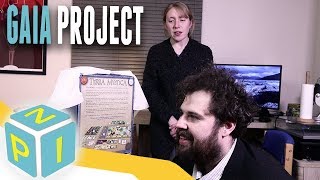
Where the community splits is on theme and on how Terra Mystica stacks up against its own descendants. All You Can Board is drawn in specifically by the setting, saying the theme "absolutely resonates" and singling out the wheel of terrain types and faction variety as the reason it has stayed on their must-play list. Nights Around a Table takes the opposite view, arguing the fantasy dressing never quite fit the mechanics, right down to finding it strange that witches and Bedouin-styled desert nomads share the same fantasy board. That same tension shows up around Gaia Project, the game's space-themed successor: No Pun Included still recommends starting with Terra Mystica but personally leans toward Gaia, and 3 Minute Board Games says outright that they "slightly preferred" Gaia Project, largely because of its technology options.
Core Mechanics That Define Terra Mystica
Terraforming to Build and Expand
Each of Terra Mystica's factions has a home terrain and a matching color, and the core loop is spending workers to terraform neighboring land closer to that color so a building can go there. As 3 Minute Board Games explains, players can only terraform land adjacent to territory they already hold, and moving a space one step closer to home costs a set number of workers, though booster tiles can hand out a free step. Once land matches a faction's terrain, a basic dwelling can go up, and from there dwellings upgrade into trading posts, then into strongholds or temples, each unlocking new resources or a faction-specific special ability.
Power Bowls and the Cult Track
Resources come in four flavors: workers, coins, priests, and power, and power in particular runs on a distinctive three-bowl cycle where energy has to move from bowl to bowl before it can be spent on bigger effects. Priests, in turn, are the currency for climbing four cult tracks that make terraforming cheaper and hand out points at key thresholds. No Pun Included singles this system out as one of Terra Mystica's odder design choices, noting that "advancing on this track was important to win the game" even though the act of climbing it, step by unglamorous step, rarely felt exciting on its own.
The Terra Mystica Experience
A Puzzle of Efficient Expansion
3 Minute Board Games describes the appeal as a matter of levers: what cult upgrades to chase, how to time power spending, and how differently each faction wants to be played. Network building rewards clustering four or more connected buildings into a town, and every terraforming decision doubles as a land grab against whichever opponent is expanding toward the same territory.
Punishing for the Unprepared
That same density has a sharp edge. No Pun Included warns newcomers directly: "if this is your first game you will lose." 3 Minute Board Games echoes the same caution, explaining that "a few missteps in this game and you are in for a terrible time," since running out of money or workers can leave a faction stranded while rivals close in around it.
What Makes Terra Mystica Stand Out
A Board That Evolves Under Your Feet
For 3 Minute Board Games, the single best thing about the game is watching the shared map change shape as terraforming reshapes the landscape turn after turn, which can squeeze a faction out of its own expansion plans faster than expected. That constant reshuffling of who can reach where keeps the map itself part of the strategic puzzle rather than a fixed backdrop.
Distinct Factions With Real Constraints
Every faction gets its own terrain preference and its own twist on the rules, and 3 Minute Board Games points to the Darklings, who can only terraform by spending priests instead of workers, as an example of how differently each side plays. All You Can Board credits that same faction variety, paired with the circular wheel of terrain types each one favors, as the specific reason the fantasy setting has stuck with them even before playing.
Potential Drawbacks
A Steep Learning Curve and Dense Rules
Nights Around a Table calls Terra Mystica "a very mechanical game" that "took a very long time to teach," estimating roughly half an hour just to walk through how everything worked before a first turn could be taken. No Pun Included adds that the cult track, while essential to winning, is a strange design wrinkle: important enough to shape every game plan, yet one of the least immediately rewarding parts of a turn.
Theme That Doesn't Always Land
Nights Around a Table is the clearest voice on this drawback, saying the fantasy theme "didn't really ooze" through play and pointing specifically to the mix of witches, ogres, and Bedouin-styled desert nomads sharing one setting as a combination that never fully made sense to them. For a reviewer who cares about theme, that disconnect kept an otherwise respected design from landing emotionally the way its mechanics did intellectually.
If You Enjoy Terra Mystica
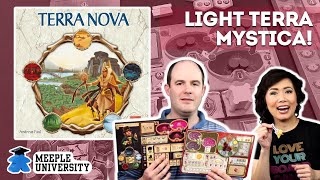
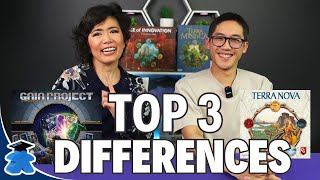
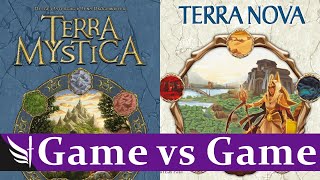
Reviewers repeatedly point players toward the same follow-up games. Gaia Project comes up most often as the natural next step, a space-themed reworking of the same system that No Pun Included, 3 Minute Board Games, and All You Can Board all bring up unprompted when discussing Terra Mystica, each weighing its added technology options and streamlined rules against the original's stronger theme. JestaThaRogue instead runs a direct head-to-head against Terra Nova, the more recent, more accessible reimplementation of the same core game, awarding Terra Mystica the edge on components and depth while conceding Terra Nova's newer rulebook is easier to teach from.
What Reviewers Are Saying
"Either version of Terra Mystica is a complicated but most importantly highly competitive game that will not just test your wits but also your ability to stay cool under the unrelentingly boring drill of math as you spin out of control or cut it short. If this is your first game you will lose."
— No Pun Included
"Terra Mystica is one of the classic heavyweight games and it's definitely for people who want something complex and challenging. There are so many levers to put on the game, from what cult upgrades you get to how you spend and gather power, and the different play styles between the factions can be dramatically different."
— 3 Minute Board Games
"It was a game that was very complex. It's a very complex game, and it ranked really highly on BoardGameGeek, because it had the kind of thing going that BoardGameGeek raters love, which is very little luck."
— Nights Around a Table