
Game Info
Year
2026
Players
1-5
Age
12+
Playtime
90 min
Collection
Ratings
Creator Score
Mechanic profile
Not enough video data yet
Vibe profile
Not enough video data yet
Description
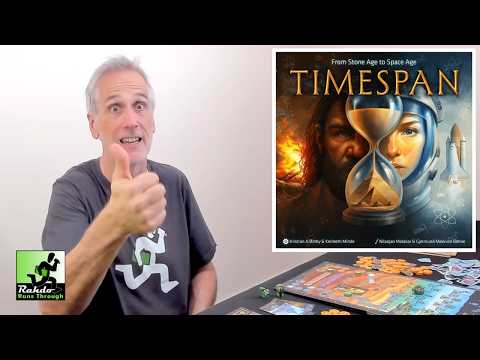
A civilization game where players guide a people from the Stone Age to the Space Age through economy and exploration and technology without military conflict
Featured Videos

Ask a Rules Question
All mentions
Browse transcript mentions, sentiments, pros/cons, mechanics, topics, quotes, and references.
Total mentions: 5
This page: 5
Sentiment:
pos 5 ·
mix 0 ·
neu 0 ·
neg 0
Showing 1–5 of 5
Video bFSP035DuK8
Rahdo Runs Through Rules Teach at 0:00 sentiment: positive
video_pk 151388 · mention_pk 425068
Click to watch at 0:00 · YouTube ↗
Overall sentiment (raw)
positive
Pros
- Epic scope and storytelling
- Simultaneous play makes it fast-paced
- Abundance of difficult and satisfying decisions
- Brilliant conveyor belt mechanism
- Dynamic resource management system
- Positive player interaction through wonders
- Excellent usability and board design (modular)
- Thematic integration of time progression
- Highly replayable due to modular setup and card variety
Cons
- Missed opportunity to use the peace track for drafting advantage (host's opinion)
- Can be overwhelming with the number of choices
Thematic elements
- Civilization building over a vast timeline.
- Spanning three eras of civilization building, from prehistory to potentially the future.
Comparison games
- Nations
- Through the Ages
- Age of Civilization
- Tapestry
- Fiords
- Zooloretto
- The Mayan Calendar
- Ancient Knowledge
- Eclipse
Mechanics (from transcript analysis)
- Area Movement — Players move pieces on tracks (science, culture, peace, sea travel/air travel) to unlock abilities or score points.
- Card Drafting — Players draft cards (inventions, people, constructions) from available bundles. In solo, this is based on peace level, emulating turn order.
- Civilization Powers — Each civilization has unique starting conditions and potentially unique upgrades, offering different strategic paths.
- Hand Management — Players hold cards in hand and must decide when and how to play them, often considering their multi-use potential (worker placement action, upgrade, or discard for resources).
- Modular Board — The game features a unique modular board system that can be adjusted in size, offering flexibility for different table spaces.
- Resource Management — Players manage various goods and coins, upgrading them or spending them to acquire other resources or perform actions. A dynamic system allows resources to be spent to upgrade other things.
- Set Collection — Players aim to achieve specific visions or goals, such as playing a certain number of inventions or collecting luxury goods.
- Technology tree — Advancing on the science track leads to breakthroughs, which unlock new abilities or options.
- Worker Placement — Players use workers to activate various spots on cards and the board to perform actions. Cards can be upgraded to improve these spots.
Video topics + discussion points
No key topics recorded for this video.
Quotes (from this video)
- This is the greatest Civilization board game of all time as far as I'm concerned.
- My favorite mechanism in board games is one that unfortunately Board Game Geek does not recognize as a mechanism even though it's the greatest mechanism in the industry. Conveyor belts.
- The fact that our playerboards come in three different things so you can arrange them in different ways so you can make it fit on your table. That's just a nod to how much attention the developers of this game put into usability.
- It's just this is a master class of so many different disperate elements you know congealing together to be so much more than the sum of its parts but all of its parts are amazing as well.
References (from this video)
No references stored for this video.
Video 1tnV4owCWl8
Board Gaming Ramblings Review at 0:06 sentiment: positive
video_pk 124904 · mention_pk 357740
Click to watch at 0:06 · YouTube ↗
Overall sentiment (raw)
positive
Pros
- Great addition of a smaller board for small tables.
- Simultaneous play keeps the game from lasting too long.
- Resource management puzzle is well-designed.
- The four-card timeline mechanic is interesting and strategic.
- Tracks feel good to move up on and are important.
- Good variability from factions, technology boards, and cards.
- Playtime is accurate and good for the game's depth.
- Medium weight, easy to get into.
- Does not feature war, which is a plus for a civilization game.
Cons
- If you dislike simultaneous action games, this one won't change your mind.
- Lack of direct player interaction.
- Some variability elements (like factions and tech boards) are minor nudges rather than game-changers.
Thematic elements
- Civilization game
- From the Stone Age all the way into the future
Comparison games
- Santa Maria
- Solfjord
- Seven Wonders
Mechanics (from transcript analysis)
- Card Drafting — Players draft cards, one face up, one face down, and a discovery tile in player order. This drafting process and the associated bonuses are noted as important. [63.60, 65.40, 69.60, 366.80]
- Hand Management — Cards are held in hand and have costs. Playing cards adds them to a player's timeline tableau. [73.24, 146.64, 148.24]
- Resource Management — Players manage resources like wood, stone, grain, sheep, and gold. There's a closed economy with a limit on resources and an upgrading system. [119.40, 440.12, 451.40, 1054.84]
- Set Collection — Scoring cards are collected, and players aim to fulfill their conditions. Some scoring cards can be claimed by multiple players. [802.52, 812.00, 816.64]
- Simultaneous action selection — Most of the game is played this way, which keeps the game from lasting too long. It differs from worker placement in that player actions don't block others directly, but observing opponents is still relevant. [53.08, 104.32, 274.84, 309.96]
- Tableau Building — Played cards move into a timeline, impacting future actions. Luxury tiles can be added to cards to enhance their actions. [151.64, 173.28, 175.28]
- Technology tree — The resource system functions like a tech tree, allowing players to upgrade resources. Technology boards also offer upgrades. [456.76, 690.36]
- track movement — Multiple tracks (culture, technology, ship, balloon, space) are present, and moving on them provides bonuses and points. [126.68, 138.00, 665.04, 676.80]
- Variable player powers — Factions and technology boards provide variability, altering player actions and bonuses. [695.32, 704.04, 873.32]
- Worker Placement — Players use workers to place on action boxes to perform actions. The happiness or sadness of workers is mentioned as a cosmetic choice with no gameplay impact. [106.76, 114.52, 309.96]
Video topics + discussion points
No key topics recorded for this video.
Quotes (from this video)
- This is a great addition. I haven't seen this in any other game ever and it's great.
- This is a civilization game where you will go from the Stone Age and all the way into the future in about 90 minutes.
- This is a simultaneous action selection game or same simultaneous action play game, which for me or not for me, but could be like the main negative for a lot of people.
- If you don't like simultaneous action games at all, I'm just going to tell you right now, then this is not going to be the game for you.
- I really like this resource management puzzle.
- The tracks feels really good to move up on. And importantly, very much of the game is moving on. That's if you don't move on the tracks, you're doing it wrong.
- The variability makes it more fun.
- This is just for me a fun game. I think that this is going to land well with so many people.
- I think that this is a great weight. Like it's a medium style game. It's not that heavy. It's easy to get into.
- Oh, timing is important in time span.
References (from this video)
No references stored for this video.
Video HSb_2ySYARs
TheGameBoyGeek - Hi Quality Hi Energy Board Game Reviews Review at 0:13 sentiment: positive
video_pk 124637 · mention_pk 357397
Click to watch at 0:13 · YouTube ↗
Overall sentiment (raw)
positive
Pros
- Fast playtime for an epic-feeling game (90 minutes or less).
- Simultaneous play minimizes downtime.
- Clever engine building with sliding cards and changing worker spots.
- Flexible resource management that avoids feeling restrictive.
- Satisfying game arc with significant progression.
- Refreshing focus on peace over military in a civilization game.
- High-quality production and artwork.
- Indirect player interaction that encourages strategic wonder building.
- Asymmetrical starting components (civilizations and technologies) add replayability.
- Inclusion of 3D printable component files in the rulebook.
Cons
- Limited direct player interaction, may not appeal to players seeking combat or direct confrontation.
- Difficulty in detecting rule/component errors made by other players due to simultaneous play.
- Wish luxury icons were on the cards themselves for easier reference.
- Yellow components with white print are hard to see.
- Only one icon reference sheet provided, which can be a bottleneck in a multiplayer game.
Thematic elements
- Progression through historical ages and technological advancement.
- Spans across different historical ages, from the Stone Age through to the Space Age.
Comparison games
- Revive
- Recall
- Bad Company
- Escape the Curse of the Temple
- Mechs vs. Minions
- Acquire
- The Lost Ruins of Arnack
- Guen
Mechanics (from transcript analysis)
- Asymmetrical Civilizations/Technologies — Players start with asymmetrical civilization boards and technology boards, offering slight differences and different starting goods.
- Card Drafting — Players draft history cards during the game, choosing which ones to add to their tableau based on available abilities and tile combinations.
- Engine Building — Players build an engine with cards that slide to the right on their player board, with some cards providing abilities when they slide off.
- Goal Setting (Visions) — Players select vision goals which are shared with neighbors, creating shared endgame objectives.
- Set Collection — Players collect luxury goods which can customize worker placement spots or be discarded for upgrades.
- Simultaneous action selection — A significant portion of the game is played simultaneously, reducing downtime.
- Track Advancement — Players advance on various tracks such as culture, science, shipping, air, and space tracks, with bonuses for reaching the end first.
- Variable player powers — Each civilization and technology board provides unique starting abilities and focuses.
- Worker Placement — Players place workers on action spots, with limited spots per action. Some spots are on pre-printed areas, while others are on randomized wonders or player-built wonders.
Video topics + discussion points
No key topics recorded for this video.
Quotes (from this video)
- Co-designed by one of the designers that also did Revive which was my strategy game of the year when it came out and Recall which was also the strategy game of the year when it came out. Can he do a repeat?
- So, there's a lot of there's almost no downtime in this game, which is great, and it keeps things moving.
- I like the interaction that is there. The indirect interaction that is there in this game. I like it because you're interacting with others wonders.
- It's not a solo game totally, but it is more of a solo. And and this is interesting because I tend to like games with more interaction than not. But the fact that I love this game, spoiler, uh, shows you how good it is because I'm less inclined to like a game that has so much of the game is just kind of like figuring out your own puzzle.
- This game is absolutely fantastic. Uh, this is going to be easily in the top five strategy games of the year for me and it's in the conversation right now for my best strategy game of the year.
- It's staying on my gaming library to get my highest honor, a saxophone serenade.
References (from this video)
No references stored for this video.
Video pSctuPnSpAY
Board Gaming Ramblings Top List at 3:12 sentiment: positive
video_pk 103727 · mention_pk 299550

Click to watch at 3:12 · YouTube ↗
Overall sentiment (raw)
positive
Pros
- Fun civilization progression from Stone Age to future
- Engaging resource management puzzle
- Simultaneous play speeds up the game
Cons
none
Thematic elements
- Civilization progression from Stone Age to future
Comparison games
none
Mechanics (from transcript analysis)
- Card Play — We're playing cards trying to do stuff in the best way possible.
- Resource Management — It's really fun uh resource management puzzle.
- Simultaneous Play — It is a simultaneous a play civilization game.
- Worker Placement — It's a worker placement game but I do the worker placement stuff on my own board.
Video topics + discussion points
No key topics recorded for this video.
Quotes (from this video)
- It's been a lot of good games we played this month. I could make like a top 10 team.
- The most important thing other than having fun is winning. You know, winning is like it's not really, but it's a thing.
- We're in it to win it.
- Because we cry a lot while playing this game and with our friends.
- It is really group dependent.
- I really like spatial puzzles, but I like spatial puzzles which doesn't just feel like randomness.
- It's just boring.
- It is interesting when you get let down with games you already played because you are sometimes you're very hyped about a new game, but then you're like you have these feelings and experiences of the game and it kind of feels different.
- It has a few things in it that I shouldn't like that cooperate cooperation.
- This is a word game and I think it worked very very well because it is a language independent.
- It was easier than I thought it would be and also more fun.
- Drillers just gave me that oh, I want to go again feeling and it's been some time since I played a deck builder that gave me like this amount of joy.
- It's really fun uh resource management puzzle all to do the best and score points which I have been kind of good at but then you are getting more and more efficient and winning.
- I liked the expansion but I didn't like the expansion.
- It has like like cog system that revolves like
- It's this and of course it's it's cool with the gimmick of it's actually moving around in the adding to the board.
- It is a action selection game with a Mancala style energy revolvement.
- It is really nice, especially the four-player version has so much interaction in like a positive and if you don't like interaction in the four-player game there is quite a lot of it, but not not negative take that the like great positive I'm saying positive interaction.
- It's been a blast to play it again.
References (from this video)
No references stored for this video.
Video 2Wy91WwuU0Y
Board Game Hangover Top List at 16:31 sentiment: positive
video_pk 102402 · mention_pk 292196

Click to watch at 16:31 · YouTube ↗
Overall sentiment (raw)
positive
Pros
- Streamlined and simplified.
- Gorgeous presentation.
- Asymmetric powers and nations.
- Low player interaction, no military conflict.
- Simultaneous play makes it quicker.
Cons
- Haven't gotten to play it yet.
Thematic elements
- civilization building
- ancient times to space travel
Comparison games
none
Mechanics (from transcript analysis)
- Card Drafting — what you do is you draft cards.
- civilization building — It's generally a civilization game where you go through time from like ancient times all the ways to space travel and so on.
- Simultaneous Play — it's simultaneous, which means that uh you basically will play at the same time most of the game so it's much quicker.
- Timeline building — you take your cards that you just drafted and add to your timeline. This timeline forever is moving forward
Video topics + discussion points
No key topics recorded for this video.
Quotes (from this video)
- King of Tokyo is having a new version.
- Wingspan now will fit your pocket and
- Scythe. Oh boy, you can't imagine what will happen with Scythe.
- The hottest board games out there right now like a civilization game that will be super streamlined and good.
- To talk about the Jewel game first, we have to check Scythe and Expeditions because the Jewel game is kind of mixture of both of these.
- It's a two-player board game where one player will play there with the rules of Scythe and the other player will play Expeditions rules and they fight with each other.
- This sounds really exciting. How exciting? Let's rank it.
- To be honest, this has really made me want to play Scythe now. So I am excited.
- In King of Tokyo, you are trying to be the best monster possible.
- This is right up Yiannis's alley.
- So, this one goes here. Whoop.
- The third place goes to -60°, which is a heavy heavy Eurogame, and we don't have much information about it.
- Gray Loon takes us back into medieval times and this board game looks gorgeous and promises us two things.
- It's generally a mechanical Eurogame, which is not bad at all.
- And this time, the top step goes to Time Span, which is a streamlined civilization game that looks gorgeous.
- It's highly worried because of those asymmetric powers and things and it's simultaneous, which means that uh you basically will play at the same time most of the game so it's much quicker.
- So these were the hottest board games of the month. What do you think? Which one of these are you the most excited to try?
- Remember to support the channel cuz that's how we can do all this research, spend time in making that lovely presentation and uh not remembering all the names of the games and people and so on.
References (from this video)
No references stored for this video.
Transcript Navigation
Showing 1–5 of 5