The Extinction of Epic Kids’ Board Games





Transcript
Millions of years ago, the earth was dominated by huge hulking beasts, a violent world which no longer exists, wiped out by a single catastrophic event. When I was a child, the board game industry was also dominated by huge hulking giants, epic, violent, plastic adventures aimed squarely at children. Unlike the dinosaurs before them, this entire genre of games which felt like everything to children like me went extinct. HeroQuest, Space Crusade, Lost Valley of the Dinosaurs, Fireball Island, gone. There was no single asteroid, no one event that killed them off. Instead, a series of economic, cultural, and technological changes culminated in the total erasure of a genre that once dominated toy store shelves. In this video, I'll explore why the epic plastic adventures of the '80s and '90s went the way of the dinosaurs and what modern game designers can learn from these products.
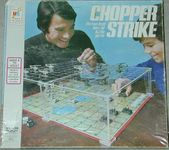
As a board game designer with a constant stream of new releases, I'm supposed to care about where the market is heading, but there's a part of me that keeps looking backward at the games which made me fall in love with the hobby in the first place. The games I experienced as a kid might not necessarily hold up to modern standards in all sorts of different ways, but in my memories, they're as perfect as the day I first encountered them. So, why are toy store shelves filled with this stuff and not these banners? For a brief period between the 1970s and the early 1990s, these giant plastic adventure games dominated toy store shelves, and they constitute a lost family of games. What they shared wasn't mechanisms, it was ambition. They were huge, packed with toyetic miniatures and terrain and aimed squarely at kids. I'm labeling this family of games epic plastic adventures and they were awesome. Tank Battle, Carrier Strike, Sub Search, and Chopper Strike represent an early wave of such games, all released by Milton Bradley in the mid-1970s.
Tank Battle is essentially a combination of Battleships and Stratego with players taking turns to move their tanks, then guessing where their opponents will move on later turns and programming a series of shots to take them out. Sub Search and Chopper Strike utilize multi-level boards to represent battles in the sky or in the depths of the ocean. These games are not credited by Milton Bradley to any specific designer, so it's hard to pin down their origins, but they certainly feel like a precursor to the spectacle first designs of the 1980s. In 1981, Dark Tower was an enormous investment for Milton Bradley. The budget for development and production was huge, approaching a million dollars. Dungeons and Dragons was a major new player in the tabletop industry and Milton Bradley hoped that Dark Tower could take a slice of that market by replacing the need for a game master with a computerized unit. George Ditomassi, the Milton Bradley vice president of sales, reportedly said at the time, "Dark Tower will not attract the Dungeons and Dragons aficionado, but that's a small, intense market. We wanted the next level down. People who had heard about D&D, but didn't want to be Dungeons and Dragons freaks."
Dark Tower fell short of Milton Bradley's expectations, hampered by high manufacturing costs, which led to a steep retail price and discouraged buyers. A legal dispute over the game's origins further damaged its reputation and imposed significant financial strain on the company. And as a result, production ceased within months of release, turning the game into a rare and coveted collector's item. In 1983, the toy company Lakeside released Crossbows and Catapults from inventor Ray Frigard. The game was much too large for the average table and more likely to be played spread across a living room floor. Players positioned large plastic towers at each end of a playing space and then constructed walls from plastic bricks to protect them. The game involved hurling plastic projectiles at each other's constructions using the plastic crossbows and catapults referenced in the title. The game was successful enough to spawn multiple expansions and new editions from various publishers, each with their own toyetic components and contraptions. In 1989, Milton Bradley hadn't given up on their goal of profiting from the still expanding Dungeons and Dragons craze.
After the disappointment of Dark Tower, they got back on the horse with the release of a trilogy of games from in-house designer Stephen Baker, a former employee of Games Workshop. HeroQuest represents the peak of the epic plastic adventure genre. One player acts as a dungeon master, an evil sorcerer who controls all of the game's monsters, and the other players control a group of heroes, a barbarian, a wizard, an elf, and a dwarf. The heroes roll dice to move around the dungeon, drawing cards to search for treasure and traps. Each game constitutes its own mission, and items gathered can be brought forward into future games forming a narrative campaign. The miniatures for the game were produced by Games Workshop's studio, Citadel Miniatures, and they were a huge draw for the game. The sequel, Space Crusade, was essentially HeroQuest in space, pitting Space Marines against a variety of alien species from the Warhammer 40,000 universe. And in 1992, a third game, team, a much simplified miniatures war game in the vein of Warhammer Fantasy Battle.
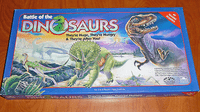
But the series was producing diminishing returns, and a fourth entry in the series based around chariot racing never came to fruition. Lost Valley of the Dinosaurs and Battle of the Dinosaurs represent the death throes of a struggling genre. Lost Valley of the Dinosaurs was designed by a husband and wife team, Julian and Tony Courtland-Smith, hoping to replicate the success of their Parker Brothers title Survive, which was dropped by the company in the mid-80s in the wake of the video game boom. Lost Valley was picked up by UK publisher Waddingtons, and it was a big hit. Waddingtons also took over production of Survive, reworking it into Escape from Atlantis, but this was a company in its twilight years, selling to Hasbro not long after, marking the end of the road for Survive and Lost Valley, which never got a US release.
Die Schlacht der Dinosaurier, sorry for the pronunciation, Battle of the Dinosaurs we'll call it. This was a late entry into the epic plastic adventure genre from Schmidt Spiele. It was released in 1993 and only in Germany, and it was another new game from HeroQuest designer Stephen Baker. Two to four players each control an army of dinosaurs with warriors riding on their backs. Players take turns to select a card to determine which dino to activate, either moving it or attacking. Bigger units move slowly, but roll more dice in combat. Smaller units are more agile, but roll fewer dice. It's a glorious production and a really fun experience, and it's sad to look back upon it and realize that this was essentially the end of an era. Now, several of these games have had recent revivals, of course, but they are marketed at an older audience. They're sold on nostalgia rather than their original intent. They're distributed through hobby stores rather than high street stores, and they're priced at a premium. These wonderful new additions are museum pieces. They're not evidence of a living genre. Make no mistake, this family of games is extinct. And that's rare. I can't think of many examples of a once extremely popular category of game which is now entirely absent. If you do fancy a bit of an archaeological dig through board game history, you might want to check out my book Adam in Wales' Legacy: Design Lessons from History's Most Influential Tabletop Games. It's available now on Amazon.
Epic plastic adventure games were enormous. Oversized boxes, mountains of plastic, three-dimensional terrain, armies of miniatures. They demanded attention from the moment you saw them on a shelf. But they were also enormous in scope. Many offered multiple scenarios, branching adventures, expansions, or the promise of an entire world waiting to be explored. These weren't simply games to be played and put away, they were events. And the marketing reflected that ambition. These products were backed by television commercials, glossy catalog spreads, and advertising budgets that would be unthinkable for most board games today. The commercial for Dark Tower featured Orson Welles. Most importantly, every one of these games promised the same thing: adventure, danger, discovery, spectacle.
They were sold as toys and they were aimed directly at children. But unlike many children's games that came before and unlike many that followed, these games were also surprisingly focused on conflict. Not graphic violence, not gore, but violence nonetheless. In Lost Valley of the Dinosaurs, your explorers are repeatedly eaten by a Tyrannosaurus Rex. In Thunder Road, you ram enemy vehicles off the highway and into oblivion. In Fireball Island, the central challenge is avoiding death at the hands of an erupting volcano. Even HeroQuest, perhaps the most beloved of them all, is fundamentally about wandering through dungeons and killing monsters. The details varied, but the formula did not. Big boxes of plastic and bucket loads of peril.
To truly understand these products, we really need to put them in the context of the media environment at the time. This was a period immediately prior to the video game industry boom, or at least immediately prior to the graphical advances which allowed video games to bring fantastical worlds to life on screen. If you wanted to immerse yourself in a fantasy world as a kid in the 80s, then tabletop games were the way to do it. In 1976, Kenner produced a range of action figures to accompany the release of Star Wars. And this line of toys was so successful every toy brand wanted their own line of action figures with good guys and bad guys facing off against each other in their own little universe. Mattel launched He-Man and the Masters of the Universe. Hasbro produced Transformers and expanded its existing line of G.I. Joe figures. LJN had ThunderCats. And all of these featured in well-loved cartoons for kids and all were focused on combat and violence.
Toned down enough to satisfy the senses, but violence nonetheless. So, this was the backdrop for the creation of these tabletop games. Kids just couldn't get enough of this stuff. Do these two characters from Hero Quest look in any way familiar to you? And it wasn't just children's cartoons that toy lines were honing in on. Even ultra-violent adult-only movies like Aliens, Terminator, and RoboCop got their own toy lines. With home video now being an option, kids were consuming this stuff and the toy makers saw an opportunity to sell them merch. Where do you think the inspiration came from for the mighty Dreadnought in Space Crusade? Or the Genestealer aliens? In hindsight, it's hardly surprising that toy companies started producing giant board games full of miniatures, monsters, and combat. These games were the tabletop expression of a much larger trend. And yet, they vanished. Before we talk about why, it's worth exploring what made them so memorable. Because despite their age, these games got a lot of things right.
First up, accessibility. The rule sets to the epic plastic adventures were kept very streamlined to get kids playing as quickly as possible. Lost Valley of the Dinosaurs is as basic as roll a dice to move, draw a card, and do what it says. This simple formula allows a wealth of different scenarios, sending the T-Rex after your opponents, stealing treasure from the temple, plucking adventurers from the board with a pteranodon, cutting off your opponents with lava. It's a richly thematic world with minimal rules overhead. HeroQuest and its sci-fi sequel Space Crusade have got a bit more going on, but they remain pretty straightforward. Using my ladder system, I score games in five different categories to move them up an engagement ladder. And although the maximum score is 15, a score of 10 or above tops the ladder and represents a hugely engaging product. So, the first category is thematic immersion, and these games have this in spades. In fact, I would say that they're even more immersive than the more complex games which came later, because those additional rules come at a significant cost. If you're spending your play time searching through a rule book to clarify edge cases, you're not truly immersed in the game's world. No such issue in these epic plastic adventures. If a rules issue comes along, frankly, you house rule it on the spot. They are super intuitive. The second category is player interaction. And again, these games excel here. The interaction is brutal,
it's direct, and it's often mean. But they wear their violent themes on their sleeve. You know what you're getting into when you sign up for a game of Fireball Island. Third, we've got tension and this genre is full of it. Make or break dice rolls, hidden information, card draws and reveals, it's hard not to feel a little bit stressed when the swamp monster is lingering just one or two spaces from your last remaining adventurer. The next category is feedback, the ways in which a game responds to player inputs. So, that's rewards, punishments, victory points, special abilities and items gained along the way. Again, these games excel at this. If you lose a combat, you feel the damage. If you locate a treasure, you level up.
Every turn adds a new twist to the narrative. And finally, meaningful decisions. And this is where the genre struggles. These are games aimed at children and they're designed 30, 40, 50 years ago. So, players do have a ton of choices to make, plenty of agency, but the outcome of those decisions is more often than not determined by a dice roll, which makes strategizing challenging. In most cases, you're simply in it for the ride. So, the total, a collective score for the entire genre, is 13, topping the ladder and then some. These are really engaging experiences. So, awesome presentation, simple rules, engaging gameplay, what's not to love? Why are we no longer making games like this? Well, the answer is that almost everything around them changed. Culture changed. At exactly the same time as these games were creeping into children's closets, another new product was becoming a family staple, home computers. In the 1980s, video games couldn't compete with the gorgeous presentation of epic plastic adventure games, but they could provide considerably more variety with no setup and minimal rules overhead. By the early '90s, video games could realize complex fantasy worlds which far exceeded anything achievable on a tabletop with impressive graphics to boot. The kids who loved analog games were going digital and this was only the
beginning. These games were expensive, not just to buy but to manufacture, to ship, to stock. The giant boxes helped the games stand out, but they also consumed enormous amounts of shelf space. And to retailers, shelf space is money. The problem became even worse once expansions arrived. A toy store couldn't just stock HeroQuest or Crossbows and Catapults, it also had to stock the expansions and the sequels and all the other giant plastic games competing for the same limited space. Eventually, the economics stopped making sense, particularly as specialist toy stores came under pressure from supermarkets, department stores, and later online retailers. The ecosystem that had supported these games was disappearing. And at the same time, parents were becoming less enthusiastic about fantasy combat. In the US, Dungeons and Dragons was generating something of a moral panic with religious groups linking the game to Satanism, witchcraft, and suicide. And given the choice between two games to place under the Christmas tree for their beloved offspring, one a familiar wholesome game from their own childhood and another bearing a muscle-bound, sword-wielding barbarian, parents started to vote with their wallets. Now, this was not enough to kill the genre on its own, but it was enough to weaken it.
And by this point, the genre was already under pressure from every direction. So, no single factor killed epic plastic adventures. Video games didn't kill them, retail didn't kill them, changing cultural attitudes didn't kill them. But together, they created an environment in which these games could no longer thrive. One by one, they disappeared. And by the mid-1990s, an entire category of board games had largely vanished from mainstream toy stores. The dinosaurs were extinct, and the dungeons, volcanoes, and apocalyptic car battles went down with them. Epic plastic adventure games did get a swan song with the release of Heroscape in the early 2000s. Again, designed by Stephen Baker of HeroQuest fame. The game had a good run, five or six years of consistent releases before joining its ancestors in the annals of discontinued titles.
But there is a twist in this tale. There's an argument that this genre didn't actually disappear at all, but instead, it aged up. The descendants of HeroQuest are still with us. Descent, Gloomhaven, Warhammer Quest, Zombicide, Nemesis, massive boxes full of miniatures and adventures. The difference is that they're now aimed at adults with a considerable disposable income, adults who don't mind spending 100 pounds on a giant box of plastic soldiers. Modern adult gamers are comfortable learning complicated rule sets, and they're perfectly happy ordering expansions online. So the business model still works. It's just for a different audience. The reality is that epic plastic adventure games for kids represented a very specific cultural moment, and one which we can never get back. Children are no longer restricted to the same four TV channels, an entire generation captivated by handful of thinly veiled toy advertisements masquerading as cartoons.
They can pick and choose what they watch and when they watch on any number of streaming channels, often without embedded advertisements. Children no longer select their Christmas gifts from an Argos catalog or a Sears Wish Book. They don't peruse the shelves of specialist toy stores. They'll lean towards whatever's trending on social media, or perhaps eschew analog toys altogether, preferring to keep things digital. In 2026, oil and plastic costs are high, shipping costs are high, and environmental initiatives have guided publishers towards more sustainable materials like wood and cardboard. A large portion of the post-Catan gaming community values elegant mechanisms over spectacle, as games are increasingly aimed at adults rather than children.
There are still games in the hobby market which do feel like they have some of the DNA of the kid-focused epic plastic adventures of the '80s and '90s. King of Tokyo, with its ridiculous giant monsters and dice-rolling combat on every turn. Little Soldiers, which pits toy soldiers against each other using household items as terrain. But these are few and far between, and crucially, they're not epic. Crowdfunding has also allowed companies to bring back some of the most popular titles from the '80s and '90s. HeroQuest, Thunder Road, Crossbows and Catapults, Dark Tower. They've all had remakes, but they're sold primarily on nostalgia, and they're not troubling the mainstream staples in the way that they once did. With these tentpole titles ticked off the list, is it time to stop recreating earlier titles and start creating some new ones?
Grab a block of amber, extract a little dino DNA, and rewild the board game ecosystem with new epic adventures for kids. Now, that's an innovation that I would like to see. Now, if you enjoyed this journey through the rise and extinction of the epic plastic adventures, you're going to find dozens more stories like it in my book, Admin Weal's Legacy, design lessons from history's most influential tabletop games, which is available now on Amazon worldwide. Follow the link in the description to this video. And in the comments, let me know if I've missed any epic plastic adventures from the '80s and '90s. I love looking this stuff up. I love searching eBay for old copies and trying to get some of them into my collection. I don't know why. Maybe at one point my son will be old enough and enjoy these things just like I enjoyed them as a kid. Maybe I'll be disappointed.
But even if not, I enjoy opening the boxes and picking out the pieces and just exploring them again for the first time like I was a kid. So please do let me know your favorites in this now lost genre. I look forward to seeing you in the next video. Until then, all the best.