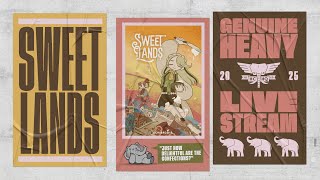











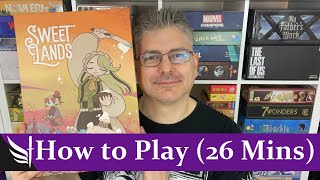











Sweet Lands box art

Sweet Lands

Game Info
Year
2025
Players
1-4
Age
14+
Playtime
200 min
Publisher
Collection
Ratings
Mechanic profile
Percentile rank vs. all games
Vibe profile
How this game feels to play
Description

Welcome to “Sweet Lands”, the kingdom of delightful confections! The former king has succumbed to his gluttonous love for sweets, leaving behind a final decree. Summoned by this royal edict, you and your fellow players are challenged to build the most magnificent city — and if you succeed, you will ascend as the new ruler of Sweet Lands. Gather the support of various townsfolk and navigate through fierce competition to create the richest and most prosperous city of sweets!

Sweet Lands is a heavyweight Euro-style game with over 200 cards, 14 unique characters, and 449 wooden tokens, offering an unprecedented gaming experience. This game captures the essence of traditional Euro-style games while introducing fresh and innovative mechanisms. Come and experience our biggest masterpiece!

—description from the publisher

Ask a Rules Question
All mentions
Browse transcript mentions, sentiments, pros/cons, mechanics, topics, quotes, and references.
Total mentions: 86
This page: 36
Sentiment: pos 30 · mix 3 · neu 1 · neg 0
Mentions per page
Showing 51–86 of 86
Video UrQ0waIzjM Review at 0:00 sentiment: positive
Sweet Lands video thumbnail
Click to watch at 0:00 · YouTube ↗
Overall sentiment (raw)
positive
Pros
  • Wonderful art and production
  • Satisfying core gameplay
  • Relatively easy to learn and plays easier than weight suggests
  • Straightforward and intuitive mechanics
  • Streamlined and quick solo mode
Cons
  • Abstract theme with poor integration
  • Solo mode might be too lightweight and lacks tension
  • Worker placement in solo feels too open
  • Feels like you accomplish too much in solo
  • Card draw can be a bit random
Thematic elements
  • Candy Land
Comparison games
  • Vital Lacerda games
Mechanics (from transcript analysis)
  • Area Control — Race on tracks to reach final spots for bonuses, and worker placement spots are contested.
  • Card Play — Cards are played to take actions, costing money or contributing to worker placement actions.
  • city building — Players build a city by placing terrains, roads, and houses.
  • Resource Management — Resources like wood, iron, and wheat are used, tied to exploration on the map.
  • Set Collection — Collecting three different houses together forms a city.
  • solo mode — Streamlined solo mode that blocks worker placement spots and focuses on reaching a point threshold.
  • Worker Placement — Players place workers to take actions, with costs potentially increasing based on the slot chosen (1, 2, or 3 cards).
Video topics + discussion points
No key topics recorded for this video.
Quotes (from this video)
  • Sweetlands is a heavyweight, low-interaction city-building and worker placement game with a streamlined and puzzly solo mode.
  • The art and production are wonderful.
  • I found the gameplay to be really satisfying.
  • It plays, I think, a lot easier once you've got it under your belt than the weight would suggest.
  • my biggest criticism is simply that this is a fairly abstract game.
  • The theme of this being a Candyland that we're creating doesn't really come through.
  • That's a real shame. That's a missed opportunity.
  • The question is, is it too lightweight?
  • I would have liked that to have been tighter.
  • Ultimately, I'm a really big fan of this game. I recommend it.
References (from this video)
No references stored for this video.
Video oGB0VXoLSKk Rules Teach at 1:25 sentiment: mixed
Sweet Lands video thumbnail
Click to watch at 1:25 · YouTube ↗
Overall sentiment (raw)
mixed
Pros
  • Enjoyable theme and puns.
  • Engine building with incremental growth.
  • Track progression offers strategic depth.
  • Good for groups that don't like direct conflict or 'stomp on my sand castle' mechanics.
Cons
  • Game can feel long, especially the fifth round.
  • Mechanically familiar, drawing heavily from Terrammystica and Terraforming Mars.
  • High component count can be overwhelming.
  • Player interaction is present but can be heads-down.
  • Divisive in the group, with some loving it and others strongly disliking it.
Thematic elements
  • Succession to the throne of a kingdom ruled by King Sugar Syrup, who has fallen ill from overindulgence of sweets.
  • Country of Confectionary Sweetlands
Comparison games
Mechanics (from transcript analysis)
  • action selection — Players choose from a variety of actions each turn, such as using action spaces, playing cards, or using skill tile abilities.
  • Card Drafting — Players draw cards into their hand which are used to pay for actions or provide ongoing benefits.
  • Set Collection — Collecting specific sets of tags or buildings can unlock bonuses or points.
  • Tile Placement — Players build terrain tiles onto a map, which must be placed adjacent to existing tiles or the capital.
  • Track Advancement — Players move markers along various tracks (e.g., prosperity, food, industry) to gain benefits and score points.
  • Worker Placement — Action spaces are used, similar to worker placement, where players place tokens to take actions, with costs increasing based on occupancy.
Video topics + discussion points
No key topics recorded for this video.
Quotes (from this video)
  • This is layer upon layer. It took a lot from Terrammystica. It took a lot from Terraforming Mars.
  • The fifth round is simultaneously the longest and the shortest round.
  • Solo or two-player is where this game is going to shine.
  • The cookie rabbits deserved no less than 4K.
  • Pay attention to your milestones.
  • We're going to go ahead and start by just burning a card.
  • Math ain't math.
  • I have no idea who's going to win this at this point.
References (from this video)
No references stored for this video.
Video 28w9Ab5Be_k Rules Teach at 0:00 sentiment: positive
Sweet Lands video thumbnail
Click to watch at 0:00 · YouTube ↗
Overall sentiment (raw)
positive
Pros
  • Structurally simple despite complexity.
  • Solo mode is handsoff and engaging.
  • Lots of cards and potential strategies.
  • Satisfying engine building.
  • Clear path to victory points.
Cons
  • Can be complex to grasp initially.
  • Requires careful resource management.
  • Some aspects of the solo bot and blocking are unique.
  • Connecting all four ports is challenging.
Thematic elements
  • Transforming a small track of land into a magnificent sugary kingdom to prove oneself a worthy heir to the throne.
  • Sweet Lands, a country of confectionary ruled by the king Sugar Sura
Comparison games
none
Mechanics (from transcript analysis)
  • Area Control — Building roads and terrain tiles on the board can flip adjacent tiles and lead to building placement, influencing the game state.
  • Card Play — Cards can be played for their action by paying a cost, or automated by paying a diamond, providing ongoing benefits or discounts.
  • Hand Management — Players draw cards from a large deck and must manage their hand, playing cards for their actions or costs, and holding onto at least one card for the next round.
  • Income generation — Players have tracks to increase their income of various resources and money, which they collect at the start of each round.
  • Set Collection — Collecting sets of buildings to form cities, and connecting all four ports contribute to end-game scoring.
  • Tile Placement — Players place terrain tiles adjacent to existing tiles or starting spaces, with some tiles flipping to reveal bonuses when a road is built adjacent to them.
  • Variable player powers — The character Alice T-Rose has special abilities related to developing cities and ignoring certain building rules.
  • Worker Placement — Players place action tokens on board spaces to perform actions, with some spaces requiring discarding cards as a cost.
Video topics + discussion points
No key topics recorded for this video.
Quotes (from this video)
  • In this complex strategy game, we'll try to prove ourselves a worthy heir to the throne by transforming our small track of land into a magnificent sugary kingdom.
  • This game has a ton of tokens and icons, but at its heart, structurally, it's actually very simple.
  • The solo mode for this game is about as handsoff as you can get.
  • We're trying to get 250 points. That's sort of considered a victory. And then over 300 points is considered like an extreme victory or something like that.
  • We won by two points.
References (from this video)
No references stored for this video.
Video _2lN1GRWHZs Top List at 0:39 sentiment: positive
Sweet Lands video thumbnail
Click to watch at 0:39 · YouTube ↗
Overall sentiment (raw)
positive
Pros
  • one of the most beautiful games
  • really fun
  • combos just pop off
Cons
  • heavy game
Thematic elements
  • sugary empire
Comparison games
none
Mechanics (from transcript analysis)
  • Card Play — playing cards to boost that engine.
  • Engine Building — by making a strong resource engine and playing cards to boost that engine.
Video topics + discussion points
No key topics recorded for this video.
Quotes (from this video)
  • Here are my top five board games of 2025.
  • Here's my top five of 2025. If you had to pick one, which one of these games would you play
References (from this video)
No references stored for this video.
Video Xm8v72Ovxlo Unknown Channel Top 10 List at 1:13 sentiment: positive
Unknown Channel - Sweet Lands video thumbnail
Click to watch at 1:13 · YouTube ↗
Overall sentiment (raw)
positive
Pros
  • Interesting take on trick-taking with face-down elements
  • No bidding; scoring based on color sets
Cons
none
Thematic elements
  • gummy/trick-taking with twist
  • Trick-taking with candy-themed visuals
  • light, family-friendly
Comparison games
none
Mechanics (from transcript analysis)
  • Trick-Taking — Three face-down cards can be played; must-follow rules apply with color choices; scoring by color combinations.
  • Trick-taking with a twist — Three face-down cards can be played; must-follow rules apply with color choices; scoring by color combinations.
Video topics + discussion points
No key topics recorded for this video.
Quotes (from this video)
No quotes stored for this video.
References (from this video)
No references stored for this video.
Video jELFJ5_rBZc Board Gaymes James Playthrough at 1:29 sentiment: positive
Board Gaymes James - Sweet Lands video thumbnail
Click to watch at 1:29 · YouTube ↗
Overall sentiment (raw)
positive
Pros
  • Cute visual design (eyeballs).
  • Magnetic components add tactile appeal and strategic depth.
  • Clear area majority scoring with a neat inner/outer zone mechanic.
  • Easter candy theme noted positively by players.
Cons
  • Not all rules are explicitly described in the transcript; potential for confusion without full rules.
  • Dexterity-based elements may be challenging for some players.
Thematic elements
  • Candy/Easter
  • Easter candy-themed world
Comparison games
Mechanics (from transcript analysis)
  • Area Majority — Scoring based on control of inner and outer zones, with eyeball orientation affecting points (face up = 2, face down = 1).
  • Area majority scoring — Scoring based on control of inner and outer zones, with eyeball orientation affecting points (face up = 2, face down = 1).
  • Compound Scoring — Eyeball pieces score 2 points when face up, 1 point when face down.
  • eye orientation scoring — Eyeball pieces score 2 points when face up, 1 point when face down.
  • jammer mechanic — A central jammer influences scoring; being in the same area as the jammer can remove pieces from scoring.
  • magnet-based stability / flipping — Magnet-assisted flipping that can be flipped down to make pieces harder to knock over.
  • movement and placement rules — Pieces can be clicked or slid; touching the ring places pieces on the inner side.
  • Pattern Movement — Pieces can be clicked or slid; touching the ring places pieces on the inner side.
  • round structure and scoring tokens — Four rounds of play; end-of-round scoring; ties yield a times-two token.
Video topics + discussion points
No key topics recorded for this video.
Quotes (from this video)
  • these are so cute. Look, it's an eye that's like closed with eyelash.
  • Eye that's open.
  • Sweet Lands is like candy, so Easter theme kind of.
References (from this video)
No references stored for this video.
Video kdQUqLqDMZM Board Gaymes James Playthrough at 16:25 sentiment: mixed
Board Gaymes James - Sweet Lands video thumbnail
Click to watch at 16:25 · YouTube ↗
Overall sentiment (raw)
mixed
Pros
  • Deep card-driven euro with multiple progression tracks
  • Integrated production and engine-building elements
  • Engaging thematic elements around ice cream, bunnies, and world-building
Cons
  • Steep learning curve; teach phase is somewhat unusual
  • High complexity with many interacting systems
Thematic elements
none
Comparison games
Mechanics (from transcript analysis)
  • bunnies_and_housing — bunnies are housed in buildings; housing bunnies contributes to points; placing and connecting buildings enables bunny deployment.
  • cards_as_currency_and_actions — cards are used to perform actions; some cards or card effects grant benefits; cards can be tucked under sections to grant ongoing abilities; diamonds can be spent to tuck cards.
  • city_building_and_scoring — players place buildings to form cities on their boards; connected buildings form cities; end-game scoring has city-related bonuses and track conversions.
  • end_game_scoring_complexity — final scoring incorporates city points, industry/track points, tucked cards, bridges, land masses, and various end-of-game bonuses.
  • income_and_production_phase — at the start of each round, players receive income from their boards; production and resource generation are tracked, with some markers providing diamonds or additional effects.
  • Multi-Use Cards — cards are used to perform actions; some cards or card effects grant benefits; cards can be tucked under sections to grant ongoing abilities; diamonds can be spent to tuck cards.
  • tech_tracks — three tech tracks on the personal board, split into two sub-tracks, which progress to unlock points and abilities; tracks can be advanced in any order.
  • train_ports_and_scoring — train/rail-like mechanics and harbor connections provide bonuses; roads may be required to access certain areas and scores.
Video topics + discussion points
No key topics recorded for this video.
Quotes (from this video)
  • This is a heavy euro
  • Terraforming Mars. This is basically terraforming Mars.
References (from this video)
No references stored for this video.
Video yaYk0_Fzh9E Jamie, Tabletoptiktok Review at 0:00 sentiment: positive
Jamie, Tabletoptiktok - Sweet Lands video thumbnail
Click to watch at 0:00 · YouTube ↗
Overall sentiment (raw)
positive
Pros
  • Accessible and quick to learn
  • Hidden-card twist adds strategic depth
  • Works well with 3-5 players
  • Affordable and well-made packaging (not a flimsy tuck box)
Cons
none
Thematic elements
  • Color-coded suits, scoring via hidden, revealed and face-down cards.
  • Abstract color-based trick-taking game with hidden information (six suits; each player has nine cards and three face-down cards).
  • Analytical and enthusiastic overview of gameplay.
Comparison games
none
Mechanics (from transcript analysis)
  • End-of-trick mitigation with face-downs — Face-down cards can be used strategically; once exhausted, choices are limited.
  • Hidden Cards — Each player has three face-down cards unknown to opponents.
  • Must-follow color — If you have the color led, you must play it.
  • Scoring of cards — Face-up cards score by their value; face-down cards are worth 1 point.
  • Trick-Taking — Players compete to win tricks; must follow the leading color if possible.
  • Turn order and start of trick — The winner of a trick usually starts the next trick; the game allows a house rule where the last winner starts.
  • Two-number cards with scoring — Cards show a main rank and a tiny score value; higher main rank corresponds to a lower tiny score.
  • Variable suits — Number of suits depends on player count (up to six).
Video topics + discussion points
No key topics recorded for this video.
Quotes (from this video)
  • This is Sweet Takes.
  • I think it's a great trick taking game.
  • I love that multiple people can take cards at the, you know, on each turn.
  • the big trick to this game is you have the three face down cards
  • This is a great trick taking game. I taught it to my nephew who had never really done trick taking and he caught on like that.
  • It's not in a tuck box like an Uno game that's just going to fall apart.
References (from this video)
No references stored for this video.
Video TqmCph6_-HM Tim Chuon Discussion at 0:00 sentiment: positive
Tim Chuon - Sweet Lands video thumbnail
Click to watch at 0:00 · YouTube ↗
Overall sentiment (raw)
positive
Pros
  • The action economy cascades: most actions lead to multiple downstream benefits, creating a satisfying sense of chained progress.
  • Asymmetric player setups and maps promote varied gameplay experiences and diversification between sessions.
  • Endgame scoring rewards a broad portfolio of activities, reducing the risk of stalling on a single path and encouraging exploration.
  • Solo play is solid and enjoyable, offering a relaxing engine-building experience without heavy AI management.
Cons
  • Iconography can be clunky and hard to parse, especially in the iconography-heavy cards and rulebook; deciphering card effects often requires rulebook consultation.
  • Citizen deck is large (around 200 cards) and some cards feel opaque, leading to impression of Dead Space and occasional confusion about interactions.
  • Backtracking or changing planned actions can be awkward and cognitively intensive, which may slow down or frustrate players who like to adjust plans on the fly.
  • Resource tokens are tactile but could be more distinctive; deluxe resource sets with uniquely shaped tokens could elevate immersion and tactile satisfaction.
Thematic elements
  • Resource generation, city-building, and trade in a candy-coated setting; progression through tracks and asymmetric development create a narrative of growth and official prosperity within a playful dessert universe.
  • A whimsical confectionery-themed kingdom-building world where players expand a sweet realm by placing terrain tiles, building properties, and trading through ports to grow a diversified economy.
  • Light, thematic, and approachable; the theme serves as a vivid backdrop to engine-building and strategic placement rather than a heavy narrative drive.
Comparison games
Mechanics (from transcript analysis)
  • Asymmetric player boards and character abilities — Each player has a unique character board with a one-time per-round ability and a personalized map board, producing early-game divergence and varied strategic options across play sessions.
  • Asymmetric Player Powers — Each player has a unique character board with a one-time per-round ability and a personalized map board, producing early-game divergence and varied strategic options across play sessions.
  • Cards and automation engine — Citizen cards provide diverse effects that influence phase actions and resource flows. Automation cards, once activated, grant ongoing bonuses and must be slotted under the appropriate color area to continuously empower a player’s engine.
  • Compound Scoring — Final scoring blends scores from the prosperity track, city development, industry progression, and bonuses for roads, cookies, and other town features, creating a dense, multi-faceted endgame where every choice contributes to the final total.
  • Multi-track scoring and final tally — Final scoring blends scores from the prosperity track, city development, industry progression, and bonuses for roads, cookies, and other town features, creating a dense, multi-faceted endgame where every choice contributes to the final total.
  • Resource generation and track-based income — Income is produced via multiple sources: round support tiles, character-driven income, and a left-hand track on the player board. Resources are represented by differently sized cubes (e.g., 10s, 5s, 1s) to indicate value, and the generation rules emphasize planning and efficiency rather than brute accumulation.
  • Resource Management — Resources are represented by tactile tokens (wood, wheat, ore, gold, diamonds) that players physically manipulate during play; while functional, the reviewer notes a desire for more tactile differentiation and potential deluxe upgrades to enhance immersion.
  • Resource tokens and tactile components — Resources are represented by tactile tokens (wood, wheat, ore, gold, diamonds) that players physically manipulate during play; while functional, the reviewer notes a desire for more tactile differentiation and potential deluxe upgrades to enhance immersion.
  • Skill tiles and endgame scoring — Skill tiles offer high-value scoring opportunities and are typically unlocked as milestones are reached along-progress on the map, providing powerful late-game levers and defining end-game scoring potential.
  • Tile-based map expansion and city-building — Players acquire terrain tiles and place them on their map to expand their kingdom. Building properties (such as tents and factories) yields bonuses and enables the creation of cities when three properties are connected, which serves as a key engine for point generation.
  • Trading and ports for draw power — Ports on the map create triggers for trade and draw power. Trading basic resources for terrain tiles and leveraging port locations are central to growing throughput and enabling more lucrative actions later in the game.
  • Worker placement discipline with action discs — Players place one action disc per turn onto designated action spots on a central board. Each spot requires paying a card cost or other resources to perform the action, and the availability of stronger actions grows as the start and income phases advance. This creates a cascading sequence of choices where every placement can unlock additional benefits.
Video topics + discussion points
No key topics recorded for this video.
Quotes (from this video)
  • the actions cascade and it feels so satisfying when you chain them together
  • you're rewarded for all the little things you do and for building out your sweet Kingdom
  • it's heavier than I expected but still approachable and fun
  • the theme is refreshing and not dry or dreary
  • this is a fantastic solo engine-builder and it fits a mellow evening session with friends
  • I'm backing it 100% and I think the gameplay justifies backing despite it being a prototype
  • the ports and draw power mechanic make exploration feel meaningful rather than arbitrary
  • the endgame scoring ties together so many different threads that you feel rewarded for your whole playstyle
  • iconography aside, the game sings when you start to chain actions and unlock engine bonuses
  • building out your city and watching bonuses cascade is incredibly satisfying
References (from this video)
No references stored for this video.
Video LPmiMzlCPjI Tabletop Tokki Playthrough at 0:05 sentiment: positive
Tabletop Tokki - Sweet Lands video thumbnail
Click to watch at 0:05 · YouTube ↗
Overall sentiment (raw)
positive
Pros
  • Vibrant, unique art and presentation
  • Deep engine-building with multiple tracks and synergistic card interactions
  • Engaging solo gameplay with clear progression and end-game push opportunities
  • Potential for powerful late-game combos via skill tiles, bridges, and city expansion
  • Thematic cohesion around sweets and cookie rabbits enhances immersion
Cons
  • Prototype components and rules may differ from final production
  • Rule complexity can be high; initial learning may be intimidating
  • Solo rules diverge from multiplayer patterns; balance may depend on final rule set
Thematic elements
  • Prosperity through urban development and strategic resource management in a whimsical sugar-laden setting.
  • A confectionery-themed land-building world with territories connected by bridges and harbors, featuring cookie rabbits and baked goods as central motifs.
  • Narrated as a solo game playthrough with occasional humorous commentary; emphasis on world-building and track progression.
Comparison games
Mechanics (from transcript analysis)
  • Action discs on boards — Discs representing actions are placed on a board to activate multiple actions in sequence and manage efficiency.
  • Automation and tuck mechanics — Some cards allow automation of tokens and tucking of cards for points or bonuses.
  • Card Drafting — Draw five citizen cards, choose which to keep, and leverage discounts, bonuses, and unique abilities.
  • Card drafting from citizen deck — Draw five citizen cards, choose which to keep, and leverage discounts, bonuses, and unique abilities.
  • End Game Bonuses — Rounds progress with end-of-round bookkeeping; solo variant omits certain mid-game objectives found in multiplayer.
  • End-game scoring from multiple tracks — End-game scoring factors include prosperity, cities, tucked cards, and cookie rabbits, with late-game synergies.
  • End-of-round and end-of-game flow — Rounds progress with end-of-round bookkeeping; solo variant omits certain mid-game objectives found in multiplayer.
  • Resource Management — Citizens produce resources that are spent to perform actions, buy cards, and advance tracks.
  • Tile Placement — Place terrain tiles to expand your city's landscape, with bridges unlocking production bonuses when tiles touch.
Video topics + discussion points
No key topics recorded for this video.
Quotes (from this video)
  • this is a pre-production copy so just do be aware that the final components rules Etc may be different from what you see here
  • the art is from tasuki ano super cool
  • this game deserves all the hype it can get
  • I will be releasing a very in-depth review of this prototype hobby
  • the top is just so delicious in theme and presentation as well
References (from this video)
No references stored for this video.
Video uCUM1sTp3rQ Tabletop Tokki Review at 0:21 sentiment: positive
Tabletop Tokki - Sweet Lands video thumbnail
Click to watch at 0:21 · YouTube ↗
Overall sentiment (raw)
positive
Pros
  • Elegant cube-based resources that simplify counting and enable smooth resource exchanges
  • Beautiful screen-printed wood tokens and well-designed components
  • Dual-layer, double-sided player boards with unique pass abilities and building options
  • Strong flow from turn to round with momentum-building engine-building
  • Solid solo mode and scalable player count
Cons
  • Prototype-specific scoring track is fiddly due to a small track and three point tokens
  • Citizen card rule requiring one card to be kept in hand each round can feel limiting
  • Long playtime may not fit all collections or players, especially with heavier expectations
Thematic elements
  • Candy-themed Euro game focusing on engine-building, city-building, and resource management.
  • A whimsical confectionery land where players expand territory, build terrain, and attract cookie rabbits over five rounds.
  • Economy and development driven with light thematic flavor; not strongly narrative.
Comparison games
none
Mechanics (from transcript analysis)
  • Card-based triggers — Card play enables combos and triggers on the main board and prosperity tracks.
  • Engine Building — Combine citizen cards, skill tiles, and buildings to trigger chains of bonuses.
  • engine-building — Combine citizen cards, skill tiles, and buildings to trigger chains of bonuses.
  • Multi-Use Cards — Citizen cards can be used for multiple purposes and must be managed across rounds.
  • Resource Management — Use cubes representing resources (wood, stone, coins, etc.) on a compact, numeric track to optimize actions.
  • Tile Placement — Place terrain tiles to expand your land and gain bonuses.
  • Worker/turn-based action economy — Take actions by placing citizens or paying money to employ citizens; action costs increase with use.
Video topics + discussion points
No key topics recorded for this video.
Quotes (from this video)
  • oh my gosh honestly y'all it blew me out of the water you can just stop the video right now and just go make sure you get a copy
  • the resources are actually just a series of Cubes
  • this is just a pre-production copy
  • I would absolutely recommend checking out Sweet Lands
  • wow number two criteria of it better do it better than anything else I own or anything else currently on the market that I have access to
  • the solo play is so great at least in this iteration of the rules and with the sample copy it just comes in two decks where you flip over two cards and then those actions are blocked out from the beginning of the round
  • being able to hold on to one card from round to round really can give you a boost on long-term planning
  • you absolutely need to keep an eye out and grab a copy of Sweet Lands as soon as you can
References (from this video)
No references stored for this video.
Video arGIXWqWDRY Neon Gorilla Review at 0:20 sentiment: positive
Neon Gorilla - Sweet Lands video thumbnail
Click to watch at 0:20 · YouTube ↗
Overall sentiment (raw)
positive
Pros
  • Card-driven engine with multi-use cards and sweet tags
  • Deep, crunchy decisions with multiple interaction layers
  • Strong thematic integration with Candy Lands and town-building
  • High variability and potential for powerful combos
  • Rich production and component feel (noted by the speaker)
Cons
  • AP-prone; can be overwhelming and slow to optimize
  • Very table-hogging with multiple boards and components
  • Early card costs and resource constraints can hinder starts; potential for unplayable hands
  • No in-game hand limit may cause awkward discard decisions unless house rules are applied
Thematic elements
  • Sweet treats, candy-based economy, and city construction with resource production
  • Candy Land-themed city-building on a hex grid with a king candy ruler
  • Flavor-forward, heavy crunch and multi-layer decision-making with automation and tags
Mechanics (from transcript analysis)
  • Automation / multi-use cards — Some cards can be automated by spending diamonds, triggering effects from tucked cards.
  • Card Drafting — Draw five cards per turn; play or activate actions from cards; some cards grant bonuses.
  • card drafting/hand management — Draw five cards per turn; play or activate actions from cards; some cards grant bonuses.
  • Multi-Use Cards — Some cards can be automated by spending diamonds, triggering effects from tucked cards.
  • Prosperity/Industry tracks and endgame scoring — Progress on terrain-based prosperity tracks and industry tracks affects end-game points.
  • Public/shared action board — A central board provides actions that players can take by paying costs with strategic timing.
  • Resource Management — Track iron, wood, wheat, water, gold, and other resources to pay costs and activate actions.
  • Round structure with pass and round aid tokens — Five rounds with pass mechanics that grant bonuses or priority via round aid tokens.
  • Sweet tags / synergies — Tags on cards interact to discount costs or multiply effects based on tag counts.
  • Tags — Tags on cards interact to discount costs or multiply effects based on tag counts.
  • Tile placement / hex grid city-building — Place hex tiles on a personal map to build routes and districts; flips tiles to activate production.
  • Track Advancement — Progress on terrain-based prosperity tracks and industry tracks affects end-game points.
Video topics + discussion points
No key topics recorded for this video.
Quotes (from this video)
  • the cards everything you do in this game revolves around cards
  • it's a point salad
  • this game is right up my alley
  • not sponsored not paid whatsoever
  • it's insane table hog
References (from this video)
No references stored for this video.
Video IazUNw2N3QU Board Game Sanctuary Discussion at 0:00 sentiment: positive
Board Game Sanctuary - Sweet Lands video thumbnail
Click to watch at 0:00 · YouTube ↗
Overall sentiment (raw)
positive
Pros
  • Lush track-based economy with satisfying growth opportunities
  • Engages players in building an economic engine
  • Table presence provides a strong tactile experience
Cons
  • High complexity and significant table space requirements
  • Potentially long playtime and setup
Thematic elements
  • economic engine building, prosperity, urban development
  • Industrial city-building economy on a modular, tabletop board
  • abstract economic simulation with track-based progression
Comparison games
none
Mechanics (from transcript analysis)
  • Building construction and engine — Places/buildings create an engine that generates benefits and options.
  • Citizen card actions — Citizens are used to take actions that drive the economy and building phase.
  • Economy engine management — Players optimize sequences of actions to pull buildings and move up tracks.
  • Engine Building — Places/buildings create an engine that generates benefits and options.
  • Multi-Use Cards — Citizens are used to take actions that drive the economy and building phase.
  • Track Advancement — Prosperity and Industry tracks advance to unlock actions and build opportunities.
  • Track progression — Prosperity and Industry tracks advance to unlock actions and build opportunities.
Video topics + discussion points
No key topics recorded for this video.
Quotes (from this video)
  • this is a golden crunchy Euro game that redefines the word sweet
  • oh my goodness
References (from this video)
No references stored for this video.
Video x4HuZIS4czk The Dice Tower Top 10 List at 4:16 sentiment: positive
The Dice Tower - Sweet Lands video thumbnail
Click to watch at 4:16 · YouTube ↗
Overall sentiment (raw)
positive
Pros
  • Beautiful, charming presentation with a candy-inspired aesthetic
  • High variability and strong engine-building feel
Cons
  • Long playtime; can be lengthy for some groups
  • Some mechanics can feel dense for players new to heavy euros
Thematic elements
  • building candy and ice cream infrastructure while climbing tracks
  • Candy- and dessert-themed Euro game world
  • theme-forward with familiar heavy-game influences
Comparison games
Mechanics (from transcript analysis)
  • city-building/placement — Players expand their candy-themed districts with different building types.
  • Multi-Use Cards — Cards provide multiple uses, used to pay for actions or unlock bonuses.
  • Track Advancement — Advancement on varied tracks provides bonuses and influences scoring.
  • track-driven progression — Advancement on varied tracks provides bonuses and influences scoring.
Video topics + discussion points
No key topics recorded for this video.
Quotes (from this video)
  • The heaviest on this list physically just massive, huge, untenable how big and heavy it is, but it's such a cool adventure game as you're going through using your dice, a very interesting, clever mitigation and dice resource management systems in order to go out and adventure and fight and go through these stories.
  • I love a good track.
  • Galactic Cruise. This is such a phenomenal game. It is a Vital Lacerda-esque game, but it also smoothens so much of that onboarding and learning process, but also gives you so much crunch as you're trying to build up your cruise ships.
References (from this video)
No references stored for this video.
Video gwepGUzhiII The Board Gaming Doctor Review at 0:10 sentiment: positive
The Board Gaming Doctor - Sweet Lands video thumbnail
Click to watch at 0:10 · YouTube ↗
Overall sentiment (raw)
positive
Pros
  • Strong asymmetry with multiple character powers and personal boards.
  • Robust card-driven engine with high card variability and multi-use utility.
  • High replayability due to a large pool of cards and asymmetric plans.
  • Engaging solo mode that both teaches the game and provides replayability.
  • Satisfying track system that complements tableau-building without overwhelming players.
Cons
  • Downtime potential at four players due to heavy optimization and planning per turn.
  • Rulebook accessibility concerns in non-English digital versions; English rules are available on BGG.
  • Overall complexity may be a barrier for lighter-weight or gateway players.
Thematic elements
  • Economic tableau-building with asymmetric powers and a confectionery theme.
  • A whimsical confectionery kingdom focused on building a sweet fantasy realm and infrastructure to attract residents (bunnies).
  • Abstract, puzzle-driven with minimal storytelling; thematic flavor through sweets and kingdom-building.
Comparison games
Mechanics (from transcript analysis)
  • card drafting and multi-use cards — Each card can be played for its effect or tucked under the player board for ongoing benefits; can discard for actions.
  • Resource conversion economy — Converts basic resources (e.g., wheat, wood, stone) into actions and abilities; money is central to many transactions.
  • Resource Management — Converts basic resources (e.g., wheat, wood, stone) into actions and abilities; money is central to many transactions.
  • Solo mode with AI blocking — Solo variant uses AI tiles that block spaces; players choose a column of benefits each round to shape strategy.
  • Tableau Building — Each player has an asymmetric board and eight character powers; builds tracks and structures to progress.
  • Tableau building with asymmetry — Each player has an asymmetric board and eight character powers; builds tracks and structures to progress.
  • Terrain/road building and tile placement — Place terrain tiles to enable road-building and unlock actions; roads and buildings interact with the tableau.
  • Tile Placement — Place terrain tiles to enable road-building and unlock actions; roads and buildings interact with the tableau.
  • Track Advancement — Multiple shared tracks provide VP and income; milestones set end-game or scoring goals.
  • Track advancement and milestones — Multiple shared tracks provide VP and income; milestones set end-game or scoring goals.
  • Worker Placement — Use cards or discard cards to take actions on a worker placement board; blocking or competing for spaces.
Video topics + discussion points
No key topics recorded for this video.
Quotes (from this video)
  • But I think the most unique things about this game first of all are the cards/worker placement system.
  • I would give this an 8 out of 10.
  • the solo mode is really good.
  • this is a very very fun game.
References (from this video)
No references stored for this video.
Video 5ybzrZwG1TI Tim Chuon Top 10 List at 5:01 sentiment: positive
Tim Chuon - Sweet Lands video thumbnail
Click to watch at 5:01 · YouTube ↗
Overall sentiment (raw)
positive
Pros
  • Inventive engine-building
  • Engaging pacing and progression
  • Great solo or multi-player experience
Cons
  • No insert reduces physical experience
  • Learning curve for new players
Thematic elements
  • Imaginative engine-building with progressive seasons
  • Fantastical kingdom-building world
  • Fantasy, imaginative, discovery-driven
Comparison games
  • Luther
  • Ten
  • Roth
Mechanics (from transcript analysis)
  • action discs and resource board — Choose actions by placing discs and manage resources.
  • Engine Building — Play cards and manage income tracks; cards can be automated with gems.
  • engine-building and card play — Play cards and manage income tracks; cards can be automated with gems.
  • neighbor bonuses and interaction — Share resources and benefits with neighbors to increase interaction.
  • Neighbor Interaction — Share resources and benefits with neighbors to increase interaction.
  • tile and bridge expansion — Place tiles/bridges to expand empire and increase income.
Video topics + discussion points
No key topics recorded for this video.
Quotes (from this video)
  • Luther is a heavy game. There's a lot of rules overhead.
  • Top-notch game for me.
  • I love that every system feels connected.
  • The checks and balances system works for a game that is themed around classical music.
  • Sweet Lands is really cool because I love how fantastical, how imaginative, how creative it is.
  • It feels like a breath of fresh air in the Euro genre.
  • 10 is the first ever flip and right game that has ever made my top five lists because it has completely broken that mold for me.
  • I wouldn't choose to play most flip andright/roll andright type games.
  • My absolute favorite faction, the orcs, the oolin, because they have this ability called invasion for the horde, and they just spawn out of freaking nowhere.
  • I love Roth so much. It gives every player their spotlight moment.
  • The goal of Roth is to dominate this playing field and being the first to get to 30 points.
References (from this video)
No references stored for this video.
Video 6ujkiN6Y_wk Board Of It Top 10 List at 47:19 sentiment: positive
Board Of It - Sweet Lands video thumbnail
Click to watch at 47:19 · YouTube ↗
Overall sentiment (raw)
positive
Pros
  • deep variability and high production quality
  • lots of strategies and routes to explore
Cons
  • heavy for players seeking lighter games
  • complex to learn at first
Thematic elements
  • production, routes, and character-driven bonuses
  • candy kingdom, candy-themed heavy euro
  • varied, character-driven variability
Comparison games
none
Mechanics (from transcript analysis)
  • Compound Scoring — different tracks and routes provide different scoring opportunities
  • multi-route scoring — different tracks and routes provide different scoring opportunities
  • Worker Placement — discard a card to perform actions; some cards provide one-off or ongoing benefits
  • worker placement with card costs — discard a card to perform actions; some cards provide one-off or ongoing benefits
Video topics + discussion points
No key topics recorded for this video.
Quotes (from this video)
  • I think we both found this year quite difficult.
  • rough list, but yeah.
  • Skull King is iconic.
  • Sweet Lands is the best game that we've played this year.
References (from this video)
No references stored for this video.
Video Wz4QqgGXHlk Board Of It Top 10 List at 1:08:30 sentiment: positive
Board Of It - Sweet Lands video thumbnail
Click to watch at 1:08:30 · YouTube ↗
Overall sentiment (raw)
positive (prototype)
Pros
  • extremely engaging and addictive vibe in playtests
  • strong potential for a rich, modular system
  • very thematic with bold visual language
Cons
  • prototype status means unknown balance and final component quality
  • not currently a released title; subject to change
Thematic elements
  • lush, confectionery utopia with economic engine concepts
  • Candy‑land fantasy with cascading bonuses and city-building vibes
  • prototype-driven with modular components and evolving gameplay
Comparison games
Mechanics (from transcript analysis)
  • high interactivity, cascading bonuses — Bonus chains create satisfying feedback loops and opportunities for big swings.
  • module/expansion toggles — Prototype scope with potential modules introducing new twists.
  • multi-path action chains — Numerous paths to scoring through evolving action chains and bonuses.
  • resource/gain cycles — Players derive resources and bonuses from card-driven actions and placements.
Video topics + discussion points
No key topics recorded for this video.
Quotes (from this video)
  • Undaunted is an incredible system that we love.
  • it's a two-player head-to-head game and it is tense and stressful but a real testament that it's always come very close to who's won.
  • Worm Span is the new reimplementation of Wingspan with worms or dragons.
  • Pampero has everything I love: big chunky euro, heavy energy production.
  • Sweet Lands is a prototype that exists somewhere; it could be transformative if it becomes a real game.
References (from this video)
No references stored for this video.
Video KAaT9wPeOLY Maple University Discussion at 16:22 sentiment: positive
Maple University - Sweet Lands video thumbnail
Click to watch at 16:22 · YouTube ↗
Overall sentiment (raw)
positive
Pros
  • Strong interlocking engine and thematic cohesion
  • Appealing artwork and feel of the confectionary setting
Cons
  • Can be dense and absorbent for players new to euro-heavy designs
Thematic elements
  • building sweet lands with edible aesthetics
  • Confectionery-laden land
  • playful, confectionary theming with crunchy card interactions
Comparison games
Mechanics (from transcript analysis)
  • Deck-building with multi-use cards — Cards fuel actions, with costs paid via cards; engine-building elements drive income.
  • worker-placement-lite / action-costing — Three action options are available each turn; waiting costs more as more players take actions.
Video topics + discussion points
No key topics recorded for this video.
Quotes (from this video)
  • This is our first 2026 vlog video.
  • Gatsby is a two-player game in its simplicity and I recommend it.
  • The interlinking part is very satisfying and the engine grows as you chain actions.
  • We are going to share our top five new-to-us games of 2025.
  • This is by Cranial Creations. And this is so good.
References (from this video)
No references stored for this video.
Video S3Uvp1o0sx4 Board Of It Review at 0:05 sentiment: positive
Board Of It - Sweet Lands video thumbnail
Click to watch at 0:05 · YouTube ↗
Overall sentiment (raw)
positive
Pros
  • Rich, crunchy decisions with many viable options
  • Engaging action selection and card economy
  • Strong asymmetry and variety from citizen cards
  • Beautiful production and the 3D kingdom visual payoff
  • High replayability due to multiple tracks and strategies
  • Whimsical theme with humorous card names
Cons
  • Prototype balance concerns (some citizen cards over/underpowered)
  • Harbors mechanic feels idiosyncratic and can penalize players
  • High complexity and long first plays; requires rulebook familiarity
  • Need for player aids in final product; order of income timing matters
  • Rule friction: certain constraints (e.g., always keeping a citizen card) may be unnecessary
Thematic elements
  • Economic development through track and building expansion in a candy-themed world
  • Whimsical candy kingdom with tracks, trains, and city-building
  • Playful, humorous with whimsical character cards
Comparison games
none
Mechanics (from transcript analysis)
  • Action selection with card economy — You hold Candy Citizen cards; you can play them for their action on the card or spend them to take actions on the main board; actions become more expensive as cards are reused.
  • Asymmetry via citizen cards — Citizen cards provide varying benefits and can be attached to a player board to trigger payouts.
  • City-building with group bonuses — Aim to form distinct cities with groups of three unique buildings for scoring.
  • Compound Scoring — Prosperity tracks determine scoring from tiles, roads, buildings, etc.
  • End Game Bonuses — End scoring across many categories with a visually impressive 3D kingdom display.
  • End-game payoff and 3D kingdom — End scoring across many categories with a visually impressive 3D kingdom display.
  • Resource Management — Manage resources to perform actions; income increases via tracks and citizen cards.
  • Resource management and income — Manage resources to perform actions; income increases via tracks and citizen cards.
  • Tile Placement — Place train tiles, then roads; once flipped, buildings can be added.
  • Tile placement and track expansion — Place train tiles, then roads; once flipped, buildings can be added.
  • Track-based scoring — Prosperity tracks determine scoring from tiles, roads, buildings, etc.
  • Worker Placement — Card-driven actions function like worker placement on the main board.
  • Worker-placement-like actions — Card-driven actions function like worker placement on the main board.
Video topics + discussion points
No key topics recorded for this video.
Quotes (from this video)
  • this game is absolutely brilliant
  • one of the best gaming experiences this year
  • the core action selection system is very interesting
  • the joy of it is just playing it and working your way through all of its bells and whistles
  • you want to keep coming back to it
  • it's just so addictive to play again and again
References (from this video)
No references stored for this video.
Video MlVxOs_3yFY JestaThaRogue Rules Teach at 0:03 sentiment: positive
JestaThaRogue - Sweet Lands video thumbnail
Click to watch at 0:03 · YouTube ↗
Overall sentiment (raw)
positive
Pros
  • Deep, multi-track scoring and resource systems
  • Rich thematic flavor and design depth
  • Solo and two-player variants with bots
  • Clear setup guidance and modular progression through rounds
Cons
  • Long play time (~200 minutes described in the video)
  • High complexity with numerous rules and interactions
  • Steep learning curve for newcomers
Thematic elements
  • Kingdom-building with sweet-themed economy and production
  • A confectionery kingdom where players compete to develop land, terrain, and cookie rabbits.
  • lighthearted and flavor-forward with confectionary imagery
Comparison games
none
Mechanics (from transcript analysis)
  • Card Drafting — Draft citizen cards to gain immediate or ongoing benefits; automate via diamonds to trigger industry bonuses.
  • Citizens cards drafting and automation — Draft citizen cards to gain immediate or ongoing benefits; automate via diamonds to trigger industry bonuses.
  • Cookie rabbits and exploration — Place cookies rabbits to gain bonuses and contribute to endgame scoring opportunities.
  • Endgame scoring tracks — Score across multiple tracks (terrain, rabbits, roads, properties, automation, industry points, etc.) and endgame bonuses.
  • Industry and food tracks and carriages/locomotives — Advance carriage and locomotive along industry and food tracks to unlock regional bonuses and shifting dynamic between tracks.
  • Property tokens and building bonuses — Place tokenized buildings on terrain tiles or capital to gain terrain bonuses and track-specific rewards.
  • Resource Management — Advance on prosperity, food, and other income tracks to increase resource generation and unlock bonuses.
  • Resource management and income tracks — Advance on prosperity, food, and other income tracks to increase resource generation and unlock bonuses.
  • Terrain flipping and road building — Flip terrain tiles using road tokens to activate bonuses; place roads to connect tiles and unlock further benefits.
  • Tile Placement — Place terrain tiles matching terrain type next to capital hex or existing tiles to gain bonuses and expand your map.
  • Track Advancement — Advance carriage and locomotive along industry and food tracks to unlock regional bonuses and shifting dynamic between tracks.
Video topics + discussion points
No key topics recorded for this video.
Quotes (from this video)
  • This is a game for one to four players
  • Whoever does all of that, as well as managing their booming industries, will get the most victory points and prove themselves worthy as the next king of Sweetlands.
  • A city is formed on your map if you have at least three different property tokens in a contiguous adjacent group on your map.
  • Endgame points are shown with the moon symbol, and there are three ways to score as shown on your industry board.
  • Victory points are gained by moving the victory point marker along the track.
References (from this video)
No references stored for this video.
Video tfs0_MVy8lw Just the Rogue Top 10 List at 0:51 sentiment: mixed
Just the Rogue - Sweet Lands video thumbnail
Click to watch at 0:51 · YouTube ↗
Overall sentiment (raw)
mixed
Pros
  • strong theme and cute artwork
  • asymmetric powers add variety between plays
  • interconnected systems feel thematic when explained well
Cons
  • edge-case rules can slow teaching and play
  • execution can be slower due to depth and complexity
Thematic elements
  • Noble city-building with hand management and prosperity tracking
  • A candy-themed kingdom where nobles build a prosperous city
  • asynchronous player powers, variable paths per play
Comparison games
none
Mechanics (from transcript analysis)
  • Asymmetric Player Powers — Each player has a unique power/board affecting actions and scoring
  • asymmetric_player_powers — Each player has a unique power/board affecting actions and scoring
  • Hand Management — Discard cards to take actions; discarded cards cannot be used for their abilities
  • hand_management — Discard cards to take actions; discarded cards cannot be used for their abilities
  • prosperity_tracks — Prosperity tracks provide multipliers and endgame scoring opportunities
  • Track Advancement — Prosperity tracks provide multipliers and endgame scoring opportunities
Video topics + discussion points
No key topics recorded for this video.
Quotes (from this video)
  • Sweetlands looks like candy but punches like a brick.
  • Nova Era is my game of 2025.
  • Pandemic with extra steps, but walking is on brand.
References (from this video)
No references stored for this video.
Video ABl6MlFkR2o Board Of It Top 10 List at 17:43 sentiment: positive
Board Of It - Sweet Lands video thumbnail
Click to watch at 17:43 · YouTube ↗
Overall sentiment (raw)
positive
Pros
  • Excitement about a forthcoming heavy euro with expansions
  • Promising design language and components
Cons
  • Prototype state means limited public data
Thematic elements
none
Comparison games
none
Mechanics (from transcript analysis)
  • prototype / crowdfunding context — Forecasted production with expansion potential and heavy euro traits.
Video topics + discussion points
No key topics recorded for this video.
Quotes (from this video)
  • Very interesting. I put at number 10 the Imperium series.
  • I stand by it.
  • This is it was my favorite kind of main Undaunted game. I just thought what it did uh was very interesting to me.
  • I think it's fair placement. I do really like Worms Span.
  • Just One. I absolutely love just one.
  • Pamperro. And I completely stick by this.
References (from this video)
No references stored for this video.
Video uz4IaX-lkYY kovray Discussion at 0:00
kovray - Sweet Lands video thumbnail
Click to watch at 0:00 · YouTube ↗
Pros
none
Cons
none
Thematic elements
none
Comparison games
none
Mechanics (from transcript analysis)
Mechanics unknown.
Video topics + discussion points
No key topics recorded for this video.
Quotes (from this video)
  • It's just delightful.
  • the sequencing and the pattern recognition in this game is really really interesting
  • start at the bare table, then all of a sudden there's all these galaxies and all these suns
  • this is a set collection game at the base of all of it
  • the box is actually the board
  • There you go. That's rival cities.
References (from this video)
No references stored for this video.
Video jtY31_tFo4g The Board Gaming Doctor Top 10 List at 13:16 sentiment: positive
The Board Gaming Doctor - Sweet Lands video thumbnail
Click to watch at 13:16 · YouTube ↗
Overall sentiment (raw)
positive
Pros
  • highly thematic and replayable
  • deep puzzle with many strategies
Cons
  • heavy and lengthy to learn and play
Thematic elements
  • asymmetric characters; tableau-building; large card pool
  • candy/cookie-like civilization; Terramystica-like expansion with asymmetry
  • heavy euro with puzzle-solving focus
Comparison games
  • Terramystica
  • Hollertow
Mechanics (from transcript analysis)
  • area expansion — expand and develop your candy civilization on a personal board
  • Asymmetric Player Powers — different characters with unique abilities
  • Tableau Building — develop a personal engine via cards
Video topics + discussion points
No key topics recorded for this video.
Quotes (from this video)
  • it's a very interactive card battling, lane battling type of experience with some betting and bluffing and above the table aspects which I do enjoy in a lot of games.
  • The major issue with Finsspan for me was how long it took to play this game.
  • Epoch is one of the best approximations to a real-time civ game such as Age of Empires.
  • Sweet Lands is the perfect game for me this year.
References (from this video)
No references stored for this video.
Video TFGkBwwNLkY Chairman of the Board Top List at 14:53 sentiment: positive
Chairman of the Board - Sweet Lands video thumbnail
Click to watch at 14:53 · YouTube ↗
Overall sentiment (raw)
positive
Pros
  • quick, approachable filler with a crescendo of scoring
  • interesting tension between public objectives and private cards
Cons
  • similar to other for-sale-style games; not groundbreaking
  • may feel manufactured in some respects
Thematic elements
  • simultaneous bidding with scoring-card tableaux
  • colorful, whimsical land of candy-themed adventures
Comparison games
Mechanics (from transcript analysis)
  • set collection / tableau — build sets and triggers for higher point combos
  • simultaneous bidding (for sale style) — players bid publicly to secure scoring cards and objectives
Video topics + discussion points
No key topics recorded for this video.
Quotes (from this video)
  • I love the scoring mechanism in this game
  • it's a great progression from a game like Carcassonne
  • this game had a tendency to go too long
  • one-trick pony ... not really a game we're ever going to go back to
  • this for me should have been a 45 minute game sadly sometimes it did end up 90 minutes
References (from this video)
No references stored for this video.
Video hhEPICPbANU Before You Play Discussion at 11:11 sentiment: positive
Before You Play - Sweet Lands video thumbnail
Click to watch at 11:11 · YouTube ↗
Overall sentiment (raw)
positive
Pros
  • Interest from listeners of the channel
  • Mentioned as a popular pick by peers
Cons
  • Details not provided in transcript
Thematic elements
  • Unknown
Comparison games
none
Mechanics (from transcript analysis)
  • unknown — Unknown
Video topics + discussion points
No key topics recorded for this video.
Quotes (from this video)
  • There's no solving it.
  • It's a waiting game.
  • We love her. She's great and she's going to grow out of this.
  • Please let us know what you've been playing and what games you're looking forward to that are releasing this year.
References (from this video)
No references stored for this video.
Video CUUr0Mbqajs Chairman of the Board Discussion at 2:06 sentiment: positive
Chairman of the Board - Sweet Lands video thumbnail
Click to watch at 2:06 · YouTube ↗
Overall sentiment (raw)
positive
Pros
  • snappy, quick play
  • multiple scoring paths with synergies between cards
  • easy to teach and accessible to casual players
Cons
  • not widely known; may have limited visibility/popularity
Thematic elements
  • set-collection with tableau building
  • light, whimsical land-building theme
  • pleasant filler with gentle tension
Comparison games
Mechanics (from transcript analysis)
  • blind bid on cards — bidding mechanic to gain access to strategic cards
  • Set Collection — players collect cards to build a tableau for scoring in multiple ways
Video topics + discussion points
No key topics recorded for this video.
Quotes (from this video)
  • it's a very tense um small and compact little area majority game
  • it's definitely one of the best two-player games to come out in quite some time
  • the way that these tokens kind of go on the border lines between two different areas
  • this is a really cool little filler all this building i suppose but it's mainly a set collection style game
  • it's a real pleasant experience that you know what
  • the word association is a bit more difficult and it's the pairing of words sometimes just do not go together
References (from this video)
No references stored for this video.
Video _M8cZZ9TdVA Board Game Hangover Top List at 5:23 sentiment: positive
Board Game Hangover - Sweet Lands video thumbnail
Click to watch at 5:23 · YouTube ↗
Overall sentiment (raw)
positive
Pros
  • Highly rated game with many nines, tens, and eights from players
  • Beautiful visual presentation with great components
  • Heavy Euro game with substantial depth
Cons
  • Very heavy game - weight does not match the sweet theme
  • Cover art deceptive for game complexity
Thematic elements
  • Building and managing a sweet industry
  • Sweet/candy industry
  • Economic simulation
Comparison games
none
Mechanics (from transcript analysis)
  • Action Drafting — Limited spots for actions mean players must prioritize carefully
  • Action Priority — Limited spots for actions mean players must prioritize carefully
  • Area Building — Build roads, buildings, and production facilities on your board
  • disc placement — Place discs on player board to take actions, with first-come-first-serve action spots
  • Resource Management — Manage production and resources to build industry
  • Tile Placement — Place discs on player board to take actions, with first-come-first-serve action spots
Video topics + discussion points
No key topics recorded for this video.
Quotes (from this video)
  • It's a boss fighting game with QR codes. In this game, you're going to get pick one of four heroes and then mix it with one of the four classes
  • Every other page in the rule book has this info about how the mechanisms in the game relate to real life
  • It's a dice placement game by Stefan Feld. What else do you need to know?
  • It's basically trick taking game with a lot of things around it
  • If you lose an auction, you also get some rewards
  • Let us know which ones are you most excited to try down in the comments
References (from this video)
No references stored for this video.
Video e3j50weF_uM BoardGameGeek Top List at 14:59 sentiment: positive
BoardGameGeek - Sweet Lands video thumbnail
Click to watch at 14:59 · YouTube ↗
Overall sentiment (raw)
positive
Pros
  • high-production feel with cute, detailed art
  • strong weight and depth for a heavy Euro experience
  • clear progression and satisfying scoring
Cons
  • noted as heavy; balancing and setup considerations discussed
Thematic elements
  • kingdom management with candy and pastry motifs
  • A candy- and architecture-themed kingdom on a Mars-like world
  • whimsical, humorous
Comparison games
none
Mechanics (from transcript analysis)
  • engine_building — players develop their own score engine via buildings and districts.
  • polyomino-like_placing — placing shapes to complete lines and score.
  • tile_placement — placing hex or hex-like tiles to form districts and unlock bonuses.
Video topics + discussion points
No key topics recorded for this video.
Quotes (from this video)
  • The art is off the chain.
  • I'm a big Sudoku fan. I play Sudoku almost every day.
  • The memory board is a fantastic idea; it mirrors real memory of trips.
  • This is one of the best gaming experiences I've had all year.
  • The Kickstarter fulfillment milestone is humbling.
  • If you are messaging Bezier on social, it's probably Jay answering.
  • Game Makers on a pallet forklift at Gen Con was incredible.
References (from this video)
No references stored for this video.
Video vhwqrvI_Wi4 Board Gaming Ramblings Top List at 11:00 sentiment: positive
Board Gaming Ramblings - Sweet Lands video thumbnail
Click to watch at 11:00 · YouTube ↗
Overall sentiment (raw)
positive
Pros
  • production quality is standout
  • familiar yet fresh mix borrowing from Terra Mystica and Terraforming Mars
Cons
none
Thematic elements
  • card-driven action and synergy-building
  • Mixed fantasy/engineering world with terraforming vibes
  • high-energy, fast-paced euro with combos
Comparison games
Mechanics (from transcript analysis)
  • card-driven action chaining — cards enable combos and powerful actions
  • Worker Placement — classic euro framework with multiple worker actions
Video topics + discussion points
No key topics recorded for this video.
Quotes (from this video)
  • Power of Love basically is very strong in this game
  • it's a pure Euro with some like is really good
  • the artwork we have seen on the front of the Box looks amazing
  • this might be the coolest thing I have played in like a choose to own ADV Adventure
References (from this video)
No references stored for this video.
Video 85VA7jHzdJQ Meeple University Rules Teach
Pros
none
Cons
none
Thematic elements
none
Comparison games
none
Mechanics (from transcript analysis)
Mechanics unknown.
Video topics + discussion points
No key topics recorded for this video.
Quotes (from this video)
  • In Sweetlands, players compete to build the best confectionary realm, building up their personal boards with terrain tiles, roads, and properties.
  • Over five rounds of play, whoever scores the most victory points indicated by this icon will be the winner.
  • The main resources are gold, wheat, wood, and iron.
  • On your turn, you'll take one main action and any number of free actions.
  • Most main actions will cost you some combination of resources and cards, either because you're playing a card for its effect or discarding cards without their effects as part of the cost of taking an action from the main board.
  • The other major way to take a turn is to play a card rather than just discarding them for action points.
  • There can be only as many slotted cards as the number of these revealed card icons for that color.
References (from this video)
No references stored for this video.
Video 85VA7jHzdJQ Meeple University Rules Teach at 0:05 sentiment: positive
Meeple University - Sweet Lands video thumbnail
Click to watch at 0:05 · YouTube ↗
Overall sentiment (raw)
positive
Pros
  • Clear, concise start-to-finish tutorial that covers setup, income, actions, and key scoring.
  • Well-structured progression through board actions and card automation, making complex mechanics approachable.
  • Visual cues and board layout explanations (income icons, tracked resources) help new players understand resource flow quickly.
  • Comprehensive coverage of main action rhythm, including main actions, free actions, and card-driven paths.
  • Includes detailed examples of how to flip terrain, reveal benefits, and chain actions to maximize turns.
Cons
  • Some core game concepts (like automation prerequisites and disc-copy nuances) may require a second viewing for full mastery.
  • The wizardry of tracking multiple tracks (industry, city, prosperity) could be overwhelming for very new players in a single session.
  • Edge-case rules around passing, final scoring, and tie-breakers could benefit from a dedicated reference sheet.
  • Publisher/designer details are not provided, which can leave players curious about original intent or design lineage.
Thematic elements
  • Candy-based economic engine combining tile placement, route development, and real estate-like scoring on a modular map.
  • A confectionary realm built on a map where players lay terrain tiles, roads, and properties to craft a sweet empire across five rounds.
  • Tutorial, instructional, with step-by-step sequencing designed to get new players up to speed quickly.
Comparison games
none
Mechanics (from transcript analysis)
  • action_discs_and_copying — Take generic action discs to activate main board actions. Some discs grant resources (diamonds, new cards, coins) and can be saved. In later turns, you can place a disc to take an action without discarding more cards. On extended boards, you can copy an action by paying with coins and the appropriate number of cards, then perform the corresponding icon action from the main board, enabling a flexible planning footprint.
  • card_play_and_automation — Reveal a card by paying its gold cost. You gain the benefits printed on the top row, but not the bottom row. You then decide whether to automate: slot the card into a matching colored slot (pay a diamond) so its icons are visible for ongoing benefits across all cards in that column. Automated icons resolve benefits later whenever activating that color column; if you do not automate, you simply collect the card beside your board and rely on the row of icons for future bonuses.
  • final_scoring_and_endgame — The game culminates after five rounds with scoring based on cities (clusters of adjacent properties), prosperity tracks, and endgame objective tiles. You gain points for automation, properties built, roads, and other achievements highlighted on the tracks. Milestones and final scoring objectives further shape last-round decisions, with tie-breakers defined by specific bonuses such as cookie rabbits and ports.
  • free_actions_and_exchanges — Free actions allow a less efficient but flexible exchange of resources: convert base resources to gold, swap multiple resources for different types, or draw/replace cards. These options add strategic depth to tempo and resource cycling, enabling players to optimize turns even when constrained by hand.
  • multi_track_movement — Movement is split between two pieces: a carriage and a locomotive. This dual-piece system allows you to allocate movement points across both pieces, with the locomotive unlocking additional space and benefits once it reaches its start space. The green spaces along the track confer benefits, and you must clear blocks (milk) before advancing on certain spaces, creating strategic gating and timing considerations.
  • resource_tracks — Track core resources (gold, wheat, wood, iron) on dedicated tracks with cubes and markers. Income is gained at the start of each round, represented by icons on your round aid board, while in-hand resources are represented by separate markers. The distinction between income and on-hand resources introduces strategic timing and planning for actions that consume those resources.
  • road_building — Pay six wood to place roads along hex edges, connecting to your capital or existing roads. When a road runs adjacent to face-down terrain, you flip the terrain to reveal its benefits. Reaching the final space on the road track grants a special bonus. A diamond is required to advance to that final space, adding a costly but rewarding endgame incentive.
  • tile_placement — Spend six wheat to place three terrain tiles from the supply, placing face-down adjacent to your capital or to existing terrain, then gain the benefit of the revealed space when you flip or utilize it. This mechanic creates path-building opportunities and reveals immediate or future bonuses tied to the terrain you place.
Video topics + discussion points
No key topics recorded for this video.
Quotes (from this video)
  • In Sweetlands, players compete to build the best confectionary realm, building up their personal boards with terrain tiles, roads, and properties.
  • Over five rounds of play, whoever scores the most victory points indicated by this icon will be the winner.
  • The main resources are gold, wheat, wood, and iron.
  • On your turn, you'll take one main action and any number of free actions.
  • Most main actions will cost you some combination of resources and cards, either because you're playing a card for its effect or discarding cards without their effects as part of the cost of taking an action from the main board.
  • The other major way to take a turn is to play a card rather than just discarding them for action points.
  • There can be only as many slotted cards as the number of these revealed card icons for that color.
References (from this video)
No references stored for this video.
Video xtAbGekJTbw The Dice Tower Top List at 11:06 sentiment: positive
The Dice Tower - Sweet Lands video thumbnail
Click to watch at 11:06 · YouTube ↗
Overall sentiment (raw)
positive
Pros
  • cozy but crunchy engine-building with familiar heavy-game vibes
  • strong interlocking systems that reward planning
  • beautiful thematic integration and approachable depth
Cons
  • complexity can push away newcomers
  • the depth may feel repetitive if played frequently
Thematic elements
  • city-building and tile/track-based expansion
  • cozy, terraforming-like world with diverse tracks and tracks-driven end-game scoring
  • engine-focused, with aesthetic warmth and approachable rules
Comparison games
  • Terraforming Mars (engine-building scale)
  • Terra Mystica (track-driven choices)
Mechanics (from transcript analysis)
  • card-driven actions and discounts — cards enable or discount actions; synergy multiplies when plans align.
  • Multi-track scoring — various tracks influence end-game scoring; advancing on tracks multiplies effects.
  • Worker Placement — spots can be used by up to three players but require cards to place, creating a shared economy.
  • worker placement with shared spots — spots can be used by up to three players but require cards to place, creating a shared economy.
Video topics + discussion points
No key topics recorded for this video.
Quotes (from this video)
  • the map has all these different ways, and where they're located is very deduction-based
  • this is a nice marriage of the two—cooperative play and deduction
  • I love the pieces on this
  • it's a good heavy euro where you have action bidding; you don't just place out a worker
  • the interaction of the player spaces and the gears that you put out that allow you to basically pick from adjacent action spaces
  • everything in this game is so logical and cohesive
References (from this video)
No references stored for this video.
Video OOKz8HkGI8o Board Game Hangover Top List at 7:01 sentiment: positive
Board Game Hangover - Sweet Lands video thumbnail
Click to watch at 7:01 · YouTube ↗
Overall sentiment (raw)
positive
Pros
  • dense, visually appealing infrastructure
  • intriguing blend of production chain and territory ideas
Cons
  • heavy for a candy/production-theme game
  • could be overhead for casual players
Thematic elements
  • factory building and distribution network for sweets
  • industrial candy/food production empire
  • economic/engine-building with colorful components
Comparison games
none
Mechanics (from transcript analysis)
  • Resource Management — Use discs to activate actions and manage production output
  • resource_and_discs_management — Use discs to activate actions and manage production output
  • Worker Placement — Place workers on actions to build factories and fulfill production needs
  • worker_placement — Place workers on actions to build factories and fulfill production needs
Video topics + discussion points
No key topics recorded for this video.
Quotes (from this video)
  • The coldest hot board game out there right now is Ory. So, Orly is actually a quite heavy Euro game from the looks of it alone, right?
  • Decorus is the new cooperative and hot board game from Pegasus.
  • The looks are not that great. Yeah, it it looks unique, but it's a really tough and heavy cooperative board game about hacking.
  • The Hobbit? Then you know what's coming.
  • This is a deck building game.
  • The board is actually very clean, yet at the same time detailed.
  • The pieces pop. I love the contrast of black and white background and then having colorful pieces.
  • First and hottest game this month is Vampire Lords, which is right now on Game Found.
  • Second hottest board game out there right now is The Old King's Crown.
  • Number three in our hotness list is Tigris and Euphrates.
  • Fourth hottest board game right now is Covenant.
  • Fifth hottest game on our list is Terramystica.
  • Number seven on the hottest games of the month is Tag Team.
References (from this video)
No references stored for this video.
Video 5p9Lfrw1kwY Chairman of the Board Discussion at 2:24 sentiment: neutral
Chairman of the Board - Sweet Lands video thumbnail
Click to watch at 2:24 · YouTube ↗
Overall sentiment (raw)
neutral
Pros
none
Cons
none
Thematic elements
  • candy land/theme park economics
Comparison games
none
Mechanics (from transcript analysis)
Mechanics unknown.
Video topics + discussion points
No key topics recorded for this video.
Quotes (from this video)
  • you start rich and you're trying to blow as much money as you can as quickly as possible by making bad investments
  • this one however has a quite a different feel to a lot of the other rolling rights
  • it's strictly two player puzzly abstract style game
  • this is the newest printing of the bunk
  • this one actually uses the between two cities mechanism where you're working with the people to your left and right except on this one
  • it's a game that's fascinated me
  • the idea of puzzle this stuff around get the ideal family photo
  • gamers bingo
References (from this video)
No references stored for this video.
Transcript Navigation
Showing 51–86 of 86
Game Deep Dive