/pic4884996.jpg)
/pic4884996.jpg)



































Tapestry Deep Dive
What the Community Thinks About Tapestry
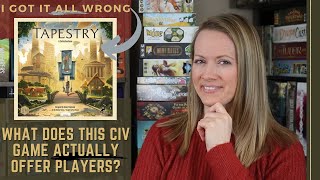
Tapestry divides the board gaming community. Reviewers consistently praise its engine-building core and the variety offered by asymmetric civilizations, yet many express frustration with the game's price, fiddly 3D components, and the gap between its "civilization game" marketing and what players actually experience. The consensus is that Tapestry rewards mastery and replayability: if you embrace what it is, you will find deep, satisfying gameplay. But if you came hoping for a true civilization-building experience like Jamey Stegmaier's other designs, you are likely to feel disappointed. The expansions, particularly Fantasies and Futures, have significantly improved perception by adding thematic flavor and mechanically robust new directions.
Core Mechanics That Define Tapestry
Track Advancement
At the heart of Tapestry lies a clean, elegant system where players advance along four independent tracks: science, technology, exploration, and military. Advancing requires spending resources matching the cost of the tier you are entering, and each space delivers a distinct reward. What makes this mechanic compelling is that players choose whether to prioritize immediate victory points or resources that fuel future advances. The puzzle deepens because completing higher tiers on tracks unlocks new income bonuses, creating a compounding advantage for early investment. The base game's simplicity in this space contrasts sharply with the complexity introduced by the expansions, which add a fifth track (arts in Arts and Architecture) that encourages a new dimension of play without overwhelming newcomers.
Engine Building
Tapestry's engine emerges gradually across five income phases. Early turns yield minimal resources, but as players advance tracks, buildings unlocked on those tracks activate income bonuses that multiply resources each subsequent phase. This creates the satisfying moment when investment compounds into visible, escalating returns. The illusion of simplicity persists throughout: each turn remains easy to execute, but the cumulative effect of early choices shapes late-game capability. Civilizations push players toward different engine styles. The Hermits, for example, thrive on isolation and territory control, while the Mystics bet on prediction and adaptive scoring. The combination of personal asymmetry and the modular track system means each player's engine builds differently, rewarding mastery through repeated plays.
The Tapestry Experience
Satisfying Puzzle Solving
Reviewers describe Tapestry as a personal puzzle where the satisfaction comes from optimizing your own engine rather than outmaneuvering opponents. The interaction with other players is minimal by design. Combat exists (via conquest), but it serves as a tactical wrinkle rather than a dominant force. What pulls players in is the silent race to reach landmarks first, to complete rows and columns in your capital, to draw the right tapestry cards, and to time your advances so that income bonuses activate when you need them most. This cerebral space appeals to solitary puzzle-solvers and strategists who value optimization over confrontation.
Volatile Swinginess
The flip side of Tapestry's variable civilizations and card draws is that the game can feel unfair. Tapestry cards are powerful and swingy; drawing the right card at the right moment can swing a game, or drawing suboptimal cards can leave you stranded. Reviewers note that some civilizations feel strictly stronger than others, and balancing patches released by Stonemaier Games after launch acknowledge the original asymmetry problem. This volatility frustrates players seeking a measured, fair contest of skill. It delights those who embrace the chaos and narrative that randomness creates. The expansions somewhat mitigate this through better card distribution and more thoughtful civilization design.
What Makes Tapestry Stand Out
Gorgeous Art Direction and Aesthetic Tokens
Andrew Bosley's artwork defines Tapestry's visual identity. The central continent board uses bright pastels and inviting illustrations that make players want to explore it. Each civilization mat carries thematic flavor through its art alone, and many reviewers report choosing their starting civilization based on aesthetics before ever reading the rules. The expansion plans and ploys added colored aesthetic tokens for track advancement, making it easier at a glance to see which building type you are tracking. These tokens represent thoughtfulness in component design that prioritizes clarity without sacrificing beauty.
Extraordinary Replayability Through Civilization Variety
The base game ships with 16 civilizations, and the three expansions add 25 more, for a total of 41 unique factions. Each civilization plays meaningfully different, offering direction without dominance (when well-balanced). Players return to Tapestry because each civilization is a fresh puzzle, a new engine type to master. Reviewers note they are years away from exhausting the variety. The asymmetry guarantees that no two games feel identical even when played on the same tracks with the same players.
Potential Drawbacks
Price-to-Content Ratio and Component Choices
Tapestry costs roughly 100 dollars, a premium justified by Stonemaier Games primarily through the inclusion of large 3D plastic buildings. Multiple reviewers object to this choice. The buildings, they argue, serve primarily aesthetic functions in a game where the actual capital-building system is abstract and minimal. More damning, the buildings are frustrating puzzle pieces. They do not align precisely with board spaces, they are awkward to place and store, and many players ignore them entirely. The consensus is that cardboard tiles would have been functionally superior, created the same aesthetic effect with better modularity, and reduced the price significantly. This remains the single loudest complaint across all reviews.
Mismatch Between Expectation and Design
Tapestry marketed itself as an accessible civilization game, evoking comparison to the Civilization video game series. Players arriving with those expectations meet instead an abstract track-advancement engine with light civilization theming. Nothing about combat, city placement, or culture resonates with classical civilization-builders like Twilight Imperium or even older titles. The four-page rulebook is admirably concise, but reviewers note it leaves newcomers overwhelmed by the sheer number of distinct space effects. Learning Tapestry requires at least one full game; there is no way to intuit the system from the rules alone. This design choice suits serious players but alienates those seeking a lighter, more intuitive experience.
If You Enjoy Tapestry
Players drawn to Tapestry's puzzle-like engine building will find similar satisfaction in Ganz Schön Clever, a lighter roll-and-write that shares Tapestry's combo-chaining track progression. Those who prize asymmetric player powers and faction variety might explore Root, though Root emphasizes negotiation and direct conflict where Tapestry minimizes both. For civilization scope at a lower price, Twilight Imperium delivers longer play but with more explicit 4X strategy. Reviewers suggest that fans of Tapestry's core design should strongly consider the expansions (particularly Arts and Architecture, which adds the fifth track), as they meaningfully expand the strategic palette without adding excessive complexity.
What Reviewers Are Saying
"The dizzying array of spaces actions and potential combinations might seem overwhelming but it is a genuine delight for someone who loves exploring the unknown likes to prod things to see what they do and genuinely gets excited when the plethora of light bulb starts blinking."
— No Pun Included
"Tapestry is a flawed but fun game there's an enjoyable engine building center here and for the most part you're gonna enjoy your time with it."
— Talia, Board of It
"I really am wholly enthusiastic about this game but these expansions and how much they offer players when it comes to playing it again and again and again because you really do want to play this game over and over and over again."
— Tabletop Tolson