/pic5089618.jpg)
In Ora et Labora (Latin for 'Pray and work'), each player is head of a monastery in the Medieval era who acquires land and constructs buildings – little enterprises that will gain resources and profit. The goal is to build a working infrastructure and manufacture prestigious items – such as books, ceramics, ornaments, and relics – to gain the most victory points at the end of the game.
Ora et Labora, Uwe Rosenberg's fifth "big" game, has game play mechanisms similar to his Le Havre, such as two-sided resource tiles that can be upgraded from a basic item to something more useful. Instead of adding resources to the board turn by turn as in Agricola and Le Havre, Ora et Labora uses a numbered rondel to show how many of each resource is available at any time. At the beginning of each round, players turn the rondel by one segment, adjusting the counts of all resources at the same time.
Each player has a personal game board. New buildings enter the game from time to time, and players can construct them on their game boards with the building materials they gather, with some terrain restrictions on what can be built where. Some spaces start with trees or moors on them, as in Agricola: Farmers of the Moor, so they hinder development until a player clears the land, but they provide resources when they are removed. Clever building on your personal game board will impact your final score, and players can buy additional terrain during the game, if needed.
Players also have three workers who can enter buildings to take the action associated with that location. Workers must stay in place until you've placed all three. You can enter your own buildings with these workers, but to enter and use another player's buildings, you must pay that player an entry fee so that he'll move one of his workers into that building to do the work for you.
Ora et Labora features two variants: France and Ireland.

- Interesting implementation of rondelle representing time
- Gives players interesting choices and limits options strategically
- Racing ahead in time to get an action means missing other good stuff
- Time representation
Mechanics (from transcript analysis)
- Rondelle (time-based) — The rondelle represents time, allowing players to race ahead to desired actions, but this might force seasons/harvests and cause them to miss other opportunities unless they spend money.
Video topics + discussion points
Quotes (from this video)
- it's a circle and this is a very loosely defined thing there's no set in stone way to do a rondelle in a game but it's a circle
- what a rondelle does in this particular implementation is it discourages me uh from taking the same action multiple times in a row i have to sort of like spin around the circle doing other things before i can do this one thing
- it's not a hard and fast rule all this mechanic is not set in stone because with game design it's constantly evolving and we're constantly finding out uh new and better ways to have fun
- you don't have to be uh you don't have to have a like a circle a geometric circle drawn on the board for a game to have a rondelle mechanic
- it's neat all kinds of implementations all over the board
References (from this video)

- The resource wheel mechanic is clever and creates a race for resources.
- The game offers many strategic options and paths to victory.
- The ability to use other players' buildings adds interesting interaction.
- The artwork, while criticized by some, is described as having 'quirky' and 'personable' elements.
- 3D printed inserts and organized components significantly improve the play experience.
- The game provides a satisfying puzzle-like experience, especially for those who enjoy optimization.
- The rulebook is described as 'bonkers' and difficult to learn.
- The game can feel like a 'solvable puzzle' with little randomness, which might reduce replayability for some.
- The artwork's perspective on some buildings is criticized as 'whack'.
- The two-player variant's endgame condition can lead to a 'boring' and 'dragging on forever' experience if played by the official rules without modification.
- Building a prosperous diocese in medieval Ireland or France.
- Agricola
- Caverna
- Patchwork
- A Feast for Odin
- Lahvre
- Hot
- Halita
- Keyflower
- Terraforming Mars
- New Fjord
- Orleans
- Farmers of the Moor
- Barrage
- Imitation Game
- Race for the Galaxy
- Roll for the Galaxy
Mechanics (from transcript analysis)
- action selection — Players choose from a limited set of actions on their turn, including clearing land, placing workers, or building structures.
- Area Movement — The game features a circular wheel or 'rondelle' mechanism where resource availability changes as a beam moves.
- End game scoring — Points are awarded based on built buildings, settlements, and adjacency bonuses during settlement phases.
- Resource Management — Players collect and manage various resources like wood, peat, grain, sheep, and money to build structures and fulfill objectives.
- Set Collection — Players collect sets of buildings and settlements to maximize points during scoring phases.
- Tile Placement — Players place biome tiles (districts) to expand their player board and create advantageous building locations.
- Variable player powers — The host mentions a 'prior' (a special worker with a hat) that grants a bonus action when building.
- Worker Placement — Players place their 'dudes' on buildings to take actions, with a rule that occupied buildings cannot be used by another player.
Video topics + discussion points
Quotes (from this video)
- Blessings and peace be upon you brothers and sisters welcome as i brother ryan from noctis circumstance and my fellow brother david also from noctis circumvention.
- it's bonkers trying to learn this game.
- the entire month of november is going to be Uwe Rosenberg.
- we're going to confess your board game sins and we will forgive you of your board game sins however we will also issue the sacrament of penance.
- the penance picker 900 is gonna pick a board game.
- what would you do differently the next time you played.
- Uwe Rosenberg is love but sometimes Uwe's a jerk.
- my nemesis the hillside damn you round tower damn you damn it.
- this is the funniest thing about the code breaking stuff was that they'd break the code but then they wouldn't want the enemy to know that the code was broken.
- i don't know if you're going to like this but the horribly drawn chapel is my only good move at the end of the game.
- Uwe Rosenberg bingo because a lot of the same stuff in his games have like a lot of similar elements.
References (from this video)
Mechanics (from transcript analysis)
Video topics + discussion points
Quotes (from this video)
- when you get to harvest you have to feed all the members of your family and if you don't feed all the members of your family you have to take a begging card
- and that i think is where all the pressure is because like you think man everything's gonna go okay as long as i can just get that read space as long as i can put my family member on there i just get all i need is one read and then it's fine i'll be able to feed my family because of this and that and the other and then some dinkus at the table takes read and it's just like it you just you want to flip the table at that point
- the reason i mentioned uve rosenberg month was i was i said i was going to try to stick some stuff on the calendar what you can count on i'll let you know just verbally what you can look forward to
- i have eyesight problems today i have to confess to you haven't put up my glasses because i wear them so seldom that whenever in the rare cases where i do need to wear them i get headaches from them so i thought i'll just i'll just try to survive but now i'm reading that you have to put put the new family member in your butt
- the problem with agricola is that family member is costing you food right that they're eating food and you have to keep them thriving and surviving they are worth points though at the end of the game
- the campaign in agricola holy crap but beats poppy 17. i'm just gonna say i'm not i'm not saying i'm a better player than bobby but i'm just saying to get 29 points at a gracola
- the trough sounded awesome when it looked like you were going to manage livestock and not cook them all well sure i still want to see a justification for that grocer
- i paid five food for this guy when it should have only been four food for this guy
- and I need to get up to a stone house so that I can do that on these two rounds plow plow you see what I'm saying so so that solves it I need to it's stone house time and I don't have the stone Oh shoot but I'm going to be one stone short if I take it now
References (from this video)
Mechanics (from transcript analysis)
Video topics + discussion points
Quotes (from this video)
- we're going to need a bigger printer
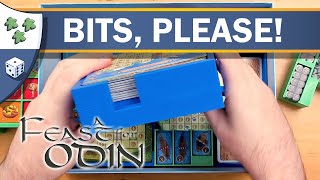
- what do you do when you want to print a 3d insert for your board game but the pieces are too big to fit on your printer bet well that exact thing happened to me
- we're looking for something that fits the base game and its expansions in the original game box with no box lift
- for my money this is the best free piece of software i think you could possibly get your hands on
- now the joke was on me because i should have checked the remixes section on thingiverse first if i had i would have discovered that someone named kind s had already made a split up version of that first tray so all my efforts were for naught
- splitting up big models so that they fit your printer bed is a great skill to have
- so close we needed like an inch more plastic ladies and gentlemen
- figuring out how to put all of these trays back in the box can be it's a little bit of like a like a jigsaw puzzle where all the pieces can fit each other but they'll only fit one way
- if you have a 3d printer and you own this game it makes setup a breeze
References (from this video)
Mechanics (from transcript analysis)
Video topics + discussion points
Quotes (from this video)
- the solo rules for Darwin's Journey were a mountain among themselves
- my wallet thanks you for Darwin's Journey and Ostia
- Nana toridori
- Hachi Train is a game that came out last year that I really liked
- Tigers and Euphrates is very dry except the river part of the title
- Newton has no theme
- Aura at Labora you are just going through the motions
References (from this video)
Mechanics (from transcript analysis)
Video topics + discussion points
Quotes (from this video)
- the goal is to win but it is the goal that is important not the winning
- Fromage is a game where it seems like to me in the design of it that it's intended to very much be played in a sense where like you're doing your own thing and spinning
- the simultaneous nature is just that whatever action card you see on the table, you're going to get to develop
- Moon Colony Blood Bath will never feel good to win
- winning just feels like an accomplishment
References (from this video)

- Generous production and components
- Clear card layouts and UI
- Has a solo mode
- Dense and potentially overwhelming rulebook
- Artwork style is not universally liked
- Not enough plastic bags provided
- Reprint may have cost-cutting measures (cardboard instead of wood)
- monks, work, possibly wine production
- monastery
- Agricola
- Caverna
- Last Will
- A Feast for Odin
- Patchwork
- The Princess of Florence
- The Voyages of Marco Polo
- Oh My Goods!
- Anachrony
Mechanics (from transcript analysis)
- Resource Management — The conversion of various resources into others and the large number of components suggest managing resources is key.
- Rondel — The presence of a 'gigantic circle' that looks like a spinner or wheel makes the host suspicious that it might be a rondel.
- Set Collection — The variety of resources (wood, stone, grapes, iron, wheat, sheep, clay) and cards with special abilities or conversions imply set collection.
- Tile Placement — The player boards are described as having areas 'that you can put tiles on and build out your little thing,' indicating tile placement.
- Worker Placement — The player boards with spaces for tiles and the mention of monks and actions suggest a worker placement element.
Video topics + discussion points
Quotes (from this video)
- So i will recap what's been happening on the channel for the past few weeks. It has been an... at DMExplains's urging, and it was a pretty good instinct, i think... it has been Uwe Rosenberg month.
- So i don't know if it's the same situation is with Agricola, where they had the original version. And then they thought, "Oh shoot, we gotta make the base game a little bit cheaper for, you know, entry level people."
- Look at this! Look at this! What is this six point font nonsense??
- The problem with the close-up cam is that when it's over here, i can't read what's on there. So you're just going to have to read for yourself what these cards say.
- Uwe Rosenberg likes this idea of bogs. He did the expansion for Agricola, all based... it's all entirely bog-based. Farmers of the Moor.
- He's obsessed with meat, and killing and eating animals. Like every game he does involves - even Patchwork, you're like, "Mah! Let's make a quilt! Nah - we'll eat animals while we're doing it!"
- That's really all eurogames are, really, isn't it? Just converting things into other things?
- I'll probably be taking an Uwe Rosenberg break after this. i just wanted to get this one unboxing out. And then we'll talk about something other than Uwe Rosenberg.
References (from this video)

- strong thematic coherence with medieval monastic life
- clear progression and satisfying engine development
- inserts and material quality add depth
- heavy rules complexity
- potentially slow pacing for some players
- monastic economy, architecture, and resource management
- monastic estate and cathedral construction in early Europe
- system-driven progression with thematic flavor
- Agricola
- Le Havre
- A Feast for Odin
Mechanics (from transcript analysis)
- resource wheel — track resources with a rotating wheel for upgrades and actions
- Worker Placement — workers perform actions across a shared board and personal boards
Video topics + discussion points
Quotes (from this video)
- the feeding mechanism exemplified and represented this thought that his games are easy to learn and hard to master basically
- thematic integration is Peak when it comes to U Rosenberg games
- the arc of gameplay is very unique to me and the reasons that I think about this include say Agricola
- the chess-like nature of his games particularly with games such as caverna fields of ARL
- cozy theme such as farming and still and have a session where you come out of it either winning or losing
References (from this video)

- engaging tile interactions and dynamic board states
- overbuilding rules add depth
- can be heavy and complex; presenter mentions learning curve
- building and farming with tile placement
- Medieval monastery resource management
- multi-layer engine with workflow
- Agricola
- Caverna
- Gaia Project
Mechanics (from transcript analysis)
- Tile Placement — fields and buildings; grid-like board with revolt/war mechanics via colors.
- tile placement / worker placement — fields and buildings; grid-like board with revolt/war mechanics via colors.
Video topics + discussion points
Quotes (from this video)
- There is a lot of tension around the table with arcs; the tension is utmost.
- This is one of the more polarizing games, but I enjoyed it.
- Mechs versus Minions is pure fun; you are manipulating this mech by running your command line.
- Race for the Galaxy which for both of us is our most played game from a physical play standpoint.
References (from this video)
- dense strategic depth with a clear, disciplined tempo
- strong thematic cohesion around monastic economy and spatial puzzle
- high replay value via identical card decks (Irish vs French variants) and abundant build options
- greatly enjoyed by players who appreciate Rosenberg’s systems and careful planning
- rulebook described as terrible; the game can feel intimidating to newcomers
- heavy and long sessions require substantial time and space
- cluttered decision space can be overwhelming; missteps are easy and costly
- monastic production, resource conversion, spatial planning
- Medieval monastery economy and settlement building
- sandbox economic strategy with spatial adjacency scoring
- Agricola
- Black Forest
- Glass Road
- Gricola
Mechanics (from transcript analysis)
- coins as actions blockers/relays — coins can force another player to take an action, or be spent to unlock options
- land planning and terrain — buildings must respect hillside, coastal, and orthogonal adjacency constraints
- production wheel — resources rotate and produce according to wheel position; placement round ends trigger settlement phase
- Resource conversion — goods can be converted (e.g., grain to straw, meat from sheep, whiskey from malts) to meet needs
- set collection / scoring adjacency — settlements and adjacent buildings score based on red numbers and surrounding tiles
- tableau building and extensions — each player develops a personal board with buildable structures and optional extensions
- Worker Placement — clergyman workers are sent to buildings to activate effects, gather resources, or convert goods
Video topics + discussion points
Quotes (from this video)
- We desperately want expansions that are never going to happen, but maybe maybe it'll happen.
- This is Rosenberg's Magnum opus.
- This game is a phenomenal puzzle with a sandbox of options.
References (from this video)

- Rich strategic depth
- Two-player tight design with timing nuance
- Complex to explain to new players
- Requires careful planning to optimize
- regional development and timing of networks
- Two-player heavy infrastructure building with canals and railways
- strategic, timing-focused planning
- Feast for Odin
- A Feast for Odin
Mechanics (from transcript analysis)
- surround-and-connect scoring — surrounding cards or areas to activate bonuses and complete structures
- variable action spaces via wheel/board — players place resources to activate actions and expand their networks
Video topics + discussion points
Quotes (from this video)
- we're going to be talking about 10 games we will have some runners up as usual
- it's a memory game through and through
- this is a card game that we were sponsored to play on the watch it play live stream
- Rome in 20 minutes and that's about it
- it's the first time we've ever done a three game video
- Anacron with the fractures of time expansion really changes the game
References (from this video)

- rich economic system
- highly satisfying engine when optimized
- classic Rosenberg design with deep strategic space
- weighty rules
- takes time to teach and play a full game
- crafts, trade, and religious order management
- Medieval resource management and monastery-building
- historical economic simulation with heavy thinking
- Las Vegas
- Agricola
Mechanics (from transcript analysis)
- Tile Placement — placing structures to optimize production networks
- Worker Placement — assigning workers to gather resources and perform tasks
Video topics + discussion points
Quotes (from this video)
- we've dropped our tier system
- there's going to be a lot more content on this channel over the summer
- Arc Nova is addictive and it's great to play
- we're celebrating our three-year anniversary on YouTube next month
- I miss doing this we haven't done this in so long
- I'm not sure I'm a good storyteller, but I like doing podcast-style content for Patreon
References (from this video)

- designed by excellent designer
- farming and trading theme
- rich resource management
- classic resource types (wood, corn, stone, sheep)
- very complex and convoluted
- possibly dated
- difficult to find in print
- high complexity barrier
- farming
- trading
- resource management
- religious medieval setting
- Glass Road
- Agricola
- Le Havre
Mechanics (from transcript analysis)
Video topics + discussion points
Quotes (from this video)
- you're listening to the broken meeple show a podcast that speaks passionately about board games
- i'm trying to keep this episode a little bit shorter
- i'm the sort of person who likes to play the sport not watch it
- i started my new job what two weeks ago now and it's going well
- all i hear about tsu is that if you play with anybody who knows how to play the game they're going to hate your guts afterwards
- ryan lockett what are you on so what are you seriously on
- this guy does not sleep this guy does not age
- this is just way too much stuff for one single person to undertake it's crazy
- i don't want to have to care anymore about sleep or aging
- convert me into a machine and i'll join the robot uprising
- it's only a game
- i am mainly just a case of i'll wait and see
- the amount of buzz that game has got has to put it at the top ten
- so many games so little time well who'd be a content creator with a job anyway
References (from this video)

- deep, thematic Rosenberg experience
- strong solo or 2-player play
- heavier for casual gamers
- resource management and construction
- medieval monastery
- historical farming/monastic economy
- Agricola
- At the Gates of Loyang
Mechanics (from transcript analysis)
- resource-management — balance food, wood, stone to build and expand
- worker-placement — send monks to gather resources and perform tasks
Video topics + discussion points
Quotes (from this video)
- I love the game Patchwork, a brilliant tile-laying game
- if Cottage Garden becomes something like that, then that's fantastic news for all of us
- the main Crux of the game is serving customers
- I love the artwork, it's a totally new style again
- Rattus is coming back after a while, out of print with all the expansions and a new expansion
- this big tin here I've been looking forward to this one for a long time because Sushi Go is just a magnificent game
- Skull King, a trick-taking dice game
- adults version of Code Names Not Safe for Work
- Evolution Junior, it's called Evolution the Beginning is only going to be available at Target for its first year