/pic3530661.jpg)
/pic6326934.png)
/pic3530661.jpg)

































Twilight Struggle Deep Dive
What the Community Thinks About Twilight Struggle
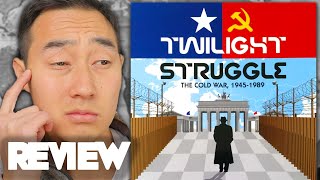
Twilight Struggle occupies a unique place in board gaming: it was the top-ranked game on BoardGameGeek for six years and remains in the top 15 more than 20 years after its 2005 release. The consensus among reviewers is nearly unanimous in recognizing its historical significance and elegant design. Players describe it as a masterpiece of thematic integration, where the mechanics and historical narrative reinforce each other perfectly. Even casual players who might not consider themselves history enthusiasts or wargame fans find themselves drawn to the game's depth, though they also recognize it demands commitment and knowledge to truly shine. Several reviewers note that the game especially appeals to players looking for a deep two-player head-to-head experience that rewards repeated play and careful study of the card set.
Core Mechanics That Define Twilight Struggle
Area Control and the Tug of War
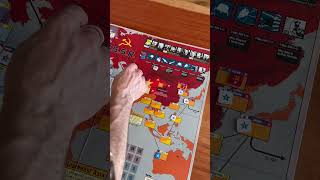
At its heart, Twilight Struggle is a brilliant execution of area control mechanics refined into a push-pull dynamic. Players place influence tokens across regions of the world, competing for control based on who has more influence than the opponent in each country. The genius lies in the adjacency restrictions: you can only place influence adjacent to where you already control territory. This creates natural choke points, like Iran and France, that become flashpoints of contention. Reviewers praise how this mechanic drives strategic thinking about which regions matter most, particularly when scoring cards emerge and certain areas suddenly become valuable. The Defcon track adds teeth to the system by restricting military operations as nuclear war looms, forcing players to decide between spreading influence safely and taking the riskier coups needed to generate military operations before each round ends.
Hand Management and Card Play Tension
The card system is where Twilight Struggle achieves its most distinctive gameplay. Each turn, players must play almost all cards from their hand, even cards favoring their opponent. When you play an opponent's card for its operations value, their event automatically triggers, forcing a constant calculation of damage mitigation. Reviewers consistently describe this as creating agonizing decisions, since saving powerful cards means potentially facing them later, while playing them means triggering their negative effects now. Some cards are permanently removed from the game after being played as events, creating a subtle deck-thinning dynamic where the strongest cards gradually leave circulation. This system rewards knowledge and foresight; experienced players know which cards are in the deck, when to expect them, and how to prepare. One reviewer notes the headline phase especially becomes nuanced among veterans, who can anticipate which cards will be played based on game state and opponent patterns.
The Twilight Struggle Experience
Cerebral and Intense
Playing Twilight Struggle demands sustained mental engagement. Reviewers describe the experience as requiring players to think turns in advance while managing short-term risks based on hand draws. The game rewards deep strategic planning similar to chess, where seasoned players develop long-term territory plans. Yet every decision carries weight because your opponent's cards in hand are unknown, creating tension and forcing you to adapt. The constant threat of the Defcon track reaching one and ending the game instantly adds a layer of existential risk. Players describe leaning forward, locked in, with high stakes on each move. The space race, military operations, and scoring cards all layer onto this core tension, making virtually no turn feel safe.
Historical and Political
Twilight Struggle immerses players in Cold War history through its card text and events. Cards represent pivotal moments: the Korean War, the Cuban Missile Crisis, the Vietnam War, Soviet expansionism, and more. Reviewers stress that every event card makes thematic sense with what actually happened historically, grounding the mechanical choices in real events. Playing the game becomes a history lesson where the mechanics reinforce the narrative. A reviewer who is a Cold War novice describes learning more about the era through this game than from formal education. The political elements strengthen this immersion: players aren't just moving armies, they're conducting coups, spreading ideological influence, managing prestige, and balancing the risk of nuclear annihilation. The game captures the feeling of superpowers maneuvering for advantage across a divided world.
What Makes Twilight Struggle Stand Out
Perfect Integration of Theme and Mechanics
Reviewers emphasize that every mechanism serves the theme and every historical element informs the gameplay. The adjacency rules reflect Cold War geopolitical reality. Regional scoring reflects which parts of the world mattered most at different eras. The Defcon track simulates the ever-present nuclear risk. The card-driven system ensures players must grapple with historical events they'd rather avoid, just as real policymakers had to contend with unexpected developments. This is not a pasted-on theme; the game's mechanics are inseparable from its narrative. One designer of the game notes that realignment mechanics and other system details were carefully crafted to make the rules feel intuitive if you understand the Cold War context. Reviewers note this makes the game deeply satisfying for those who invest time in understanding both the historical context and the card set.
Mastery and Replayability
Twilight Struggle significantly rewards repeated play. Early games feel chaotic and luck-driven because players don't know the card set. But around 10-15 plays, the game transforms. Veterans who know what cards exist, when they typically appear, and how to leverage them gain a dramatic edge. Reviewers describe this learning curve as part of the appeal: the game becomes more enjoyable and more tactical as players progress. Some players report having played 20-30+ games and still discovering new nuances. The shuffled deck order, variable scoring card placement, and opponent tactics ensure every game feels fresh despite the fixed card pool. Reviewers note this rewards the kind of deep expertise that appeals to serious gamers willing to invest time.
Potential Drawbacks
Steep Learning Curve and Complexity
Twilight Struggle is not approachable for casual players. The rulebook is dense with few diagrams, the card text requires historical knowledge to parse fully, and the strategic depth is substantial. Reviewers describe new players struggling with basic decisions like when to coup, when to realign, and how to read the Defcon restrictions. Teaching the game requires not just explaining rules but coaching strategic nuance. The gap between an experienced player and a newcomer is significant; games between mismatched players often feel like one-sided victories. For this reason, reviewers strongly recommend playing Twilight Struggle only with a consistent partner at similar skill levels, so both players grow together rather than one dominating early games.
Dice Randomness and Play Time Variance
Coup attempts and realignments rely on single d6 rolls, which can create swingy outcomes. A player rolling poorly on critical coups can waste entire turns, while lucky rolls can swing the board state dramatically. Some reviewers note that across 20-30 plays, randomness is always a factor; they've never seen a game where luck wasn't influential. This randomness compounds with the inherent advantage the USSR enjoys in the early war; combined with early dice luck, games can end in Soviet blowouts before reaching the mid or late war. Related to this, the game's length is unpredictable. Games can end in 30 minutes if one side achieves a 20-point victory early, or stretch to three hours if both players survive to endgame. This makes scheduling difficult and means players committed to the game must block substantial time.
If You Enjoy Twilight Struggle
Players drawn to Twilight Struggle's tense two-player conflict will find similar satisfaction in Paths of Glory, which simulates World War One with an elegant card system. Those interested in other card-driven historical simulations should explore 1960: The Making of a President and Founding Fathers, both designed by Jason Matthews (co-designer of Twilight Struggle). Players who love the political maneuvering aspect might enjoy Imperial or Imperial Struggle, which explore economic and diplomatic intrigue. If the Cold War theme specifically appeals, Flashpoint: China Sea offers a smaller, faster take on Cold War brinkmanship. For players seeking deep strategic head-to-head games, Brass Birmingham delivers economic tension, while Pandemic Legacy: Season 1 provides a narrative arc that unfolds across plays. Finally, those seeking games that teach history as they play should look to Wilderness War or other GMT historical simulations.
What Reviewers Are Saying
"I have learned more about the Cold War in this game than my entire education leading up to it. Hopefully none of my former teachers are watching. Because the entire game is events that happened in the Cold War, but what they do when you play the cards, it makes total sense with what actually happened in the event."
— Rolls in the Family
"It really is the Cold War in a box, but all these different events that happen as soon as World War II ends all the way up to, you know, the fall of communism in '89. It really covers that time frame."
— The Dice Tower
"Every card played in Twilight Struggle represents a real event something that happened during the Cold War and the way that this game is played is very much a struggle because you can't play a single card without conceding something to your opponent."
— Board Game Dad