














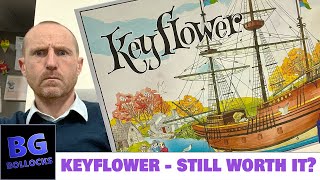



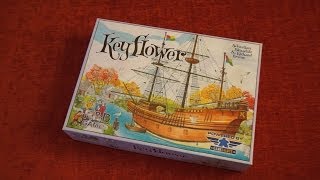


Keyflower box art

Keyflower

Game Info
Year
2012
Players
2-6
Age
13+
Playtime
120 min
Publisher
R&D Games
Collection
Ratings
Mechanic profile
Percentile rank vs. all games
Vibe profile
How this game feels to play
Description

Keyflower is a game for two to six players played over four rounds. Each round represents a season: spring, summer, autumn, and finally winter. Each player starts the game with a "home" tile and an initial team of eight workers, each of which is colored red, yellow, or blue. Workers of matching colors are used by the players to bid for tiles to add to their villages. Matching workers may alternatively be used to generate resources, skills and additional workers, not only from the player's own tiles, but also from the tiles in the other players' villages and from the new tiles being auctioned.

In spring, summer and autumn, more workers will arrive on board the Keyflower and her sister boats, with some of these workers possessing skills in the working of the key resources of iron, stone and wood. In each of these seasons, village tiles are set out at random for auction. In the winter no new workers arrive and the players select the village tiles for auction from those they received at the beginning of the game. Each winter village tile offers VPs for certain combinations of resources, skills and workers. The player whose village and workers generate the most VPs wins the game.

Keyflower presents players with many different challenges and each game will be different due to the mix of village tiles that appear in that particular game. Throughout the game, players will need to be alert to the opportunities to best utilize their various resources, transport and upgrade capability, skills and workers.

Keyflower, a joint design between Richard Breese and Sebastian Bleasdale, is the seventh game in the "Key" series from R&D Games set in the medieval "Key" land.

Ask a Rules Question
All mentions
Browse transcript mentions, sentiments, pros/cons, mechanics, topics, quotes, and references.
Total mentions: 95
This page: 45
Sentiment: pos 36 · mix 6 · neu 0 · neg 0
Mentions per page
Showing 51–95 of 95
Video YBYRNHJUzdw All You Can Board Discussion at 1:20:20 sentiment: mixed
All You Can Board - Keyflower video thumbnail
Click to watch at 1:20:20 · YouTube ↗
Overall sentiment (raw)
mixed
Pros
  • rich bidding and village-building interplay
  • multiple strategies can emerge from a single setup
Cons
none
Thematic elements
none
Comparison games
none
Mechanics (from transcript analysis)
  • Auction / Bidding — Bidding for tiles and building up a village with meeples during rounds.
  • auction/bid and village-building — Bidding for tiles and building up a village with meeples during rounds.
Video topics + discussion points
No key topics recorded for this video.
Quotes (from this video)
  • this first play of Queen's Dilemma is already feeling like some of this like was as good, if not better, than some of the strongest plays of King's Dilemma
  • 90% discussion, 10% gameplay
  • you are an actual individual person, but you have regions that you're responsible for
  • it's a game that stands on their own
  • Terramystica and Age of Innovation are probably 80/20 STR strategic
References (from this video)
No references stored for this video.
Video NPB6SzRILcs Matthew answers the internet Analysis at 7:47 sentiment: positive
Matthew answers the internet - Keyflower video thumbnail
Click to watch at 7:47 · YouTube ↗
Overall sentiment (raw)
positive
Pros
  • Keyflower is just amazing I love that game
Cons
none
Thematic elements
none
Comparison games
none
Mechanics (from transcript analysis)
  • Auction — but you're bidding on them with workers and you get the workers that people bid on them if you bid too much and someone else wins it they also get what oh they get more power to bid next time
  • Tile Placement — you're bidding on tiles to put them into your little town that you're building and then you want to have a network of things that produce Goods you want to have a network of ways to deliver those goods you want to use people's other buildings in their towns but you're bidding on them with workers
  • Worker Placement — you're bidding on tiles to put them into your little town that you're building and then you want to have a network of things that produce Goods you want to have a network of ways to deliver those goods you want to use people's other buildings in their towns but you're bidding on them with workers
Video topics + discussion points
No key topics recorded for this video.
Quotes (from this video)
  • dealing with cheaters is easy you simply burn down their house but with board game cheaters ah I don't feel like I run into that many people cheating in board games
  • I think cheating by its very nature denotes intent there has to be an intent to cheat for it to be cheating otherwise it's just playing the game wrong
  • no game is that important who cares it's not like the world league of Poker there's no money on the line it's just meant to be a bit of fun in a make-believe world pushing cardboard around a table it's just not that important
  • should I just buy the games in the top 100 on Board Game Geek no good Lord no
  • Board Game Geek leans heavy the games that are popping on Board Game Geek most often lean heavy they are heavier more complicated games and when you're just getting to the Hobby they're not the games that I would recommend you play
  • people will rank lighter weight games easier games lower than heavier games and by that I mean if the game is very easy to play learn it's just a very quick and easy game regardless of the fun factor of the game people will rank it lower
  • what they're looking for is what are the fun games what's the most fun and I often think those late games are the games are going to really get someone who is just nuzzling into the heartbeat thinking oh this is fun that's what's gonna like latch them on Like A Parasite and grab them and keep them in and suck them into our world our board game world
  • Dominion is a fantastic one of the absolute OG death building games
  • The only problem with Dominion is it it is a dangerous pit to fall in because I tell you you'll want more sets
  • Keyflower is just amazing I love that game
  • The incomparably fantastic Five Tribes
  • Azul one of the modern Evergreen games I think people will be playing us all for many many years to come
  • The devious nature of it is that is is when you're Drafting and putting them onto your board there's some limitations there that mean that you can really get screwed and you can really screw other people and that's the fun bit
  • Crocodile one of the games that was there then went away for a very long time and now it's back again
  • Power Grid is a great game in it it's got the best color palette of any game I think out there
  • The Crew: Mission Deep Sea is my favorite game
  • Mission Deep Sea is just better than Quest Supply 9 in every single way
  • Viticulture is a game of making wine and selling wine and it's just the most wonderful worker placement game I can think of
  • Seven Wonders Duel one of the best head-to-head card games
  • The Castles of Burgundy is one of the best games ever made
  • it's probably just the closest thing I can think of to a masterpiece in Euro board games
References (from this video)
No references stored for this video.
Video via0ElmJ7S4 Watch It Played Rules Teach at 0:21 sentiment: positive
Watch It Played - Keyflower video thumbnail
Click to watch at 0:21 · YouTube ↗
Overall sentiment (raw)
positive
Pros
  • The game offers strategic depth with worker placement, bidding, and tile upgrading.
  • Seasonal progression introduces variety and changes the available mechanics.
  • Village building allows for personal village development and scoring opportunities.
  • The concept of gold as a wild resource adds flexibility.
  • The game provides clear guidance for tile abilities in the rulebook.
Cons
  • Supply of resources and workers can be limited, potentially preventing actions.
  • Green workers are a limited supply and can be difficult to acquire.
  • The rule regarding not splitting workers from a losing bid when reassigning them is important to remember.
Thematic elements
  • Bringing new workers into your community each round, collecting and transporting resources, bidding on village tiles, and acquiring new skills to collect victory points.
Comparison games
none
Mechanics (from transcript analysis)
  • action selection — Players choose between using a tile for its benefit, bidding on a tile, or passing. Actions can also involve transporting resources, upgrading tiles, or using skills.
  • bidding — Players bid with workers on village tiles to acquire them for their personal village or to secure turn order. Bids must match the color of the previous bid and include at least one more worker.
  • Player Elimination — The game ends after four seasons, and the player with the most victory points wins. Ties may be broken by playing a second game.
  • Resource Management — Players collect, transport, and use resources like gold, wood, stone, and iron. Gold is a wild resource.
  • Set Collection — Certain tiles and boat tiles provide victory points based on collected sets or adjacent tiles, encouraging strategic acquisition.
  • tile laying — Acquired village tiles are added to a personal village, with placement rules requiring matching sides (e.g., road to road, field to field).
  • Worker Placement — Players place workers on tiles to gain benefits, bid for ownership, or use upgrade abilities. Workers are a limited resource that must be managed.
Video topics + discussion points
No key topics recorded for this video.
Quotes (from this video)
  • The player who can do this the best will collect the most victory points, and win the game.
  • Players take turns placing workers either on a tile in order to gain the benefit listed on it, or on their side of the tile to bid for ownership of it.
  • Gold is the wild resource of the game, meaning it can be used where needed in place of wood, stone, or iron.
  • The rules do say you can feel the bag maybe before placing a bid to determine approximately how many workers are in there because that might influence how many workers you're willing to bid for a particular tile.
  • Each item can only be scored once.
References (from this video)
No references stored for this video.
Video LdWNtdsItS8 Getting Games Interview at 33:58 sentiment: positive
Getting Games - Keyflower video thumbnail
Click to watch at 33:58 · YouTube ↗
Overall sentiment (raw)
positive
Pros
none
Cons
none
Thematic elements
  • tile-laying, worker placement
Comparison games
Mechanics (from transcript analysis)
Mechanics unknown.
Video topics + discussion points
No key topics recorded for this video.
Quotes (from this video)
  • priority number one is to have fun
  • priority number two is to make sure everyone else is having fun
  • priority number three is to try to win
  • board games are human compiled
  • the rule book is code the human brain is the compiler
  • there's no scriptwriting that happens over here
References (from this video)
No references stored for this video.
Video S-xW5lg6Cfc All You Can Board Top List at 18:23 sentiment: positive
All You Can Board - Keyflower video thumbnail
Click to watch at 18:23 · YouTube ↗
Overall sentiment (raw)
positive
Pros
none
Cons
none
Thematic elements
none
Comparison games
none
Mechanics (from transcript analysis)
  • combination of worker placement + auction — uses bidding to obtain tiles and then deploys workers on those tiles to execute actions.
  • Worker Placement — uses bidding to obtain tiles and then deploys workers on those tiles to execute actions.
Video topics + discussion points
No key topics recorded for this video.
Quotes (from this video)
  • this video i was actually voted on by our patrons
  • for each one i'm going to talk about they are some of my favorite mechanics
  • i'm going to list two to three of my favorite games for each one
References (from this video)
No references stored for this video.
Video ERWtwYNYKC8 All You Can Board Top List at 22:21 sentiment: mixed
All You Can Board - Keyflower video thumbnail
Click to watch at 22:21 · YouTube ↗
Overall sentiment (raw)
mixed
Pros
  • phenomenal game; third favorite board game of all time
Cons
  • often just too long; length can be a barrier to playing with larger groups
Thematic elements
none
Comparison games
none
Mechanics (from transcript analysis)
Mechanics unknown.
Video topics + discussion points
No key topics recorded for this video.
Quotes (from this video)
  • we're going to be doing our updated top 50 games of all time pretty soon
  • be critical about the things you love because nothing is perfect
  • healthy debates and discussions
  • we can all be looking at things we love more critically
  • this is a really important exercise
  • don't tell me anything you like about it or why it's your number one; tell me what you don't like about it
References (from this video)
No references stored for this video.
Video yr9MMc4Ln_o All You Can Board Top List at 54:37
All You Can Board - Keyflower video thumbnail
Click to watch at 54:37 · YouTube ↗
Pros
none
Cons
none
Thematic elements
none
Comparison games
none
Mechanics (from transcript analysis)
Mechanics unknown.
Video topics + discussion points
No key topics recorded for this video.
Quotes (from this video)
No quotes stored for this video.
References (from this video)
No references stored for this video.
Video T-kBBwCrMK4 All You Can Board Top List at 57:51
All You Can Board - Keyflower video thumbnail
Click to watch at 57:51 · YouTube ↗
Pros
none
Cons
none
Thematic elements
none
Comparison games
none
Mechanics (from transcript analysis)
Mechanics unknown.
Video topics + discussion points
No key topics recorded for this video.
Quotes (from this video)
  • it's the meanest game in my top 10, no question
  • there's just always something exciting to do on your turn
  • it's an absolute hit
  • it's the best social deduction experience I've ever had
  • the shortest playing time
References (from this video)
No references stored for this video.
Video FKSllbPaQKo BoardGameCo Discussion at 5:35 sentiment: mixed
BoardGameCo - Keyflower video thumbnail
Click to watch at 5:35 · YouTube ↗
Overall sentiment (raw)
mixed
Pros
  • Deep strategy, interesting tile interactions
Cons
  • Felt less joyful on revisits
Thematic elements
  • Medieval
  • Economy
  • Medieval village
  • Euro-style engine/worker interaction
Comparison games
none
Mechanics (from transcript analysis)
  • Auction / Bidding — Tiles/resources are acquired through bidding and timing.
  • market/auction — Tiles/resources are acquired through bidding and timing.
  • Worker Placement — Players place workers to claim resources and activate tiles.
Video topics + discussion points
No key topics recorded for this video.
Quotes (from this video)
  • I love Shallow Sea. I am really enjoying this one.
  • I do not think it's forever game.
  • There’s a fun little tension of laying cards down and trying to min-max where each card goes as it goes towards multiple scoring criteria.
  • The Druids of Adora, I cannot wait to give you a review on this one, but I need more plays first.
  • Onward is replacing Guards of Atlantis.
  • Way Too Many Cats had way too many symbols and things going on to be able to at a glance understand what's happening.
References (from this video)
No references stored for this video.
Video 2Sr825NkHwc All You Can Board Playthrough at 1:39 sentiment: positive
All You Can Board - Keyflower video thumbnail
Click to watch at 1:39 · YouTube ↗
Overall sentiment (raw)
positive
Pros
  • Deep, strategic bidding with hidden information
  • Tense, chain-reaction bidding that rewards foresight
  • High interaction with opponents without heavy downtime
  • Compact box with substantial depth and replayability
  • Rich mix of tile drafting and worker placement
Cons
  • Steep learning curve for new players
  • Rules can be opaque on first few plays
  • Some players may prefer lighter games with less disruption
Thematic elements
  • Residential expansion via tile bidding and worker placement
  • A village-building setting across seasons with tile bidding.
  • Abstract economic/resource management
Comparison games
Mechanics (from transcript analysis)
  • Auction / Bidding — Players bid with colored meeples to acquire tiles.
  • bidding — Players bid with colored meeples to acquire tiles.
  • chained_bid_dynamics — Outbidding cascades cause chain reactions affecting multiple bids.
  • color_management — Colors of meeples determine bidding power and interaction.
  • hidden-information — Bids are placed behind screens revealing only color neutrality to others.
  • seasonal_mechanics — Four seasons (Spring, Summer, Fall, Winter) with winter endgame scoring tiles.
  • Tile Placement — Acquired tiles are placed on your home board to build your village.
  • tile_placement — Acquired tiles are placed on your home board to build your village.
  • Worker Placement — Placed meeples on actions provide benefits and are partly reusable next round.
  • worker_placement — Placed meeples on actions provide benefits and are partly reusable next round.
Video topics + discussion points
No key topics recorded for this video.
Quotes (from this video)
  • it's my favorite game of all time.
  • it's the game of the week.
  • it's such a great game with so many layers that it's hard to even properly describe all the things that make it great.
  • honestly, highly recommend.
References (from this video)
No references stored for this video.
Video eQTk0cTErcw All You Can Board Discussion at 12:10 sentiment: positive
All You Can Board - Keyflower video thumbnail
Click to watch at 12:10 · YouTube ↗
Overall sentiment (raw)
positive
Pros
  • Clever, crunchy decisions
  • Strong integration of auction with worker placement
  • Condenses a lot of depth into a single game with thematic flair
Cons
  • Longer playtime, especially at 6 players
  • Hidden information can increase downtime
Thematic elements
  • seasonal development with hidden meeple information
  • Worker-placement and tile auction integrated into a village
Comparison games
Mechanics (from transcript analysis)
  • auction and worker placement hybrid — Seasonal auctions for hex tiles; workers act as currency and can be placed to utilize tile abilities.
  • hidden meeples and color-based rules — Meeples are hidden behind screens; tile and color placement restricts future bids.
  • tile movement to villages and color restrictions — Winning bids move tiles to the winner's village; first color placement determines future bid mechanics.
Video topics + discussion points
No key topics recorded for this video.
Quotes (from this video)
  • Auction and bidding is honestly one of my favorite board game mechanics
  • This is such a fun game and can be really cutthroat.
  • Modern Art is pure economic knife fighting.
  • Keyflower is clever, crunchy, full of tough choices, and is just one of the greatest games ever made.
  • it's just such an amazing game.
References (from this video)
No references stored for this video.
Video SXSgSP_8LIg All You Can Board Top List at 38:50 sentiment: positive
All You Can Board - Keyflower video thumbnail
Click to watch at 38:50 · YouTube ↗
Overall sentiment (raw)
positive
Pros
  • rich thematic integration
  • great for 4-5 players
  • deep strategy and interaction
Cons
  • long learning curve
  • heavy setup and teaching
Thematic elements
  • workers, bidding, and tile placement
  • Seasonal village development with tile bidding
  • evolving village-building narrative
Comparison games
none
Mechanics (from transcript analysis)
  • Auction / Bidding — Bid on tiles with colored meeples to acquire actions
  • auction/bidding — Bid on tiles with colored meeples to acquire actions
  • tile adjacency and color meeples — Color constraints influence bidding and actions
  • Worker Placement — Place workers to activate tiles or bid on them
Video topics + discussion points
No key topics recorded for this video.
Quotes (from this video)
  • The main thing about this is that each of our picks from one through five as we go through them should be a noticeable step up in complexity.
  • There’s complexity kind of seen in two different ways. I think there’s the rules complexity.
  • complexity means different things to everyone.
  • one of the hardest like of all these kinds of videos we do where we do these categories or recommendations.
  • Age of Innovation does that—it rewards you for learning them by giving you a game that every time you play is going to feel unique.
References (from this video)
No references stored for this video.
Video 8P2wnpdhg8w All You Can Board Discussion at 1:07:40
All You Can Board - Keyflower video thumbnail
Click to watch at 1:07:40 · YouTube ↗
Pros
none
Cons
none
Thematic elements
none
Comparison games
none
Mechanics (from transcript analysis)
Mechanics unknown.
Video topics + discussion points
No key topics recorded for this video.
Quotes (from this video)
  • optimization is the death of discovery and exploration in board games.
  • We don't accept gatekeeping.
  • Gloom Haven sized box.
  • Don't think you have to back day one.
  • This is going to be a standalone game. This isn't meant to be combined.
  • You can't please everyone.
References (from this video)
No references stored for this video.
Video pRZZxx_rRWM Board Gaming Ramblings Top 10 List at 2:16 sentiment: positive
Board Gaming Ramblings - Keyflower video thumbnail
Click to watch at 2:16 · YouTube ↗
Overall sentiment (raw)
positive
Pros
  • Innovative bidding that intertwines multiple players’ choices
  • Strong interaction through auctions and tile stacking
  • Deep strategic variety with color-meeple choices
Cons
  • Steep learning curve and multi-step scoring
  • Rules heavy for new players
Thematic elements
  • auction-driven tile placement and worker involvement
  • Viking/medieval village auction environment
  • competitive, multi-turn planning with hidden/partial info via color-tinted meeples
Comparison games
Mechanics (from transcript analysis)
  • Auction — players bid to acquire colored meeples or tiles that affect future actions
  • Auction / Bidding — players bid to acquire colored meeples or tiles that affect future actions
  • Tile Placement — tiles are placed to form a network and unlock actions
  • Worker Placement — workers lead to actions and can be reinforced by tiles
  • Worker placement / action selection — workers lead to actions and can be reinforced by tiles
Video topics + discussion points
No key topics recorded for this video.
Quotes (from this video)
  • it's back and forth because you bidding and taking out the others
  • the timing is so important
  • you can push other ships through so that you no need to pay more money for your ship than you thought you would
  • there's so many things you can do to interact here
References (from this video)
No references stored for this video.
Video RosrP4jUF4g Board Gaming Ramblings Discussion at 1:03 sentiment: positive
Board Gaming Ramblings - Keyflower video thumbnail
Click to watch at 1:03 · YouTube ↗
Overall sentiment (raw)
positive
Pros
  • Compact and easy to learn
  • Highly interactive with back-and-forth tension
  • Cleverly designed, fits in a small footprint
Cons
  • Some elements of luck due to card draw
  • Less depth for longer play sessions
Thematic elements
  • backstabbing and competition through a shared card queue
  • fantasy/political intrigue with quick, card-driven interactions
  • short, tense rounds with direct interaction
Comparison games
none
Mechanics (from transcript analysis)
  • Card interactions (kill/neutralize) — Cards can interact with others in the queue, allowing players to affect or remove opponents' cards.
  • Card queueing — Players place cards into a shared queue that drives interactions and scoring.
Video topics + discussion points
No key topics recorded for this video.
Quotes (from this video)
  • it's a really neat game and it's so small it's easier to keep
  • I think Airlines Europe is what Ticket to Ride needs to be
  • it's the tech tree of games
  • this has some cool elements to it and it really fits the theme
References (from this video)
No references stored for this video.
Video x4YRrlqe0x4 BoardGameCo Top 10 List at 14:18 sentiment: positive
BoardGameCo - Keyflower video thumbnail
Click to watch at 14:18 · YouTube ↗
Overall sentiment (raw)
highly positive
Pros
  • brilliant first play experience
  • ambitious production with strong mechanisms
Cons
  • production visuals criticized in hindsight; deluxe version desired
  • steep learning curve for new players
Thematic elements
  • resource management and tile-based bidding
  • medieval town-building with tile bidding
  • deep strategic with strong tactile components
Comparison games
none
Mechanics (from transcript analysis)
  • Tile Placement — tiles placed and bid for actions on the board
  • Tile placement with bidding — tiles placed and bid for actions on the board
  • Worker Placement — workers assigned to workers/activities with varying returns
Video topics + discussion points
No key topics recorded for this video.
Quotes (from this video)
  • It's a deck building game that kind of gives me vibes of like let's go to Japan, like you're building your deck, but you're playing through your story and your life as you go through it.
  • The art looks great. I'm very intrigued by the art.
  • A 7.2 rating does not make me think it's going to fall into the need to add.
  • This is a meta game around the hobby that we're in featuring all these various games as you deal with the worker placement.
  • I love chaining rewards.
  • Keyflower... I thought it was absolutely brilliant.
  • Production holds it back a bit; I hope for a deluxeified version.
References (from this video)
No references stored for this video.
Video 4IVU0dEH0xk Totally Tabled Top List at 10:46 sentiment: positive
Totally Tabled - Keyflower video thumbnail
Click to watch at 10:46 · YouTube ↗
Overall sentiment (raw)
positive
Pros
  • clever auction/placement twist
  • color-coded workers create interaction and control
  • highly interactive and strategic
Cons
  • cutthroat and brutal at times
Thematic elements
  • village-building and resource management
Comparison games
none
Mechanics (from transcript analysis)
  • tile village-building — collect and upgrade tiles to gain resources and points
  • Worker Placement — place workers on tiles to activate or bid for tiles to add to your village
  • worker placement auction — place workers on tiles to activate or bid for tiles to add to your village
Video topics + discussion points
No key topics recorded for this video.
Quotes (from this video)
  • these games still represent like the top five percent of all games I've ever played
  • the theme really comes alive
  • it's incredibly dynamic and fun highs and lows and a ton of agonizing decisions
  • it's a very unique abstract game where the theme actually comes through
  • it's cutthroat brutal game actually
References (from this video)
No references stored for this video.
Video knW7X2KIGH4 Totally Tabled Top 10 List at 2:57 sentiment: positive
Totally Tabled - Keyflower video thumbnail
Click to watch at 2:57 · YouTube ↗
Overall sentiment (raw)
positive
Pros
  • Renowned in the Kum series for its auction/placement synergy
  • Notable for solo mode potential (as per the host)
Cons
  • Details about this specific entry are sparse in the transcript
  • Some uncertainty around exact publisher/designer information
Thematic elements
  • auction-driven resource gathering with a tile-placement economy
  • Auction/worker-placement world with a focus on village tiles and resource actions
  • abstract/economic strategy rather than narrative-driven
Comparison games
none
Mechanics (from transcript analysis)
  • Auction — Players bid to acquire tiles or workers to optimize their setup.
  • Auction / Bidding — Players bid to acquire tiles or workers to optimize their setup.
  • Worker Placement — Place workers to activate actions on tiles and in your village.
  • worker_placement — Place workers to activate actions on tiles and in your village.
Video topics + discussion points
No key topics recorded for this video.
Quotes (from this video)
  • "2024 is shaping up to be an amazing year"
  • "Inventions Evolution of Ideas... the genuine thing"
  • "I tend to enjoy the games he works on"
References (from this video)
No references stored for this video.
Video kCt4wj6VsiI Board Gaming Ramblings Top 100 List at 9:22 sentiment: positive
Board Gaming Ramblings - Keyflower video thumbnail
Click to watch at 9:22 · YouTube ↗
Overall sentiment (raw)
positive
Pros
  • Deep, strategic planning with tight design
  • Rich combination of auction, tile placement, and worker mechanics
Cons
  • Can be heavy and unforgiving for new players
  • Steep learning curve to master the interaction of systems
Thematic elements
  • Tile placement, worker placement, and auctions
  • Medieval village development with tile and resource management
  • Strategic, resource-focused city-building with a strong auction mechanic
Comparison games
none
Mechanics (from transcript analysis)
  • Auction / Bidding — Tiles and actions are acquired via bidding using meeples or money
  • auction/bidding — Tiles and actions are acquired via bidding using meeples or money
  • Tile Placement — Tiles determine actions and future options
  • Worker Placement — Workers can be used to activate actions and then replaced as the round progresses
  • Worker replacement — Workers can be used to activate actions and then replaced as the round progresses
Video topics + discussion points
No key topics recorded for this video.
Quotes (from this video)
  • we're starting our journey to our top 100 board games of all time
  • this is kind of like a snapshot... a freeze frame picture of how our minds are right now
  • a top hundred changes more so it will be more interesting to revisit this in a year
  • it's a real-time game where you place tiles into your city
  • it's a streamlined shorter version who does most of the great things in mysterium
  • it's the most boring theme in the whole world… it's the marker
References (from this video)
No references stored for this video.
Video htxCgrRnYPg Board With Steve Top List at 0:21 sentiment: positive
Board With Steve - Keyflower video thumbnail
Click to watch at 0:21 · YouTube ↗
Overall sentiment (raw)
positive
Pros
  • high interaction and contested tiles
  • two-player focus that can be deeply rewarding
  • tactile meeples and tangible decisions
Cons
  • the two-player mode may not be as robust for all player counts
  • rule complexity can be a barrier to new players
Thematic elements
  • village-building with direct interaction and competition for scarce resources
  • cozy village with tiles bid for, built in an auction-driven landscape
  • taut, competitive euro with high player agency
Comparison games
none
Mechanics (from transcript analysis)
  • Auction — competitive bidding for tiles that will shape your village
  • Auction / Bidding — competitive bidding for tiles that will shape your village
  • Resource Management — careful allocation of meeples and tiles to maximize score
  • Tile Placement — placing tiles to expand and develop your village
Video topics + discussion points
No key topics recorded for this video.
Quotes (from this video)
  • This pseudo tileing auction game is an absolute banger.
  • Spirit Island is the best cooperative experience you will ever have.
  • A Feast for Odin is my number one, but other games in his catalogue are almost as good.
  • In a two-player game, this is one of the tightest board games you can play.
  • The push your luck aspect in RAW is absolutely wonderful.
References (from this video)
No references stored for this video.
Video oBhWS-do-uQ Tabletop Turtle Top List at 0:04 sentiment: positive
Tabletop Turtle - Keyflower video thumbnail
Click to watch at 0:04 · YouTube ↗
Overall sentiment (raw)
positive
Pros
  • Favorite work placement feature - building your own spaces
  • Shared sense of community where opponents can use your buildings
  • Actual village building feeling over abstract mechanisms
  • Resource transportation with horse and buggy mechanics
  • Great auction mechanic that's easy to explain
  • Push-your-luck bidding strategy
Cons
none
Thematic elements
  • village building
  • worker placement
  • community
  • resource exchange
Comparison games
none
Mechanics (from transcript analysis)
Mechanics unknown.
Video topics + discussion points
No key topics recorded for this video.
Quotes (from this video)
  • Kim is a little new to gaming... I've been in the business for maybe a couple decades... he's ancient he was around before the first board game was ever created
  • The reason for that is if you check forums a lot of people will talk about how they don't like the semi-cooperative nature of the game
  • I wish he was wrong but okay in my justification if you're playing a board game it's a physical tactile thing
  • I have a lot of friends where English is not their first language... with this kind of game being abstract there are no there's no cards to read there's no complicated rule
  • Argent is one of the most beautiful mess of the games imaginable
  • If you've never seen this game before it is the cutest thing ever ever
  • It's been my favorite game forever... I wouldn't bust this down if my family came over
  • Every time I feel like playing a board game it feels like there's a part of me that's just like okay I should play Arc Nova again
  • I really like when theme matches the mechanics
References (from this video)
No references stored for this video.
Video sz5Dmz7xpbw Chairman of the Board Discussion at 2:22 sentiment: positive
Chairman of the Board - Keyflower video thumbnail
Click to watch at 2:22 · YouTube ↗
Overall sentiment (raw)
positive
Pros
  • one of the best worker-placement/bidding hybrids
  • deep strategic options
Cons
  • high interaction may deter some players
Thematic elements
  • workers and seasons with bidding
  • medieval village
  • worker-placement with strong engine
Comparison games
  • Agricola
  • Cantalope? (not literal; intended as general genre comparison)
Mechanics (from transcript analysis)
  • Auction / Bidding — seasonal bidding for workers and tiles
  • auction_bidding — seasonal bidding for workers and tiles
  • Worker Placement — seasonal worker placement with tile/tile-building interactions
  • worker_placement — seasonal worker placement with tile/tile-building interactions
Video topics + discussion points
No key topics recorded for this video.
Quotes (from this video)
  • probably my favorite tire placement game of all time
  • this one is like a companion game to el grande
  • Arc Nova certainly the hotness at the moment
References (from this video)
No references stored for this video.
Video hpMHRwHQjZM Our Family Plays Games Top List at 24:25 sentiment: positive
Our Family Plays Games - Keyflower video thumbnail
Click to watch at 24:25 · YouTube ↗
Overall sentiment (raw)
positive
Pros
  • tight, tense bidding system
  • great replayability
  • solid design and proven reliability
Cons
  • can be punishing and complex for newcomers
  • board state can be dense
Thematic elements
  • busy auction/placement mechanics with tiles and workers
  • medieval tile-based city
  • grid-like city-building with bidding
Comparison games
Mechanics (from transcript analysis)
  • Tile placement / engine building — build a city by placing tiles activated by bids
  • Worker placement with bidding — bid with workers to activate locations and tiles
Video topics + discussion points
No key topics recorded for this video.
Quotes (from this video)
  • Breaking news… our fan plays games will be at Cardboard Caucus in Des Moines October 22nd to the 24th.
  • There is light at the end of that tunnel.
  • We love Cascadia and we want to thank Efka and Ellen for the shout-out.
References (from this video)
No references stored for this video.
Video 48k8KBWpqss The Broken Meeple Review at 9:49 sentiment: positive
The Broken Meeple - Keyflower video thumbnail
Click to watch at 9:49 · YouTube ↗
Overall sentiment (raw)
positive
Pros
  • deep, satisfying puzzle with many viable paths to victory
  • strong inter-player interaction; not a solo euro
  • works well at 2-6 players and with full expansion
Cons
  • rulebook can be dry or dense; learning curve
  • some players find bidding mechanic heavy at first
Thematic elements
  • settlement-building; bidding with colored tokens
  • village-building with seasonal workers
  • thematic euro
Comparison games
  • Carcassonne-esque map-building
  • other color-meeple bidding euros
Mechanics (from transcript analysis)
  • color meeple bidding on tiles — players bid with color meeples to acquire tiles for their village
  • Multi-Use Cards — collected resources feed into multiple upgrade and expansion options
  • multi-use resources — collected resources feed into multiple upgrade and expansion options
  • seasonal timing and production — tiles and workers interact with seasonal timing to drive scoring
  • Tile Placement — tiles extend the player's village and provide resources or bonuses
  • tile placement / worker placement hybrid — tiles extend the player's village and provide resources or bonuses
Video topics + discussion points
No key topics recorded for this video.
Quotes (from this video)
  • oh my god this is one of the most tense abstract games I've ever played
  • it's that fast
  • I will teach you the game in 30 seconds and chances are we'll finish in the next nine and a half minutes
  • this is really solid
  • Keyflower is just stuck with me
References (from this video)
No references stored for this video.
Video YfMjZ_FZJw4 Our Family Plays Games Top List at 11:49 sentiment: positive
Our Family Plays Games - Keyflower video thumbnail
Click to watch at 11:49 · YouTube ↗
Overall sentiment (raw)
positive
Pros
  • Innovative interaction between workers and money
  • Rich thematic integration
Cons
  • Can be heavy for first-time players
  • Rule familiarity required
Thematic elements
  • Resource conversion via tiles and workers
  • A seaside village driven by seasonal tile placement
  • Tile-laying with vehicles of labor and money conversion
Comparison games
none
Mechanics (from transcript analysis)
  • Tile Placement — Tiles placed to unlock new actions and resources.
  • Tile-laying — Tiles placed to unlock new actions and resources.
  • Worker Placement — Workers/meeples trigger actions across the board.
Video topics + discussion points
No key topics recorded for this video.
Quotes (from this video)
  • you become that family yes you become that person who's making sure this town develops
  • our top 10 worker placement games are what we're sharing
  • it's a heavyweight it has a large table press but it's a beautiful game
  • you can throw yourself into the theme yes you can
  • you gotta feed them
  • I love the dice
References (from this video)
No references stored for this video.
Video QsrxoH6lIxs Chairman of the Board Discussion at 12:03 sentiment: positive
Chairman of the Board - Keyflower video thumbnail
Click to watch at 12:03 · YouTube ↗
Overall sentiment (raw)
positive
Pros
  • excellent two-player scaling
  • variety of viable strategies
Cons
  • initial learning curve and rules density
Thematic elements
  • resource management via workers and tile bidding
  • island-based medieval village
  • deep strategic Euro with modular components
Comparison games
Mechanics (from transcript analysis)
  • tile_laying_and_bidding — bid with meeples to secure tiles, then place them on a personal board
  • worker_placement — use workers to acquire resources and upgrade tiles
Video topics + discussion points
No key topics recorded for this video.
Quotes (from this video)
  • a simple engine building style game
  • not overly complicated and it plays in around an hour
  • this is one of those games that really did bypass me really despite me loving Wolfgang Kramer games
  • this game is absolutely phenomenal
  • the top placement style of this as well
  • tons of different ways to get points
References (from this video)
No references stored for this video.
Video D8M5ZOC-o98 Chairman of the Board Top List at 22:50 sentiment: positive
Chairman of the Board - Keyflower video thumbnail
Click to watch at 22:50 · YouTube ↗
Overall sentiment (raw)
positive
Pros
  • Harmonized multi-mechanism design
  • Dynamic economies and shifting tiles create varied play
  • Rich interaction and player-driven tension
Cons
  • Can be mechanically dense for new players
  • Can require long play sessions
Thematic elements
  • tile bidding and worker placement with shifting economies
  • Medieval village construction and expansion
  • village-building with a moving economy
Comparison games
none
Mechanics (from transcript analysis)
  • passive worker economy — Workers move between tiles and villages, creating a dynamic flow.
  • Resource Management — Resources move along roads and boards as you upgrade buildings.
  • shifting resource economy — Resources move along roads and boards as you upgrade buildings.
  • tile bidding with communal meeples — Bid with tiles/meeples and place workers on tiles to develop your village.
  • Worker Placement — Workers move between tiles and villages, creating a dynamic flow.
Video topics + discussion points
No key topics recorded for this video.
Quotes (from this video)
  • I love the sense of urgency when it comes to rushing to these islands and getting them populated as quickly as you can.
  • This game is the absolute best of the best. You know, the top 1% of the top 1% of the games that I've played.
  • I could not speak more highly of this design.
  • The dice-driven twist, the engine-building, the tension—this is why I play board games.
References (from this video)
No references stored for this video.
Video CBDnc5JMW98 Chairman of the Board Top List at 25:12 sentiment: positive
Chairman of the Board - Keyflower video thumbnail
Click to watch at 25:12 · YouTube ↗
Overall sentiment (raw)
positive
Pros
  • Deep, crunchy euro with multiple victory paths
  • Shared-worker mechanic adds unique strategic layer
Cons
none
Thematic elements
none
Comparison games
none
Mechanics (from transcript analysis)
  • Tile/bid resource cycling — Tiles contribute to a personal town and bidding shifts workers among players.
  • Tile/Map Shifting — Tiles contribute to a personal town and bidding shifts workers among players.
  • Worker Placement — Bid on tiles to place workers and gain resources; shared workers introduce bidding tension.
  • Worker placement with bidding — Bid on tiles to place workers and gain resources; shared workers introduce bidding tension.
Video topics + discussion points
No key topics recorded for this video.
Quotes (from this video)
  • I love how streamlined this game is.
  • it's a drafting style game as you're trying to build up the civilization of cards
  • one world worthy of all the hype
  • this engine builder
  • it's the crunchiness
  • this is widely considered to be one of the best if not the best economic style board game of all time
  • it's a joy to play
  • you are destined to love it
References (from this video)
No references stored for this video.
Video 8OTPm2TWY6Y Foster the Meeple Top List at 1:56 sentiment: positive
Foster the Meeple - Keyflower video thumbnail
Click to watch at 1:56 · YouTube ↗
Overall sentiment (raw)
positive
Pros
  • Really fun auction mechanic
  • Interesting player interaction
  • Solid euro design
  • High player interaction
  • Well-balanced gameplay
  • Pinky mechanism creates memorable moments
Cons
  • Not readily available currently
Thematic elements
  • Building a small city/town
  • Village development
  • Economic auction and worker placement
Comparison games
none
Mechanics (from transcript analysis)
  • Auction with worker placement — Players bid with meeples hidden behind screens to acquire tiles for their city
  • Hidden information bidding — Meeples kept behind screen for bid secrecy
  • Multi-use spaces — Players can place workers on own or other players' city tiles
  • Resource Management — Careful management of limited worker resources
Video topics + discussion points
No key topics recorded for this video.
Quotes (from this video)
  • Overrated has a very negative connotation but if i say something's overrated it means to me this game is ranked something on bgg and i think it's higher than what it should be
  • Raiders of the north seas is just like has a really unique work replacement mechanism but all the actions are pretty boring
  • The crew is not necessarily like a heinous game i don't think it's a 0 out of 10. i just i'm shocked that it's in the top 50
  • Azul is the perfect entry-level game it's very easy to teach it's beautiful it's very quick to play
  • Viticulture should be about making the wine right you should be making wine you should be fulfilling wine contracts to to win the game
  • Gloomhaven is a dungeon crawler that was kind of a first adopter but it's almost been surpassed
  • Losing gloomhaven sucks it sucks so hard because if you lose you gotta replay that mission if you lose you just spent four hours
  • I think brass does things so well it's complex but it's not so complex that everybody can learn it
  • This is maybe more of a me problem but i get kind of quarterback-y in gloomhaven because i don't want to lose
References (from this video)
No references stored for this video.
Video pShyzyypVVk Before You Play Discussion at 31:11 sentiment: positive
Before You Play - Keyflower video thumbnail
Click to watch at 31:11 · YouTube ↗
Overall sentiment (raw)
positive
Pros
  • Excellent integration of auction and worker placement
  • Very high player interaction and strategic depth
  • Tempo and round structure feel tight and balanced
Cons
  • Heavier and more complex; less approachable for new players
  • Color tracking and bid management can be challenging
Thematic elements
  • auction and worker-placement synergy
  • Village development with Tile-tiles and multi-color workers
  • heavy interaction, economic strategy with multi-layer planning
Comparison games
none
Mechanics (from transcript analysis)
  • Auction — Tiles start in the middle and are bid on using color-coded workers; ownership transfers round to round.
  • resource_delivery_and_upgrade — Deliver resources to tiles to upgrade them for points.
  • tile_activation — Activated tiles yield resources or upgrade opportunities; competition shapes future rounds.
  • worker_placement — Place workers to activate tiles, with color-based rules affecting bidding and activation.
Video topics + discussion points
No key topics recorded for this video.
Quotes (from this video)
  • This is the grandparent of all tile-laying games.
  • You draw a tile and then you must place that single tile.
  • It's very simple. It's very laid-back, but there's just enough strategy to it that it's quite enjoyable.
  • I actually really enjoyed it.
  • There are no ways to mitigate the dice.
  • This is the heart and soul of the game. It's this resource gathering mechanic.
  • I actually really liked it.
  • The tempo of the game is really nice.
  • Your entire economy is built off of these workers that you have.
  • There are three different colors of workers and you have to keep them hidden.
  • This is the heaviest of the four games that we played.
References (from this video)
No references stored for this video.
Video XF17e6woWKI Chairman of the Board Top List at 11:05 sentiment: positive
Chairman of the Board - Keyflower video thumbnail
Click to watch at 11:05 · YouTube ↗
Overall sentiment (raw)
positive
Pros
  • strong hybrid of multiple Euro mechanisms (tile placement, bidding, resource management, worker placement)
  • dynamic shared economy yields rich strategic depth
Cons
  • high complexity may intimidate new players
  • can be unforgiving depending on tile availability
Thematic elements
  • bidding, resource management, and shared economy
  • village development through tile bidding and worker placement
  • system-driven with dynamic worker reuse
Comparison games
none
Mechanics (from transcript analysis)
  • round-end and endgame scoring — endgame tiles and multiple scoring opportunities across tracks
  • shared worker economy — workers placed on tiles may be used by other players at round end
  • tile bidding and worker placement — bid to claim tiles while simultaneously placing workers to activate them
  • Worker Placement — workers placed on tiles may be used by other players at round end
Video topics + discussion points
No key topics recorded for this video.
Quotes (from this video)
  • board gaming Perfection such a an intricate and nuanced design
  • the best negotiation game out there
  • fast so engaging
  • I can't find a fault with this game it is just so much fun
  • one of the original area control style games
  • the time track system I've ever seen
References (from this video)
No references stored for this video.
Video YOjcTcMIAxE Chairman of the Board Discussion at 12:06 sentiment: positive
Chairman of the Board - Keyflower video thumbnail
Click to watch at 12:06 · YouTube ↗
Overall sentiment (raw)
positive
Pros
  • deep strategic memory layer
  • replayable bidding decisions
Cons
  • complex rules grind for new players
Thematic elements
  • memory of meeples and bids for later rounds
  • auction/placement in a flexible tile-laying ecosystem
Comparison games
Mechanics (from transcript analysis)
  • Auction — remember what meeples others may have and bid accordingly
Video topics + discussion points
No key topics recorded for this video.
Quotes (from this video)
  • the game is super fast
  • I highly recommend that one
  • Witness used memory in quite an interesting way
  • it's really good family weight game where the actual lack of memory skills can actually make the game better
  • Extremely charming and I think um very underrated actually
  • This is a cool party game because even if your trivia knowledge isn't very good, you can still get the answers correct based on the previous clues given
References (from this video)
No references stored for this video.
Video _CH652PtXac BoardGameBollocks Top List at 2:11 sentiment: positive
BoardGameBollocks - Keyflower video thumbnail
Click to watch at 2:11 · YouTube ↗
Overall sentiment (raw)
positive
Pros
  • Appealing village-building feel
  • Popular with many players in the group
Cons
  • Can be heavy with many components and setup
Thematic elements
none
Comparison games
none
Mechanics (from transcript analysis)
  • Worker Placement — Bid meeples to secure actions and tile placement on a modular board.
  • Worker placement with auction — Bid meeples to secure actions and tile placement on a modular board.
Video topics + discussion points
No key topics recorded for this video.
Quotes (from this video)
  • Dominant species is a truly awful game that I really really dislike
  • this is a very very light worker placement game
  • the seventh continent for us
References (from this video)
No references stored for this video.
Video GQthybMrgzQ Chairman of the Board Discussion at 1:28:22 sentiment: positive
Chairman of the Board - Keyflower video thumbnail
Click to watch at 1:28:22 · YouTube ↗
Overall sentiment (raw)
positive
Pros
  • tight engine-building with clear, tense decisions
  • strong scoring tiles and late-game tension
Cons
  • scoring and teaching can be dense
  • learning curve may be steep for new players
Thematic elements
  • worker placement with auctions and tiles
  • medieval village development
  • deep economy and engine-building
Comparison games
Mechanics (from transcript analysis)
  • tile placement with area majority — place tiles to score in regions and trigger end-game bonuses
  • worker placement / auction — use different colored workers to bid and activate tiles
Video topics + discussion points
No key topics recorded for this video.
Quotes (from this video)
  • i think this game is actually a huge step up when it comes to decisions choices
  • it's not the best game in the world but it's fun
  • the more you upgrade the jeep track, the more movement you get in your park
  • this is did it so well that replaced the game for you
  • it's a race game and the more you upgrade, the more income you receive
  • the q system is really clever and unique
References (from this video)
No references stored for this video.
Video gt_0L0jZwio BoardGameBollocks Review at 0:12 sentiment: positive
BoardGameBollocks - Keyflower video thumbnail
Click to watch at 0:12 · YouTube ↗
Overall sentiment (raw)
positive
Pros
  • Innovative and well-implemented auction system with clear bidding visibility
  • Lucrative tile decisions create engaging blocking and interaction
  • Good fit for higher player counts (up to six)
  • Tension between bidding and resource upgrading keeps decisions meaningful
Cons
  • Table hog at higher player counts
  • Memory load can be heavy as the tile interactions multiply with more players
  • Rulebook is dense and can be hard to teach
  • Not ideal for casual or lighter-weight gamers
Thematic elements
  • Tile-placement and resource management with auctions
  • Seasonal village-building over spring, summer, autumn, winter
  • Strategic negotiation and planning with player interaction
Comparison games
Mechanics (from transcript analysis)
  • Auction / Bidding — Players bid meeples to win tiles from a central display
  • Auction/bidding on tiles — Players bid meeples to win tiles from a central display
  • Resource conversion and upgrading — Convert resources via upgrades (hire, mason, etc.) to unlock stronger actions
  • Season and winter phase — New tiles appear each season; winter tile selection and final scoring
  • Tile Placement — Place owned tiles to form a village and score points
  • Tile placement and village growth — Place owned tiles to form a village and score points
  • Transport/donkey mechanism — Move resources between tiles using donkey transports
  • Use of opponent's tiles and wild tiles — Draft tiles from others, or use a purple meeple as a substitute for colors
Video topics + discussion points
No key topics recorded for this video.
Quotes (from this video)
  • it's a massive table hog
  • the rule book is too dense for a game of this sort of simplicity
  • an enduring euro game that plays up to six
References (from this video)
No references stored for this video.
Video EIiUSBj15xE Getting Games Discussion at 1:40 sentiment: positive
Getting Games - Keyflower video thumbnail
Click to watch at 1:40 · YouTube ↗
Overall sentiment (raw)
positive
Pros
  • Strong simultaneous decision flow for up to six players
  • crunchy mid-weight Euro with satisfying tableau growth
Cons
  • Can be lengthy; requires table space and careful management
Thematic elements
  • Resource management, tile drafting, worker placement
  • Medieval village economy with tile work and resource management
  • Mechanistic
Comparison games
none
Mechanics (from transcript analysis)
  • Card Drafting — Players draft cards at the same time; cards are passed around
  • Resource Management — Resources on cards are moved and managed to trigger actions
  • Simultaneous card drafting — Players draft cards at the same time; cards are passed around
  • Tile placement / tableau building — Drafted tiles are placed to build a tableau that yields actions and resources
  • worker/resource management — Resources on cards are moved and managed to trigger actions
Video topics + discussion points
No key topics recorded for this video.
Quotes (from this video)
  • it's a euro style game that plays up to six
  • it's fully simultaneous
  • Concordia Venus ... brings in team play and that lets you play two on two which is a four player game and it also lets you play two versus two which is a six player game
  • not a euro game really it's more of a deduction style game where it's one versus many
  • I started to work on that video and I'm hoping to make it happen
  • Miniatures don't do anything for me
References (from this video)
No references stored for this video.
Video zgPVVoQl_VU Chairman of the Board Analysis at 34:56 sentiment: positive
Chairman of the Board - Keyflower video thumbnail
Click to watch at 34:56 · YouTube ↗
Overall sentiment (raw)
positive
Pros
  • best hybrid of worker placement and bidding
  • deep strategic layering with approachable rules
Cons
none
Thematic elements
none
Comparison games
none
Mechanics (from transcript analysis)
Mechanics unknown.
Video topics + discussion points
No key topics recorded for this video.
Quotes (from this video)
  • Mandala blew me away this year
  • Chinatown is the best negotiation game out there
  • barrage is a 10 out of 10 game for me
References (from this video)
No references stored for this video.
Video VKjV8aY2Yeg Our Family Plays Games Top List at 7:57 sentiment: positive
Our Family Plays Games - Keyflower video thumbnail
Click to watch at 7:57 · YouTube ↗
Overall sentiment (raw)
positive
Pros
  • layered strategy
  • interesting worker/tiles synergy
Cons
  • learning curve
Thematic elements
  • tile placement and resource management
  • tile-driven village economy
  • thematic, midfield strategy
Comparison games
none
Mechanics (from transcript analysis)
  • set_collection — collect resources to activate tiles
  • tile_laying — tile-based village construction
Video topics + discussion points
No key topics recorded for this video.
Quotes (from this video)
  • Carcassonne is one of those beginning games and it's a gateway classic
  • number two is Umbra Alhambra plays 2 to 6 players and it was published by Queens games
  • Lantern family favorite
  • Petropolis number one comes the story
  • let's open your mind up and it's a great tile laying game
References (from this video)
No references stored for this video.
Video G8nphExb33s Rolls in the Family Top List at 4:50 sentiment: positive
Rolls in the Family - Keyflower video thumbnail
Click to watch at 4:50 · YouTube ↗
Overall sentiment (raw)
positive
Pros
  • rich decision space; tense, narrative-like pacing
Cons
  • learning curve; can be heavy for casual players
Thematic elements
  • resource management with asymmetrical tile and leader interactions
  • tile-drafting and worker placement in a village-building frame
  • euros-inspired theme with a strong feel of growth and negotiation
Comparison games
Mechanics (from transcript analysis)
  • Leader Placement — placing leaders to gain resources and influence
  • tile drafting — bidding and drafting tiles to shape actions and building plans
Video topics + discussion points
No key topics recorded for this video.
Quotes (from this video)
  • it's aggressive, but it's very like light aggressive
  • an extremely just interactive, tense, and aggressive game of going back and forth and trying to score the most points there
  • there's not a lot of times this game that it feels like, oh my gosh, why?
  • this is the most aggressive but interactive game
  • it's six people all jousting for victory points
  • you are dropped onto a map right next to everyone else and immediately you're scoring your objectives
References (from this video)
No references stored for this video.
Video D_-XavWVh_M Chairman of the Board Top List at 10:36 sentiment: positive
Chairman of the Board - Keyflower video thumbnail
Click to watch at 10:36 · YouTube ↗
Overall sentiment (raw)
positive
Pros
  • extremely nuanced and deep with many strategic layers
  • rich interaction through bidding, tile placement, and shared tile use
  • considered by the speaker as among the best games ever for its mechanisms
Cons
  • high complexity and potential opacity for new players
Thematic elements
  • multilayered tile and worker economic engine with color coded meeples
  • village building through tile placement and worker bidding
  • deep strategic planning with locked in choices and in game interaction
Comparison games
none
Mechanics (from transcript analysis)
  • hybrid bidding worker placement — tiles are bid using colored meeples that then lock their color significance
  • meeple lock and reuse — workers used to bid for tiles return to the winner and can be used against the former owner later
  • tile placement and workers on tiles — you place tiles to build your landscape and use meeples as workers on tiles instantly
  • tiles from others and shared benefits — you can use other players tiles if you win the bid, creating dynamic interaction
Video topics + discussion points
No key topics recorded for this video.
Quotes (from this video)
  • I love the fact that the game itself is so simple but the action selection system is just that compelling
  • this is one of the best games of all time I could have argued to have this from higher on the list
  • there is an amazing level of interaction here where the more you collect these Noble tokens on the map will not only score your points but give you voting power
  • the level of interaction here is very high and the dynamics around kicking off spots are interesting
  • on paper I should not like this game because I do not like terribly cutthroat games but this one is logical
  • El Grande is the forefather of the area control genre and still the best among its peers
References (from this video)
No references stored for this video.
Video 54vWXAxZJ6c Board to Death TV - Board Game Reviews Analysis at 0:00 sentiment: mixed
Board to Death TV - Board Game Reviews - Keyflower video thumbnail
Click to watch at 0:00 · YouTube ↗
Overall sentiment (raw)
mixed
Pros
  • Strong player interaction through bidding and outbidding.
  • Rich euro-game depth with multiple strategic paths.
  • Replayability due to variable tiles and scoring options.
  • Theme represented through season-based phases and tile variety.
  • Well-presented mechanics and components.
Cons
  • Steep learning curve and accessibility concerns for new players.
  • Balance not perfectly tuned; some paths yield higher VP with fewer workers.
  • Long-term strategy feels less long-term in execution.
  • Complex setup and rules may be daunting for casual players.
Thematic elements
  • Seasonal labor, bidding, resource management, and tile placement in a village
  • Seasonal, village-building in a pre-industrial setting across four seasons
  • Euro-style abstracted theme with seasonal storytelling
Comparison games
none
Mechanics (from transcript analysis)
  • Auction / Bidding — Players bid resources and turns to acquire land tiles and season tiles.
  • bidding — Players bid resources and turns to acquire land tiles and season tiles.
  • Resource Management — Produce and move resources to tiles and upgrade tiles.
  • resource_management — Produce and move resources to tiles and upgrade tiles.
  • season_end_scoring_and_final_scoring — Seasonal goals and end-game scoring across winter.
  • Tile Placement — Draft and place tiles to construct houses and village layout with constraints.
  • tile_placement_and_building — Draft and place tiles to construct houses and village layout with constraints.
  • Turn Order: Auction — Turn order tiles and outbid mechanics influence order and strategy.
  • turn_order_and_outbid_mechanics — Turn order tiles and outbid mechanics influence order and strategy.
  • Worker Placement — Place workers on tiles to perform actions, limited by color and tile occupancy.
  • worker_placement — Place workers on tiles to perform actions, limited by color and tile occupancy.
Video topics + discussion points
No key topics recorded for this video.
Quotes (from this video)
  • there's even a small element of bluffing
  • player interaction is strong as using your meeple to outbid another player
  • Keyflower gets eight Bol full of workers
  • if you like Euro games with worker placement bidding and resource management and player interaction then do check out keyflower
  • the learning curve is also a little high though so I'm a little worried for accessibility
References (from this video)
No references stored for this video.
Video C1oMy9AowB0 Our Family Plays Games Discussion at 4:29 sentiment: mixed
Our Family Plays Games - Keyflower video thumbnail
Click to watch at 4:29 · YouTube ↗
Overall sentiment (raw)
mixed
Pros
  • Online play options through Board Game Arena and TableTopia.
  • Turns-based play enables remote multiplayer.
Cons
  • Can be complex and heavy; not everyone enjoys it.
Thematic elements
  • resource management with immigrant villagers
  • village development in a harbor town, season-driven growth
  • abstract
Comparison games
none
Mechanics (from transcript analysis)
  • Seasonal mechanics — Turns progress through seasons affecting actions and scoring.
  • Tile bidding / resource management — Manage resources and tiles through a bidding-like system using workers.
  • Tile Placement — Build out the village by placing tiles representing buildings and improvements.
  • Worker Placement — Place workers to activate actions and gain resources.
Video topics + discussion points
No key topics recorded for this video.
Quotes (from this video)
  • we should ban together as one race because we always talk about you know diversity and we talked about divisions
  • this is a time when we should realize that it goes beyond black or white because neither those are races
  • our hobby is a great thing and I think this is gonna make a lot of people happy
  • wash your hands yes social distancing this to sing right yeah keep your distance from people
References (from this video)
No references stored for this video.
Video dKtNBEs5vQI Our Family Plays Games Discussion at 28:52 sentiment: positive
Our Family Plays Games - Keyflower video thumbnail
Click to watch at 28:52 · YouTube ↗
Overall sentiment (raw)
positive
Pros
  • deep strategy
  • varied paths
Cons
  • complex rules
Thematic elements
  • seasonal worker placement
  • village-building, auctions
Comparison games
none
Mechanics (from transcript analysis)
  • Auction — bid for actions and resources
  • Worker Placement — place workers to take actions
Video topics + discussion points
No key topics recorded for this video.
Quotes (from this video)
  • the apps really made it immersive in Mansions of Madness
  • open drafting, set collection, take-that in Buried Treasure
  • please play as many games as possible and listen to other podcasters
  • truth is the state of being the case
References (from this video)
No references stored for this video.
Video Ttpw1MBgVjc Adam in Wales - Board Game Design Analysis at 7:31 sentiment: positive
Adam in Wales - Board Game Design - Keyflower video thumbnail
Click to watch at 7:31 · YouTube ↗
Overall sentiment (raw)
positive
Pros
  • Colorful and distinctive
  • Immediately recognizable as Key series
  • Fits well with other games in range
  • Distinctive style
Cons
  • Looks childish or naive to some
  • Picture book-like quality
Thematic elements
  • Building/development
  • Scottish village
  • Casual
Comparison games
none
Mechanics (from transcript analysis)
  • Auction/worker placement — Village development game with worker production
Video topics + discussion points
No key topics recorded for this video.
Quotes (from this video)
  • The box cover makes a promise to the customer
  • Every box cover tells me what I'm going to be doing and how I'm going to be feeling
  • This artist is one of the best board game artists working in the industry right now
  • This is how you do it
  • This cover is a mess
  • Striking iconic design
  • The box cover is not selling the game
References (from this video)
No references stored for this video.
Video QzSUQA-zHp8 Peaky Boardgamer Rules Teach at 0:46 sentiment: mixed
Peaky Boardgamer - Keyflower video thumbnail
Click to watch at 0:46 · YouTube ↗
Overall sentiment (raw)
mixed
Pros
  • Deep, interacting auction and tile-placement loop
  • Diverse end-game scoring opportunities
  • Strong player interaction in bidding and activations
Cons
  • Custom rule interactions can be complex
  • Long playtime at higher player counts
  • Setup complexity can slow initial plays
Thematic elements
  • Tile bidding and resource management
  • Medieval village building through seasons
  • Abstract engine-building flavor with thematic elements
Mechanics (from transcript analysis)
  • auction/bidding — Players bid with colored meeples on tiles and actions, with no fixed maximum bid.
  • Resource Management — Collect resources via tiles and upgrade to gain points.
  • seasonal progression — Game progresses through four seasons; certain tiles enter auctions per season.
  • set scoring and tile-based scoring — End-game scoring based on specific tiles and resource sets.
  • Tile Placement — Acquired tiles are placed in the player’s village to unlock bonuses and scoring.
  • worker placement/activation — Meeples placed to activate tiles in one’s own or other players’ villages and in auctions.
Video topics + discussion points
No key topics recorded for this video.
Quotes (from this video)
  • the player who drew the home tile with the lowest number becomes the first player
  • an upgrade on a tile often yields victory points and new scoring opportunities
  • the winner of a tile bid gains control of that tile's bonuses in the season
References (from this video)
No references stored for this video.
Transcript Navigation
Showing 51–95 of 95
Game Deep Dive