



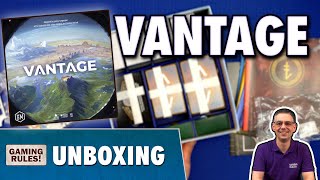
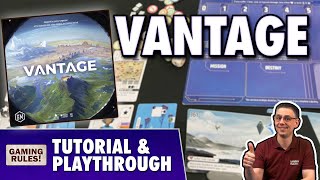



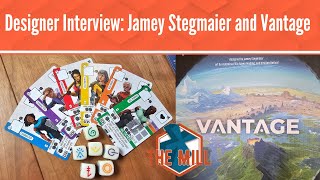
Vantage box art

Vantage

Game ID: GID0375724
Game Info
Year
2025
Players
1-6
Age
14+
Playtime
180 min
Collection
Ratings
Mechanic profile
Percentile rank vs. all games
Vibe profile
How this game feels to play
Description

Vantage is an open-world, co-operative adventure game for 1-6 players that features an entire planet to explore, with players communicating while scattered across the world. With nearly eight hundred interconnected locations on four hundred cards and over nine hundred other discoverable cards, the world is your sandbox.

You begin each game of Vantage on an intergalactic vessel heading towards an uncharted planet. After crashing far from your companions, you have complete freedom as to how you explore, discover, and interact with the planet. You view your location from a first-person perspective, and you can communicate with and support other players, but you are separated by vast distances, so only you can see your current location.

Vantage is not a campaign game, and it is completely self-contained with no expansions — just a few accessories like metal coins.

—description from the publisher

Description

Vantage is an open-world, co-operative adventure game for 1-6 players that features an entire planet to explore, with players communicating while scattered across the world. With nearly eight hundred interconnected locations on four hundred cards and over nine hundred other discoverable cards, the world is your sandbox.

You begin each game of Vantage on an intergalactic vessel heading towards an uncharted planet. After crashing far from your companions, you have complete freedom as to how you explore, discover, and interact with the planet. You view your location from a first-person perspective, and you can communicate with and support other players, but you are separated by vast distances, so only you can see your current location.

Vantage is not a campaign game, and it is completely self-contained with no expansions — just a few accessories like metal coins.

—description from the publisher

Ask a Rules Question
All mentions
Browse transcript mentions, sentiments, pros/cons, mechanics, topics, quotes, and references.
Total mentions: 276
This page: 50
Sentiment: pos 41 · mix 5 · neu 0 · neg 1
Mentions per page
Showing 101–150 of 276
Video J3hMJUahGzU Stonemaier Games Discussion at 39:35 sentiment: positive
video_pk 80597 · mention_pk 196617
Stonemaier Games - Vantage video thumbnail
Click to watch at 39:35 · YouTube ↗
Overall sentiment (raw)
positive
Pros
none
Cons
none
Thematic elements
Comparison games
none
Mechanics (from transcript analysis)
Mechanics unknown.
Video topics + discussion points
No key topics recorded for this video.
Quotes (from this video)
  • "Today is not an announcement day."
  • "I always learn a lot from playing with different people and it's nice to play sometimes with other designers because they offer a different perspective than um than than non-designers as well."
  • "I think there are certain mechanisms that struggle to work at higher player counts, but they work at lower player counts."
  • "I think that back and forth play uh and your ability to plan ahead and base your decision off of what the opponent is doing and hope for some them to do something or not to do something because you want to do something in response."
  • "I think that maybe is a little bit of a sign that you might try to test it a little bit with some distance between you as the designer and the game."
  • "I think that's one thing that online play testing can do a little bit where it adds that separation between you and the game because you got to keep in mind that if you want your game if you want thousands of people to play your game, you are not going to be there for every session."
  • "I really really enjoyed that and thanks to my co-worker Susanna for teaching that one."
  • "It really encapsulates how introversion feels in game form and gaming is one of my favorite outlets for me as an introvert."
  • "I I don't necessarily think it needs the Awakened Realms treat treatment to make it cost three times as much and look beautiful but be significantly more expensive."
  • "I love that idea. Um, so I I guess maybe I'll turn that answer around to you, Gary. Are there some games that you think are uh that are wonderful games that were held back by something that a publisher could revisit?"
  • "I think the art for Libertalia is is great. And pretty crucially, I think it's important that the characters in Libertalia don't look like real people."
  • "No, control there isn't an issue. Um, the only hesitancy is consideration for my co-workers time."
  • "I think my take in general is for for for people who love to sleeve cards is we are always happy. We always welcome you to do that, but it isn't always necessarily our responsibility to make a box big enough to to fit sleeve cards."
  • "It is heavier than the games that we publish."
  • "I would probably go on a show where I don't have to lie to people and where people don't have to lie to each other."
  • "Vidiculture released in 2013. 13 years ago is when Vidiculture originally released."
References (from this video)
No references stored for this video.
Video _SsbkrSlxjs Board Games UnLocked Top List at 9:58 sentiment: positive
video_pk 80526 · mention_pk 196126
Board Games UnLocked - Vantage video thumbnail
Click to watch at 9:58 · YouTube ↗
Overall sentiment (raw)
positive
Pros
  • Affordable
  • So much discoverability
  • Fascinating to have missions go differently
  • Amount of content and discovery
  • Always something new
Cons
  • Can eventually get tired of it after many plays
Thematic elements
Comparison games
none
Mechanics (from transcript analysis)
  • exploration — Discovering the world is a key part of the gameplay.
  • legacy elements — Player decisions carry over and impact future gameplay and narrative.
  • randomized encounters — Interacting with elements in the world leads to different outcomes.
Video topics + discussion points
No key topics recorded for this video.
Quotes (from this video)
  • So it's like if our entire collection were to go up in flames and we didn't and we didn't off ourselves. We didn't unalive, you know.
  • If I lose all this Right. I'm out of the hobby. Right. I'm not I'm there's that would be so much lost money that it wouldn't be worth it. I would just find something else to do.
  • The amount of content that's in this game of discovering stuff, of reading stuff, of the routes you're going to take, the world you're discovering. I mean, I've played this game quite a bit. And it's always something new.
  • This game is just that good that you don't have to have all the bling necessarily.
  • The core box of Aeon Trespass is three cycles.
  • The amount of content in this game from a narrative perspective is insane.
References (from this video)
No references stored for this video.
Video ATD-sL5Zvdk Stonemaier Games Rules Teach at 0:52 sentiment: mixed
video_pk 80467 · mention_pk 195867
Stonemaier Games - Vantage video thumbnail
Click to watch at 0:52 · YouTube ↗
Overall sentiment (raw)
mixed
Pros
  • Provides resources to start.
  • Offers scoring opportunities with outlined grid cards.
Cons
  • Requires careful tracking of actions due to inter-realm dependencies.
  • Can be costly to use numbers in other realms.
  • Scoring requires having unmarked resources at round end.
Thematic elements
Comparison games
none
Mechanics (from transcript analysis)
  • Marking/Outlining — Using numbers to mark outline squares or resources.
  • Realm Interaction — Actions in other realms trigger effects or requirements in Vantage.
Video topics + discussion points
No key topics recorded for this video.
Quotes (from this video)
  • It is an expandable game.
  • Vantage does something when we actually use a number in another realm.
  • Parks uses the the parks mechanism where you're you can progress as far as you want down a path, but you can't backtrack.
  • 2.6 seems honestly heavy for this game. Like this I don't consider this a particularly heavy game. Um yeah, I I would put it closer to a two really.
  • I think that is a fantastic way to uh to incorporate game design into a class in a way that is pregameified for you in a way.
  • Honey Buzz always tough to complete.
  • Pretty good overall. What was that? 15.2. two.
  • But it'll probably be two more months at least, maybe two to three months depending on freight shipping before they arrive at fulfillment centers. But they are on the way.
References (from this video)
No references stored for this video.
Video SzWQwq8oDrU BoardGameCo Other at 17:25 sentiment: positive
video_pk 80419 · mention_pk 195708
BoardGameCo - Vantage video thumbnail
Click to watch at 17:25 · YouTube ↗
Overall sentiment (raw)
Positive (but less preferred)
Pros
  • Vestige is a great game.
  • Great if you want the cheaper price point, the smaller box, or a few of the changes including the Nemesis mode where you want to add either a solo mode effectively or adding players to your game.
  • Lots of reasons for you to get Vestige.
Cons
  • Host prefers Vindication.
  • Vindication will almost always get picked over Vestige each time.
Thematic elements
Comparison games
  • Vindication
Mechanics (from transcript analysis)
  • Nemesis — Features a Nemesis mode.
  • solo mode — Includes a solo mode option.
Video topics + discussion points
No key topics recorded for this video.
Quotes (from this video)
  • I did not love this one. I I drastically prefer Hey, That's My Fish.
  • This felt like a less fun version of Hey, That's My Fish.
  • I thought the game was very dry.
  • This was very charming. I I like what the game was doing as far as the real-time speed nature of trying not to be the last one holding the bag when everything goes bust, while also trying to collect sets of cards through real-time live trading. This was very fun.
  • I was very impressed by how well the game is designed. Uh ultimately it was it was fine to play a few times and then move on from it.
  • This was very solid uh going along with Triangulation and Decrypto. It's another one of those clue intercepting games, uh, but done very differently.
  • Biggest complaint I have against it is I'm just keeping too many of these games and I can't have all these small box games be everything.
  • It's cute. It's fast. It's thematic. I've enjoyed this one, but this kind of real-time game is just not overall my jam.
  • Basically, it's a fun charming game. I'm just not overly uh enthused by it.
  • Vestige is a great game. I think I just prefer Vindication.
  • Vindication will almost always get picked over Vestige each time.
References (from this video)
No references stored for this video.
Video 6v9qN4t10zY Where There's A Wilz, There's a Play Analysis at 1:08 sentiment: positive
video_pk 80105 · mention_pk 194394
Where There's A Wilz, There's a Play - Vantage video thumbnail
Click to watch at 1:08 · YouTube ↗
Overall sentiment (raw)
positive
Pros
  • Cozy game
  • Clear theme conveyed through artwork
  • Cool wave mechanic
  • Tiles are a good thickness
  • Boards are good quality
Cons
  • Component quality was a complaint when it came out
Thematic elements
  • Collecting seashells, shark teeth, and other shells
  • Beach
Comparison games
none
Mechanics (from transcript analysis)
  • Bag Building — Players have a player board which is referred to as a bag.
  • Tile Placement — Players place tiles on their player board.
  • Turn Order Mechanism — The person in the back gets to go first, potentially allowing for two turns in a row.
Video topics + discussion points
No key topics recorded for this video.
Quotes (from this video)
  • So, one of the games that I recently actually just learned is one that I would love to play again and see where it goes.
  • I really enjoyed this game. Some people complained about the um the quality of the components.
  • I don't listen to those people. You listen to Stacy get Santa table.
  • And Shot and Totten is a push and pull.
  • It's a thinky game where you have to lay down your cards and hope that you win that lane.
  • This will help you determine what part of the states maybe you want to go visit.
  • It's a fun game. It's game of bluffing, which I am terrible at.
  • So I'm very excited about this. Um, it just I think it's going to be really cool having like these books and this these games that align with each other.
  • And it's got an otter in it, so therefore it's automatically good.
  • So, thank you to Nish Nation and if you have a moment please check them out.
  • They do it all in a very positive manner.
  • So, thank you to both of them for being so positive and bringing so many smiles to everybody.
References (from this video)
No references stored for this video.
Video O3V_SVM-7W8 BoardGameGeek Review at 36:07 sentiment: positive
video_pk 80048 · mention_pk 194201
BoardGameGeek - Vantage video thumbnail
Click to watch at 36:07 · YouTube ↗
Overall sentiment (raw)
positive
Pros
  • Built on the sense of discovery
  • Choices lead to learning new things about the world
  • Fun to play without fear of failure
  • Exciting narrative possibilities (e.g., starting a business trapped in an ice cave)
  • Good for players who enjoy exploration over winning
Cons
  • Big box, not convenient for travel
  • Can be tedious to fast-forward through already explored content when starting new games (wish for digital version)
  • Might not require sleeving cards if not played extensively
Thematic elements
  • Story-driven, sense of discovery
Comparison games
none
Mechanics (from transcript analysis)
Mechanics unknown.
Video topics + discussion points
No key topics recorded for this video.
Quotes (from this video)
  • I love fall love.
  • It's like do not shoot fireworks. It's an extremely red flag warning. Yeah.
  • My social fantasy is to be so wealthy that when the police come to your door I can just hand them a wad of cash and say have a good night officer.
  • You have to be you have to be more subtle than that. That doesn't work.
  • It's like, "Okay, great, sir. Be the citation. Have a good night, officer." And uh and then Yeah. pay the bill. It's like that scene from the with Mr. Burns.
  • I'll take that flag pole in the corner. Sold.
  • It is the very first episode of this season and I think we're on episode seven, I think, is right.
  • I don't know very many gamers that are like, "Yes, I want all over my table."
  • As as a parent of kids on the autism spectrum, there is like for some people that act of scratchers is like it's like nails on a chalk fingernails on a chalkboard for some people. So it's like scratch.
  • My favorite aspect of the game is it's built on the sense of discovery.
  • I almost tell people it's like don't I like turn off your gamer brain. You know, and don't try don't try to win. Just discover because I think you're going to have a better time.
  • You can deduce what's going on based on because you'll know what cards you'll know what people have in their hand based on the deck that they took,
  • No, I had an eight and a nine. Had an eight and a nine. That is no good.
  • I'm sure the keys are hard.
References (from this video)
No references stored for this video.
Video gmNbDFzG97Y The Broken Meeple Top List at 36:13 sentiment: negative
video_pk 80050 · mention_pk 194216
The Broken Meeple - Vantage video thumbnail
Click to watch at 36:13 · YouTube ↗
Overall sentiment (raw)
negative
Pros
  • The rulebook was particularly good and easy to learn.
  • The game is somewhat streamlined.
  • The solo mode is 'not too bad' and relaxing.
  • The Japanese theme is nice for the box cover.
Cons
  • Feels like a copy of 'The Seventh Continent' with a new paint job.
  • The game is repetitive and lacks meaningful decisions.
  • Victory is determined by luck of the draw, not player skill.
  • The theme is not well integrated.
  • The solo AI is overly punishing and cheaty.
  • The first scoring phase is inconsequential.
  • The game quickly becomes a 'rich get richer' scenario.
  • Runaway leader problem.
  • The game is too expensive for what it offers.
Thematic elements
  • Japanese
Comparison games
  • The Seventh Continent
  • Cultist Simulator
  • Hollow Knight
Mechanics (from transcript analysis)
  • Area Control — Surrounding areas with tiles allows players to place blossom counters.
  • Set Collection — Collecting certain tiles or completing patterns contributes to winning.
  • Tile Placement — Players place flower tiles to match patterns and surround areas.
Video topics + discussion points
No key topics recorded for this video.
Quotes (from this video)
  • You try to say anything negative about this game or the designer, you know, leader, you know, leader games in general, but the designer of this game, you you try to criticize any one of his games, any of his little darlings. And boy, does the fan club of this game come to stab you in the face with a pitchfork because they are feral.
  • The idea that a critical scoring mechanism is tied to luck of the draw does not jail with me as a good design that is good.
  • This is a really punishing tight euro.
  • This is one of those overhyped solo games I've seen.
  • This game has no decision space or any thinking required.
  • This thing is a monster. But it's too much.
  • You've got to relearn this game every time you play it because there's so many goddamn rules.
  • This is a Euro game with the alien theme pasted onto it because you could retheme this to so many other things and it would still function in the same way.
  • This game is a broken mess. An absolute brokefest. It just does not work.
  • This was such a bad legacy game, and it practically has killed the format for me. I am done with legacy games, okay?
  • Why do I want to play 12 games of the freaking thing where it's not just luck, it's also outright broken?
References (from this video)
No references stored for this video.
Video ZA0p2JnFT1M Rules Teach at 0:08 sentiment: positive
video_pk 79655 · mention_pk 193196
Vantage video thumbnail
Click to watch at 0:08 · YouTube ↗
Overall sentiment (raw)
positive
Pros
  • Can be played cooperatively or competitively.
  • Can be played solo or on teams.
  • Offers strategic depth with engine building and exploit possibilities.
  • Sandboxy nature allows for player-driven direction.
  • Variety in job types (bounties, artifacts, augmentations).
Cons
  • Losing leverage points if blocks are recovered from network cards.
  • Tie in final scoring results in everyone losing.
Thematic elements
  • Survivors in a science experiment gone wrong
  • dystopian future where living creatures are used as energy sources and nobody lives past 35
Comparison games
none
Mechanics (from transcript analysis)
  • Action Point Allowance — Players can take any or all of four different actions, some of which can be taken twice by spending a conviction block.
  • area influence — Players exert influence over various regions to gain leverage.
  • Attribute Tracking — Players gain and spend attributes like might, ambition, and cunning.
  • Dice Rolling — A die is rolled to determine the outcome of completing a job.
  • End-game scoring — Points are awarded based on various conditions fulfilled during the game and at the end.
  • Hand Management — Managing covert ops cards and job cards.
  • network building — Players build a network of chop bots and contacts.
  • Pick-Up and Deliver — Players complete missions by picking up and delivering items.
  • Set Collection — Players collect cards like augmentations and artifacts.
  • Variable player powers (implicit) — Bots and contacts have special abilities that can be unlocked.
  • Worker placement (implicit) — Placing blocks on cards (bots, contacts) to activate abilities or on regions to control them.
Video topics + discussion points
No key topics recorded for this video.
Quotes (from this video)
  • Leverage is victory points.
  • Pull down these pants to activate a character in your network.
  • Well, the most depressing and shameful bonus action you can take is to reclaim your blocks from anywhere around the game, from your attribute pools, from the different regions you're controlling, and from the cards in your network.
  • The player with the most leverage wins. In the case of a tie, everyone loses.
  • Winning means winning. Anything else is losing.
References (from this video)
No references stored for this video.
Video YPHlDT64kLQ Top List at 1:18 sentiment: positive
video_pk 79532 · mention_pk 193018
Vantage video thumbnail
Click to watch at 1:18 · YouTube ↗
Overall sentiment (raw)
positive
Pros
  • Never-ending exploration possibilities
  • Discovering underwater cities
  • Discovering board games within the board game
  • Personal story progression (getting married, starting a business)
  • Finding nooks and crannies of the world
Cons
none
Thematic elements
  • Exploration of a vast, unknown world
  • Alien planet
Comparison games
none
Mechanics (from transcript analysis)
  • exploration — Predicated around having a big open world to explore, encountering different areas, characters, and quests.
  • Story/Narrative Generation — From game to game, as you play, you were going to be exploring different areas, encountering different characters, coming across quests.
Video topics + discussion points
No key topics recorded for this video.
Quotes (from this video)
  • I want everything. Put everything and the kitchen sink into the game.
  • It's like everything is in this one. It's got a little bit deck building. It's got a little bit of worker placement. It's got a little bit of this, a little bit of that.
  • All these things thrown into one, cuz sometimes you make that gumbo work really good.
  • It's a masterpiece for a reason.
  • There's just too much stuff in this game.
  • Those are 10 games that have everything and the kitchen sink in them, we think.
References (from this video)
No references stored for this video.
Video 7vfJshRZ38g Discussion at 6:43 sentiment: positive
video_pk 79426 · mention_pk 192839
Vantage video thumbnail
Click to watch at 6:43 · YouTube ↗
Overall sentiment (raw)
positive
Pros
  • Lends itself well to remote play.
  • Character backstories are inspired by personal experiences and humanize the game.
Cons
none
Thematic elements
Comparison games
none
Mechanics (from transcript analysis)
  • Remote Play — The game lends itself well to being played remotely, with tips provided for using shared documents to track player abilities and support.
Video topics + discussion points
No key topics recorded for this video.
Quotes (from this video)
  • And I think that's awesome. That's a beautiful question, actually. A human question.
  • I I I I love that. I'll just I'll just leave you with this thought.
  • So, we are um I would say we're a little behind on questions, but we're going to go long today. I think longer than we normally go. We'll try to do a semi- lightning round. Some quicker answers to some of the questions I'm seeing.
  • So, we call that a village attack. A village attacks moment is when anyone forgets something and then suddenly remembers and blurts it out.
  • And I I think you have to choose, draw, especially when there aren't things going well.
  • I don't want to do a negative review of a game. First of all, it's my own opinion, number one, and I'd rather share something that I think you'll like. Like, oh, let's take this moment to poop on a game that someone worked really hard on. Why? For what purpose?
  • I think if there was someone that I worked with or something that I loved that I read, I would definitely do it.
  • And I I I I love that. I'll just I'll just leave you with this thought.
References (from this video)
No references stored for this video.
Video oi1-Opi2PFg Top List at 28:32 sentiment: positive
video_pk 78484 · mention_pk 191169
Vantage video thumbnail
Click to watch at 28:32 · YouTube ↗
Overall sentiment (raw)
positive
Pros
  • Unique open world sandbox experience
  • Emergent narrative and gameplay
  • Encourages experimentation and discovery
Cons
  • Can be confusing for new players if they try to force objectives
Thematic elements
  • surviving after a crash landing
  • alien planet
  • emergent narrative
Comparison games
none
Mechanics (from transcript analysis)
  • emergent gameplay — The game definitely evolves as you play it.
  • exploration — You're on this massive planet.
  • hidden objectives — all the players at the table are basically looking at a card in front of them privately that is their vantage, their perspective on that world.
  • Open world — An absolute open world sandbox type experience.
Video topics + discussion points
No key topics recorded for this video.
Quotes (from this video)
  • Galactic Cruise continues to be a game I play it on BGA now. It's I'm almost constantly in a game or two of this game on BGA. Like I don't know that I'm going to get tired of playing it primarily because of of the interesting puzzle that it gives you every time you play.
  • Shallow Sea has that really, really well because you're able to accomplish something, and by accomplishing something, it gives you this little shell resource, and you could spend that immediately to accomplish another thing, gives you another shell, and you can just have these massive turns
  • The presentation is amazing. The game looks beautiful.
References (from this video)
No references stored for this video.
Video rmfm7PL80R0 Discussion at 2:49 sentiment: positive
video_pk 72343 · mention_pk 170562
Vantage video thumbnail
Click to watch at 2:49 · YouTube ↗
Overall sentiment (raw)
positive
Pros
  • Matches the vibe of camping and relaxing
  • Combats emotional burnout
  • Works well for a larger game, portable for camping
  • Adaptive to player's needs and distractions
Cons
  • Size of the box might be a surprise for camping
Thematic elements
Comparison games
none
Mechanics (from transcript analysis)
Mechanics unknown.
Video topics + discussion points
No key topics recorded for this video.
Quotes (from this video)
  • Um I always bring a green tote of board games, like in one of those All Play brand ones.
  • Um I always bring a green tote of board games, like in one of those All Play brand ones. Um I got it at a convention. I got it at Geekway, actually. And so it is limited space, and you always want the games you bring, or we do, to be camping friendly, chill vibes, um not too hard, like wind. You don't want to disrupt it. All that.
  • So, the first one, size is a factor, but also Jamie and I really love it, is Origin Story.
  • So, that's the second Stonemaier game we're going to bring on every camping trip this year.
  • Um this is another one we're excited to show to our camping friends, because like a game Game of Vantage is whatever you want it to be.
  • So, Vantage, Rolling Realms, and Origin Story are going to be coming every camping trip.
  • So, I like to commit to bringing the same set of games each year, not as like a hard rule, but it's just fun to be like, 'These are the ones that make the cut this year. This is the camping vibe for the year.'
References (from this video)
No references stored for this video.
Video wCcMLhHGY2g Unboxing at 0:03 sentiment: positive
video_pk 68536 · mention_pk 164810
Vantage video thumbnail
Click to watch at 0:03 · YouTube ↗
Overall sentiment (raw)
positive
Pros
  • Ticking a lot of boxes for the reviewer
  • Open world cooperative exploration
  • Not a campaign game, but self-contained sessions
  • Lots of narrative
  • Numerous interconnected locations and discoverable cards
  • Innovative mechanic where players always succeed, with consequences tied to cost
  • Nice box numbering for organization
  • Includes stands for player locations
Cons
  • Some uncertainty about component function (e.g., extra dice)
  • Potential for spoilers if not careful during unboxing
Thematic elements
  • exploration
  • an uncharted planet
Comparison games
none
Mechanics (from transcript analysis)
  • Card Drafting — Location cards are used, with actions determined by the card itself and potentially linked to story books.
  • cooperative play — The game is described as an 'open world cooperative exploration game'.
  • Dice Rolling — Actions involve 'the rolling of some dice' and a 'challenge pool of dice'.
  • Hand Management — Players have a location card that they must describe to others but not show, implying a form of information management.
  • Resource Management — There is a 'group board where you will track the different resources that each player has'.
  • Set Collection — Skill tokens have colors and symbols that match different actions in the game.
Video topics + discussion points
No key topics recorded for this video.
Quotes (from this video)
  • I've got an advanced copy because I'm going to be doing some videos on the game.
  • He's been working on this game for eight years, and I'm lucky enough fortunate enough to be getting an early copy of this game to be able to do a video before it is on general release.
  • This one is a little bit special.
  • The world is your sandbox.
  • You will always succeed, but then there may be consequences later.
  • So, I'm very excited to dive into this.
References (from this video)
No references stored for this video.
Video Mp0W3BQB-FI Playthrough at 0:04 sentiment: positive
video_pk 68537 · mention_pk 164811
Vantage video thumbnail
Click to watch at 0:04 · YouTube ↗
Overall sentiment (raw)
positive
Pros
  • Totally the host's type of game (exploration on a planet with the unknown).
  • Setup is quick.
  • Experience is different every time.
  • 21 different missions.
  • Lots of replayability.
  • Art is absolutely stunning.
  • Works great for 1-3 players.
Cons
  • Can be a long time between turns with 6 players.
  • Host feels it hinders enjoyment when you can't see what other players are seeing in cooperative play (though they found a workaround).
Thematic elements
  • Exploration of an unknown planet
  • An uncharted planet
  • Through story books and card entries
Comparison games
none
Mechanics (from transcript analysis)
  • Card Play — Various cards are used, including location cards, ability cards, character cards, mission cards, destiny cards, and item cards, each with unique effects and abilities.
  • Dice Rolling — Challenge dice are rolled to determine the difficulty of actions and resolve tests, with various symbols impacting health, time, morale, or providing benefits.
  • Hand Management — Players manage skills, boost tokens, and acquired cards, deciding when and how to use them.
  • Modular Board — Location cards are placed on the table, creating a dynamic play area that changes with exploration.
  • Narrative Choice — Players make choices based on reading entries from different story books, influencing the game's progression and outcomes.
  • Resource Management — Players manage health, time, and morale trackers, which can lead to losing the game if they reach zero. Boost tokens and skills are also managed.
  • Set Collection — Players collect various items, animals, flora, and cards that can have monetary value or provide benefits.
Video topics + discussion points
No key topics recorded for this video.
Quotes (from this video)
  • This is totally my type of game. Exploration on a planet with the unknown.
  • When you play this every time you're going to see just how different that experience is.
  • The art is absolutely stunning in this game.
References (from this video)
No references stored for this video.
Video t0T9wXvkSHY Review at 0:19 sentiment: positive
video_pk 68531 · mention_pk 164801
Vantage video thumbnail
Click to watch at 0:19 · YouTube ↗
Overall sentiment (raw)
positive
Pros
  • Beautiful artwork
  • Mechanisms don't get in the way of immersion
  • Concise and well-written text
  • Encourages note-taking and mapping for replayability
  • High replayability due to vast number of cards, missions, and locations
  • Clever integration of escape room-style puzzles
  • Strategic depth without high overhead
  • Quick setup time (though cleanup is longer)
  • Combos and interactions between cards are clever
  • Flexible endings based on missions, destinies, and reaching zero
Cons
  • Cards can be put in the wrong spot, requiring thorough searching
  • Cleanup takes a long time, similar to setup
Thematic elements
  • cooperative adventure
  • intergalactic vessel heading towards an uncharted planet
  • storytelling through cards and books, with players reading from books based on actions taken
Comparison games
  • Seventh Continent
  • Sleeping Gods
  • My Father's Work
  • Time Stories
Mechanics (from transcript analysis)
  • action selection — Players choose between location actions (wander, smell, ask, brew, consume, pluck), depart actions (moving to new locations), or actions on their own cards.
  • Card Play — Players use character cards with special abilities, resource cubes are added to trigger abilities, and players manage discoverable cards and location cards.
  • cooperative play — Players work together, tracking health, morale, and time, and must complete missions and destinies.
  • Dice Rolling — Dice are used for challenges when costs are not paid, and different results trigger different effects (health, morale, time).
  • Legacy / Campaign elements — Mapping out locations and notes encourages retaining knowledge for future games.
  • Modular board / tile placement — Vertical cards are placed around a player's grid, with some abilities triggering based on their row or column.
  • Open world adventure — Described as an "open world cooperative adventure game" with interconnected locations and discoverable cards.
  • Resource Management — Players manage resource cubes to trigger abilities and track health, morale, and time, which cannot reach zero.
  • Set collection / engine building — Players can craft items, gain cubes on cards, and use abilities to re-roll dice, creating small engine-building combos.
  • story integration — The game progresses through a story driven by card text, choices, and events read from accompanying books.
Video topics + discussion points
No key topics recorded for this video.
Quotes (from this video)
  • Spoiler, they got exceeded here.
  • The mechanisms don't get in the way of the immersion experience.
  • The texts don't overstay their welcome.
  • I'm extremely impressed with this game. Uh the the breath of it, the vastness of it, um the replayability of it, as I mentioned before, how smooth it plays, but yet there still does some decision-m.
  • I am calling this out as I think this is going to be Stone Meers Games biggest hobby game hit since Scythe.
References (from this video)
No references stored for this video.
Video 214a-9JbI2Y Rules Teach at 4:36:48 sentiment: positive
video_pk 68535 · mention_pk 164809
Vantage video thumbnail
Click to watch at 4:36:48 · YouTube ↗
Overall sentiment (raw)
positive
Pros
  • Highly replayable due to modular board and varied missions.
  • Offers a unique and surprising narrative experience.
  • Cooperative nature encourages player interaction and teamwork.
  • Satisfying character progression and upgrades.
  • Flexible gameplay allows for various goals and playstyles.
Cons
  • Initial learning curve can be disorienting.
  • Rules for certain card interactions can be complex.
Thematic elements
  • exploration and survival
  • crash-landed on an alien planet
  • scenario-driven with player choices impacting narrative progression
Comparison games
none
Mechanics (from transcript analysis)
  • action selection — Players choose from various actions available on their location cards, character cards, or mission cards.
  • cooperative play — Players work together to achieve shared goals, requiring communication and strategic coordination.
  • Dice Rolling — Dice are used to determine challenge difficulty and outcomes, with mitigation options through spending tokens or using card abilities.
  • Hand Management — Players manage skill tokens and acquired cards to mitigate risks and enhance their actions.
  • Legacy elements (implied) — The mention of replacing characters and gaining persistent abilities suggests a form of character progression over multiple plays.
  • Modular Board — The game world is constructed from location cards that are revealed and explored as players move.
  • Set Collection — Players collect cards representing items, abilities, and allies to achieve objectives and enhance their capabilities.
  • Variable player powers — Each player starts with a unique character and gains skills and abilities that differentiate their gameplay.
Video topics + discussion points
No key topics recorded for this video.
Quotes (from this video)
  • If you have not enjoyed any games from Stone My Games before, this might be your favorite game of all time.
  • It is so different and so unique.
  • The ambition and the conception of this I think are just extraordinary.
References (from this video)
No references stored for this video.
Video bb2GBaL2Kss Playthrough at 0:10 sentiment: positive
video_pk 68501 · mention_pk 164768
Vantage video thumbnail
Click to watch at 0:10 · YouTube ↗
Overall sentiment (raw)
positive
Pros
  • Feels like a true sandbox with high replayability.
  • Discovery is a key part of the gameplay.
  • Narrative is delivered through engaging books.
  • Cooperative nature with shared knowledge is beneficial.
Cons
  • Can be challenging to manage resources (health, morale, time).
  • Some mechanics (like the Boost token usage) might require rule clarification.
Thematic elements
  • Surviving crash landing on a planet, exploring and completing objectives.
  • A planet
  • Choose your own adventure, book-based narrative.
Comparison games
  • Seventh Continent
  • Seventh Citadel
  • Red Raven stuff
Mechanics (from transcript analysis)
  • Choose Your Own Adventure — The game uses books with numbered entries that players read to progress the narrative and gameplay, similar to a choose-your-own-adventure book.
  • cooperative play — Players work together to survive and achieve objectives, with the ability to share resources and knowledge.
  • Dice Rolling — Challenge dice are rolled to resolve actions and mitigate challenges. Skill dice are used to gain skills.
  • Mission/Objective Fulfillment — Players have missions (e.g., attain great wealth) and destinies they can complete to win the game.
  • Modular Board — Location cards are drawn and placed, creating a variable map for players to explore.
  • Set Collection — Players collect skill tokens, boost tokens, items, and blueprints to use for various actions or to meet objectives.
  • Variable player powers — Characters have unique skills and abilities represented by colored tokens and actions.
Video topics + discussion points
No key topics recorded for this video.
Quotes (from this video)
  • It's in large part of very much feels like a very sandboxy choose your own adventure.
  • Every time is wildly different, and we're experiencing new things in the game that we've never experienced.
  • Part of the game is discovery.
  • This game is a complete sandbox.
  • I've never played a game that truly felt like it was a just absolutely wide open.
References (from this video)
No references stored for this video.
Video Pwf2T_cntdg Review at 0:22 sentiment: positive
video_pk 68504 · mention_pk 164771
Vantage video thumbnail
Click to watch at 0:22 · YouTube ↗
Overall sentiment (raw)
positive
Pros
  • Absolutely love Vantage
  • One of the best modern adventure games
  • One and done (no campaign)
  • Playable in 180 minutes tops
  • So much to see and do; barely scratched the surface after five plays
  • Excellent, small, compact rule book
  • Easy to learn and teach
  • Small footprint, doesn't take up much table space
  • Short passages in story books (longest is one paragraph)
  • Writing kept to a minimum
  • Action is very present; rarely pause to read
  • Easy turn structure (one action)
  • Fail forward game design
  • Challenges never fail, no wasted turns
  • Mitigate bad things to keep resources high
  • Easy to keep track of components; not a lot of chits
  • Small table size is sufficient
  • Art is very nice and modern
  • Locations are double-sided
  • First person point of view is important for describing to others
  • Engine building with boost tokens
  • Multi-use boost tokens
  • Player aid on the side of the box
  • Huge number of different beginning missions that can evolve
  • Huge stack of side quests
  • Personal quests for each character
  • Character progression via skills and loot is extensive
  • Ability to upgrade skills
  • Huge variety of encounters (combat, non-combat, diplomatic, traps, natural disasters, underwater, mountains, pickpocketing)
  • Engaging setting that feels tangible and lived-in
  • Over 800 different location cards
  • Easy to learn (15 minutes)
  • Easy to teach
  • Effortlessly easy gameplay
  • Exploration and discovery are off the charts great
  • Passages in story books are short
  • Nails the short reading requirement for adventure games
  • Has everything wanted in an adventure game, almost nothing not wanted
  • Modern adventure game perfected
  • Does not have an app, which is appreciated by some
Cons
  • Back of the box fails to capture the exciting feel of the game, looks dull
  • Too much empty space on the back of the box
  • Significant component fishing in multiplayer
  • Would not want to play with more than three players due to component management
  • Spent a lot of time finding cards for other players in multiplayer, unable to focus on own story
  • Would never want to play with six players due to card management
  • Money tokens used infrequently in played games
  • Lack of perfect knowledge to inform decisions may be a turnoff to some players, especially early on
  • An app might be faster for indexing story book entries
Thematic elements
  • open world adventure
  • an entire planet
  • first-person point of view of your characters
Comparison games
  • Roleplayer Adventures
  • Destiny's
  • Sleeping Gods
  • Seventh Citadel/Continent
  • Tainted Grail
  • Wandering Galaxy
  • Freelancers
  • Lands of Galier
  • Poppers Ladder
  • Fallen Land
  • Dungeon Degenerates
  • Eldritch Horror
  • Seventh Citadel
  • Seventh Continent
  • Wandering Galaxy
Mechanics (from transcript analysis)
  • Action Cube/Boost Token System — Action cubes (boost tokens) are generated and spent to trigger additional effects or as timers.
  • Character progression — Characters can upgrade skills, gain loot, and acquire companions.
  • Dice mitigation — Players can lock challenge dice or use impact slots to avoid penalties.
  • Fail forward — Challenges always succeed, but players must manage negative consequences.
  • One and Done Sessions — The game is designed for standalone sessions, not a continuous campaign.
  • Open world exploration — Players explore an entire planet with interconnected locations.
  • Quest System — Includes main missions, side missions, destiny missions, and personal quests.
  • Resource Management — Players track health, time, and morale, with zero in any triggering the end of the game.
  • Set Collection — Collecting specimens (flora and fauna) is mentioned as a mission objective.
  • Skill checks — Challenges involve rolling dice and mitigating negative outcomes.
Video topics + discussion points
No key topics recorded for this video.
Quotes (from this video)
  • This is one of the best modern adventure games I have ever played, hands down.
  • The back of the box totally fails to capture the exciting feel of the game.
  • This is a failforward game.
  • Vantage has everything that I want in an adventure game. It has almost nothing I don't want.
  • I really do think that Vantage is the modern adventure game perfected.
References (from this video)
No references stored for this video.
Video FIW-vhEEwPQ Playthrough at 0:01 sentiment: positive
video_pk 68070 · mention_pk 164400
Vantage video thumbnail
Click to watch at 0:01 · YouTube ↗
Overall sentiment (raw)
positive
Pros
  • Enjoyed the gameplay and the progression.
  • Lots of different options and paths to explore.
  • Good variety in starting conditions and missions.
  • Satisfying progression, especially upgrading the mech suit into a spaceship.
  • The game offers significant replayability due to randomized elements and numerous cards.
Cons
none
Thematic elements
  • surviving and completing a mission after crashing a spaceship
  • an unknown planet
  • first-person perspective
Comparison games
none
Mechanics (from transcript analysis)
  • Card Grid Building — Players build a 3x3 grid of cards, which can be swapped out, influencing available actions and benefits.
  • Destiny/Mission Completion — Players work towards specific missions or 'destinies' which act as victory conditions, offering different paths to winning the game.
  • Dice Rolling and Mitigation — Dice are rolled for challenges, with options to mitigate results by spending tokens, using character abilities, or placing dice on specific card slots.
  • Resource Management (Tokens/Cubes) — Players use various tokens and cubes (e.g., skill tokens, boost cubes) to modify dice rolls, activate abilities, or reduce costs.
  • Set Collection — Collecting animals for a menagerie and potentially other items like flora or specific items from locations are part of the objectives.
  • Skill Tests — Players perform skill tests using dice rolls, influenced by skill tokens and character abilities, to achieve objectives.
  • Storybook/Event Resolution — Actions often require consulting a storybook or book of secrets, which presents narrative events and consequences based on player choices.
Video topics + discussion points
No key topics recorded for this video.
Quotes (from this video)
  • It's time to head home. The game ends and you achieve an epic victory if you also completed the mission.
  • The game has many books. Uh, so you get the one for the action that you're particularly doing.
  • So, the game is in first person. It's your vantage point. This is what you can see.
  • Yeah, really enjoyed that. I hope you did, too.
  • We've got a second Destiny. Our other destiny is upgrade into a spaceship.
References (from this video)
No references stored for this video.
Video p8GqOFBpR5w Review at 0:50 sentiment: positive
video_pk 68060 · mention_pk 164391
Vantage video thumbnail
Click to watch at 0:50 · YouTube ↗
Overall sentiment (raw)
positive
Pros
  • Freedom to create own goals and motivations.
  • Rich world-building and ecosystem.
  • Variety of non-combat actions.
  • Concise narrative delivery.
  • Accessible rules and setup.
  • Illusion of discovery and depth.
  • Encourages player communication.
  • Compact table presence.
  • No mandatory app integration.
  • Focus on player agency over AI.
Cons
  • Some players might feel aimless initially without explicit guidance.
  • Lack of a thematic in-game reason for it not being a campaign game.
Thematic elements
  • Exploring an adventure format, inspired by video games like Zelda: Breath of the Wild
  • Interactive passages in storybooks
Comparison games
  • Zelda: Breath of the Wild
  • Skyrim
  • Runebound
  • Talisman
  • Arkham Horror
  • Scythe
  • Myth
  • No Man's Sky
  • The Seventh Continent
  • The Seventh Citadel
  • Subnautica
  • Robinson Crusoe
  • Lands of Galier
  • Sleeping Gods
  • Freelancer
  • Wandering Galaxies
  • Madara
  • Legacy of Dragon Halt
  • Role Player Adventures
  • Time Stories
  • Elden Ring
  • Outer Wilds
  • Viticulture
  • Spirit Island
  • Mansions of Madness (Second Edition)
  • Arkham Horror
  • Elden Ring
Mechanics (from transcript analysis)
  • action selection — Players choose actions on location cards, with skills that can be mastered over time. Actions result in success, potentially with a cost (time, health, morale), rather than outright failure.
  • asymmetric characters — Characters have subtle differences and specialties, with the potential for further customization through skills and gear.
  • exploration — The game focuses on exploring a diverse planet with various biomes, including underground and underwater areas.
  • Gear system — Characters can equip unique gear, differentiating them and offering customization options.
  • Narrative choices — Players make decisions within short narrative passages, with multiple storybooks offering different experiences without an app.
  • Player communication — Designed to encourage players to communicate about what they see, as they can only see their own immediate surroundings by default.
  • Skill System — Characters can master starting skills, leading to a deeper character progression and customization.
  • Web-based interaction — A minor optional web app allows players to leave pre-defined messages for others, inspired by games like Elden Ring.
Video topics + discussion points
No key topics recorded for this video.
Quotes (from this video)
  • The freedom the element of freedom was definitely there from the beginning.
  • I genuinely wanted like a number of other viable options that you could choose other than looking at someone who looks different than you and immediately trying to kill them.
  • The illustration process took around six of the eight years to to work on together with this artist.
  • I wanted the characters in Vantage to be different from one another.
  • I generally prefer to turn off screens when I play tabletop games.
  • I think that is the reason in the end like you're right when you play Vida culture there's no thematic reason that you play viticulture and then you start over from scratch
References (from this video)
No references stored for this video.
Video AXhVGxAmEig Playthrough at 7:24 sentiment: positive
video_pk 68050 · mention_pk 164374
Vantage video thumbnail
Click to watch at 7:24 · YouTube ↗
Overall sentiment (raw)
positive
Pros
  • Large number of cards (1700+) offers variety and replayability
  • Story-driven nature provides a compelling narrative experience
  • Multiple ways to achieve victory (mission, destiny, epic victory)
  • Player agency in defining success
  • Character progression through skills and experience
Cons
none
Thematic elements
  • adventure and exploration
  • an uncharted planet in space
  • story book entries dictate events and outcomes
Comparison games
none
Mechanics (from transcript analysis)
  • card management — Players utilize a large number of cards for locations, items, and character abilities, managing them within a grid and reserve.
  • Character progression — Characters gain experience and can be replaced with more experienced versions, improving their abilities.
  • Dice rolling and testing — Players roll dice to test actions, with outcomes affecting health, time, and morale, or providing other effects.
  • Objective and Destiny completion — Players work towards fulfilling missions and destinies to achieve victory.
  • Resource tracking — Players must manage health, time, and morale, with running out of these resources having negative consequences.
  • Skill acquisition — Players gain skills that help with specific actions or tests.
  • Storybook Resolution — Actions taken by players lead to looking up entries in a storybook to determine the outcome.
Video topics + discussion points
No key topics recorded for this video.
Quotes (from this video)
  • We'd be doing similar things, but I would imagine in pretty different locations, finding very different things because there are like 1,700 cards in Vantage split between the locations and the items and things.
  • Vantage is a bit of a, you know, a story time.
  • When given the option, we go for remember the name of all the skills. Engage we get.
  • The digital one's going to be really good and for it to be all big and visible for you.
  • Hunting was great last time for getting animal friends, which was a big thing for our menagerie.
  • It's pretty amazing, isn't it?
  • The distinct odor and sound of metal smelting drifts from the building across the water.
  • I've robbed you of a battery pack.
  • The roar of engines fills the sky as a rescue class vessel from your fleet enters the planet's atmosphere.
  • But you see all from this stuff that we found as well, like it's um
  • There's loads of extra stuff that we could do.
References (from this video)
No references stored for this video.
Video CoZrE_BiBuE Top List at 9:13 sentiment: positive
video_pk 68039 · mention_pk 164363
Vantage video thumbnail
Click to watch at 9:13 · YouTube ↗
Overall sentiment (raw)
positive
Pros
  • From highly acclaimed designer Jamie Stagmire.
  • Looks incredibly good despite the reviewer not being a primary cooperative game player.
  • Excellent artwork and production.
  • Features an immersive open world sandbox aspect.
  • Includes story books to tie locations together.
Cons
none
Thematic elements
  • story books
Comparison games
  • Scythe
  • Tapestry
  • Viticulture
  • Near and Far
  • Above and Below
Mechanics (from transcript analysis)
  • Card Driven — If you like cards, this game is for you. I think there are over 900 of them in this box.
  • cooperative gameplay — since it's a cooperative game.
  • Open World Sandbox — the open world sandbox aspect of this game.
Video topics + discussion points
No key topics recorded for this video.
Quotes (from this video)
  • It's been a tiring task, but it's getting me stoked.
  • Can I first just say how stressful it was making this list?
  • narrowing it down to only 10, it felt brutal.
  • There's some really cool looking games that you can demo at Gen Con, but this list isn't about those.
  • It looks like a total blast.
  • I mean, I just have to get pumped about anything he's working on at this point.
  • This is exactly what I love about Clank, and it looks like this strikes that same chord.
  • To be honest, it's not really fair to the rest of the games on a preview list if there's a new Jaime Stagmar game, or as I like to call them, a Jaime Gamy coming out.
References (from this video)
No references stored for this video.
Video owxYCvnSHzQ Rules Teach at 0:03 sentiment: positive
video_pk 67950 · mention_pk 164250
Vantage video thumbnail
Click to watch at 0:03 · YouTube ↗
Overall sentiment (raw)
positive
Pros
  • Story driven
  • Meaningful decisions
  • Exploratory
  • High replayability
  • Open-ended
  • Can gain a lot of boost cubes and items
Cons
  • Overwhelming setup for new players
  • Session length is long (120-180 minutes)
Thematic elements
  • Seeking allies, weapons, and skills.
  • Story driven
Comparison games
none
Mechanics (from transcript analysis)
  • action selection — Players take actions, and cannot do the same action twice in a turn or at a location.
  • Card placement — Players gain cards and place them around their character.
  • Dice Rolling — Challenge dice are rolled for challenges, and skill dice are rolled to gain skill tokens.
  • Hidden Information — Normally there is hidden information in multiplayer, requiring a stand so opponents cannot see a player's location.
  • Resource Management — Boost cubes can be spent to gain coins or skill tokens. Skill tokens can be spent to decrease the dice needed for a challenge.
  • Set Collection — Gaining items, allies, and skills are part of the game's objective.
  • Story book — The game utilizes story books with numbered entries that are read based on actions or game events.
Video topics + discussion points
No key topics recorded for this video.
Quotes (from this video)
  • So, I am kind of all done setting up, but I will explain what the overall uh board state is here.
  • So, we have um this character card which will be the center of my grid at all times.
  • So, if any of these uh ever hit zero, um we end up reading a mission entry in the take story book.
  • All right. Wow, guys, that is pretty lucky because um looking at I don't know if they have the dice icons here.
  • This is the look story book and we're looking at 709.
  • I love how easy that is.
  • Ooh, if only I put these on top of each other, that would have been great.
  • And I think the beauty of it in solo is that you get to have this whole adventure to yourself.
  • my first impression is that this is probably going to be a game that um really stays on the table for a while.
References (from this video)
No references stored for this video.
Video pC0Eek3ZUB4 Review at 0:08 sentiment: mixed
video_pk 67924 · mention_pk 164203
Vantage video thumbnail
Click to watch at 0:08 · YouTube ↗
Overall sentiment (raw)
mixed
Pros
  • Does not suffer from quarterbacking.
  • Every action attempted automatically succeeds, though it may cost resources or stats.
  • The game sets players up with enough resources to not feel overwhelmed from the start.
  • The table is not cluttered, with important information easily accessible.
  • Each game is highly variable and can create very different stories.
  • Interacting with cards provides additional story, character information, and abilities.
  • It is well thought out, allowing for many different things to happen and building upon previous plays.
  • Players can lean into role-playing or play without it and still have a great time.
  • It is an impressive and audacious undertaking with extensive world-building and systems.
  • The game is designed for gamers who enjoy exploration and emergent narratives.
Cons
  • The game looks very intimidating upon opening.
  • The reviewer (Bethany) is a linear player and prefers games with a clear path, finding this style not made for her.
  • The reviewer (Bethany) felt frustrated during her first play because she wanted to follow rules and solve the game, which is not how it's intended to be played.
Thematic elements
  • Open world RPG situation
  • unknown planet
  • Describing card art and text passages from books
Comparison games
none
Mechanics (from transcript analysis)
  • action selection — Each location card has six action options, and players choose one action per turn, referencing a corresponding book passage.
  • card interaction — In addition to location cards, players can interact with item, character, and sentient cards, which also have action options.
  • cooperative play — Players work together as a team, though their escape pods land in different parts of the planet and they can't see each other's situations.
  • Dice Rolling — Dice are rolled for actions, with skill levels affecting the outcome. Unused dice can count as a negative, impacting stats.
  • Mission/Goal System — Players are given a mission or overarching goal for the game, with multiple ways to win or finish, including finishing a destiny.
  • Open World Sandbox — Similar to video games, it features an open-world RPG situation where players explore an unknown planet.
  • Player Tableau — Each player has their own tableau representing their area and location.
  • Stat Management — Players have stats that can decrease, and if any stat reaches zero, the game is automatically lost.
Video topics + discussion points
No key topics recorded for this video.
Quotes (from this video)
  • This is a full cooperative game. This is an open world sandbox style game kind of similar to like maybe a lot of video games you might have played where it's just kind of this open world RPG situation.
  • Vantage does not have that problem. That is not even a factor because of the fact that only you are the only one with that information and you are in that location and you have your own stats and your own things.
  • This game looks a lot more intimidating when you open it up.
  • But it's actually not that intimidating. Like once you start playing it, it's not this huge um I mean, it's huge, but it's not huge in complexity.
  • So, with all of that said, I have to be completely honest with all of you guys. This is not my game. Um, this is not the style of game that I like to play.
  • With that said, I can honestly say, and I truly do mean this, that this is honestly a great game. It's just not for me.
  • The game wants you to just experience it, not solve it.
  • This is extremely audacious, right? This is a an ex a big old undertaking.
  • Instead, what happened was I found myself enjoying just uh exploring, you know, I'd get I'd go into a cave and then I'd be like, 'Okay, wow. Let's figure out what's going on here. Let's let's see where this goes.'
  • Every turn was this like exciting, interesting, and couldn't wait to see what happened.
References (from this video)
No references stored for this video.
Video O14qr6DPo4Q Discussion at 0:21 sentiment: positive
video_pk 67886 · mention_pk 164166
Vantage video thumbnail
Click to watch at 0:21 · YouTube ↗
Overall sentiment (raw)
positive
Pros
  • Greatly preferred over Earthborne Rangers
  • Provides a total and complete adventure experience in a single session
  • Easy to learn with no problems
  • Good storage solutions in the box
  • Provides a vast library of cards to explore and discover
  • Constantly discovering new things, even after multiple plays
  • Offers a lot of enjoyment due to the abundance of content
  • Works exceptionally well as a solo game
  • Fast-paced gameplay
  • Progress is made even when failing
  • The game doesn't get in the way of the adventure experience
Cons
  • Art can sometimes feel more abstracted
  • Less emphasis on character impact on the world
  • Not designed for deep character interactions (though this is a pro for solo play)
Thematic elements
  • open world adventure
  • weird alien planet
Comparison games
none
Mechanics (from transcript analysis)
  • Card Exploration — Features a vast library of cards to explore and discover, leading to a high degree of variety.
  • Component Fishing — Involves constantly putting one card away and taking another card out of the box.
  • One and Done — Designed for single-session play where a complete adventure experience is achieved quickly.
Video topics + discussion points
No key topics recorded for this video.
Quotes (from this video)
  • I greatly prefer Vantage by a lot.
  • The moment-to-moment gameplay really did just a little for me. It didn't do much for me.
  • If you like a campaign, get Earthorn Rangers. If you don't, get Vantage. It really is that simple.
  • I love the art style in Earthborne Rangers and that kind of pastoral vibe that the game has. That kind of Miyazaki look.
  • I feel like this is one area where Vantage is the clear winner for me.
  • It just feels like it works more for the solo player. As a matter of fact, I greatly prefer Vantage as a solo game.
  • Whereas with Vantage, I never felt like the game was getting in the way of me having an awesome adventure on this weird alien planet, doing cool things, finding cool things, upgrading my character very quickly.
  • Failure in Earthorn Rangers feels really bad to me. It just feels like you have kind of wasted your time and some resources.
References (from this video)
No references stored for this video.
Video Vu9KFyX7BYI Let's Table It Review at 0:14 sentiment: positive
video_pk 67846 · mention_pk 164112
Let's Table It - Vantage video thumbnail
Click to watch at 0:14 · YouTube ↗
Overall sentiment (raw)
positive
Pros
  • Unique open-world exploration feel with rich world-building
  • Tactile dice mechanism that creates tension and strategic choices
  • Standalone missions offer replayability without a campaign requirement
  • Relaxed pacing and learning-focused experience suitable for casual play
Cons
  • Not a campaign/competitive euro; emphasis is on exploration over scoring
  • One location action per turn can constrain player options
  • Can involve complex setup and a fair amount of reading to grasp cards and rules
Thematic elements
  • Discovery, survival, encounter with alien life
  • Spaceship crash on an uncharted planet, open-world exploration
  • Standalone missions with evolving story through destiny and mission cards
Comparison games
  • Lands of Galazir
Mechanics (from transcript analysis)
  • card interaction and grid setup — Characters accumulate cards around a 3x3 grid to enable additional actions and slots
  • color-coded action system — Actions are assigned by color; players use tokens to reduce costs and allocate dice to slots on cards
  • dice allocation and resolution — Roll challenge dice based on action cost, mitigate with tokens and cards, manage penalties
  • modular/location-based actions — Each location card provides a set of actions; players move between locations and must choose one action per location
  • Resource Management — Tokens (skills, boost, money) are used to influence outcomes and mitigate penalties
  • token and resource management — Tokens (skills, boost, money) are used to influence outcomes and mitigate penalties
Video topics + discussion points
No key topics recorded for this video.
Quotes (from this video)
  • A world to explore, a world to learn, and a fun system to do it with.
  • If you are looking for a competitive Euro game, this is not it.
  • This is a more laid-back game really about learning this world and exploring it and trying to survive.
References (from this video)
No references stored for this video.
Video pNuxxKU23so Review at 1:21 sentiment: positive
video_pk 67029 · mention_pk 162934
Vantage video thumbnail
Click to watch at 1:21 · YouTube ↗
Overall sentiment (raw)
positive
Pros
  • Captures the open-world feel of video games like Breath of the Wild.
  • Provides a campaign-like experience without the commitment of a full campaign.
  • Art is integral to gameplay and world-building.
  • The world feels alive and interconnected.
  • Player agency and freedom to explore.
  • Immersive entry into the game.
  • Design incorporates a sense of childlike wonder and discovery.
  • Quick to set up and play.
  • The game is peaceful and allows for escapism.
Cons
  • The lack of failure consequences means players always succeed, which some might find less engaging.
Thematic elements
  • exploration and survival on an alien planet
  • a giant planet where players have crash landed
  • emergent narrative based on player choices and discoveries
Comparison games
  • Scythe
  • Expedition
  • Tapestry
  • Red Rising
  • Euphoria
  • Rise of Fenris (Scythe expansion)
  • Zelda Breath of the Wild
  • Tears of the Kingdom
  • Time Stories
  • One Deck Dungeon
  • Journey
  • Revive
  • The Seventh Continent
  • The Seventh Citadel
Mechanics (from transcript analysis)
  • Card-driven actions — Locations have multiple actions that players can choose from, contributing to the game's depth and replayability.
  • cooperative play — Vantage is a cooperative game where players work together.
  • exploration — A core mechanic involves exploring the planet to discover its secrets and resources.
  • First-person adventure — The game is played from a first-person perspective, with players seeing the world through their character's eyes.
  • limited information — Players can only see their current location, adding an element of discovery and surprise.
  • Modular board/map — The game features a large number of location cards (800 double-sided) that form a grid-like world, allowing for a vast explorable area.
  • Skill tests (modified) — Originally designed with traditional skill tests where failure was possible, the game shifted to a system where players always succeed but mitigate other resources like health and morale, influenced by One Deck Dungeon.
Video topics + discussion points
No key topics recorded for this video.
Quotes (from this video)
  • "The art isn't just there to look pretty. It is there to inform you about the world, about where you might go, about what you might do, and maybe how difficult what you what you're trying to do could be."
  • "It's like the perfect example of an open world game."
  • "Vantage doesn't have all that cumbersome tediousness. It's just like it's very quick snap stuff, but yeah, like it it managed to capture that open world feel."
  • "For those who want to wander and get lost in a world, that's what Vantage is here for."
  • "So, no expansions. You're right that there are like there's we've added some fun stuff like ways to create custom cards."
  • "I I genuinely enjoy every now and then I'll say I just want to play Vantage for like 45 minutes and I'll I'll play for 45 minutes and Yeah. It is kind of peaceful to do that to just kind of escape to other planet sometimes."
References (from this video)
No references stored for this video.
Video HYc5-6a7gEU Discussion at 10:58
video_pk 67045 · mention_pk 162998
Vantage video thumbnail
Click to watch at 10:58 · YouTube ↗
Pros
none
Cons
none
Thematic elements
Comparison games
none
Mechanics (from transcript analysis)
Mechanics unknown.
Video topics + discussion points
No key topics recorded for this video.
Quotes (from this video)
  • Now onto the video that I already filmed where I talk about sponsorships and maybe if I get to it if I have time, my ranking of my top 10 favorite Stonemaier games.
  • No money was exchanged. We're just kind of a figurative sponsorship rather than a a literal one.
  • Why build roads when you can go to space?
  • What better way to tour Japan than from inside a giant mech?
  • Making sure everyone's vantage is never blurry.
  • I love that a rum company is the sponsor of our wine making game Viticulture.
  • When you can't find enough friends to use as bait to tame real dragons, you can do it on the tabletop with much less bloodshed.
References (from this video)
No references stored for this video.
Video lDpI-7QFoec Playthrough at 0:16 sentiment: positive
video_pk 67006 · mention_pk 162919
Vantage video thumbnail
Click to watch at 0:16 · YouTube ↗
Overall sentiment (raw)
positive
Pros
  • Highly on my top 100 games of all time
  • Absolutely love it
  • Game is so vast with tons and tons of stuff
  • If you come across things... you can make different decisions and it'll open up into a whole new possible situation
  • The art is very nice
  • That's actually a great ability.
  • Absolutely love this game.
  • Sheer
  • It just still boggles my mind that I have played this game so many times and I have touched I've never touched any of this and you just miss so much.
  • It's just wild.
  • It is more about the journey, not the destination
Cons
  • Got whacked in the head and died from a plant technically
  • I just could not get one [quest].
  • The directions can be vague, especially with diagonal movements like 'northeast'.
  • The game can feel like it goes on and on with exploring different paths.
Thematic elements
  • Spread goodwill and philanthropy
  • uncharted planet
Comparison games
none
Mechanics (from transcript analysis)
  • action selection — Players choose from a variety of available actions at each location.
  • Card Drafting — Players acquire new cards and abilities throughout the game.
  • Dice Rolling — Players roll dice to determine the success or failure of actions.
  • map exploration — Players navigate a map, moving between numbered locations.
  • Quest Completion — Players work towards completing missions and quests, such as spreading goodwill and philanthropy.
  • Resource Management — Players manage health, morale, time, and boosts.
  • Set Collection — Players collect items and cards, such as the Blossom Hulk and various items like the sight stone and book of spells.
Video topics + discussion points
No key topics recorded for this video.
Quotes (from this video)
  • This is a game that is highly on my top 100 games of all time because I absolutely love it.
  • The game is so vast with tons and tons of stuff that even if you come across the things that I do in this in this playthrough, then you can make different decisions and it'll open up into a whole new possible uh situation for you.
  • I absolutely love this game.
  • It is more about the journey, not the destination.
References (from this video)
No references stored for this video.
Video hWV-e_fOAGE Top List at 16:34 sentiment: positive
video_pk 66934 · mention_pk 162809
Vantage video thumbnail
Click to watch at 16:34 · YouTube ↗
Overall sentiment (raw)
Extremely Positive
Pros
  • Designed by the host
  • Designed to be a oneshot adventure, not a campaign
  • Allows for quick leveling up and character customization
  • High variability with around 7,000 choices
  • Focus on the journey rather than just the destination
  • Easy to get to the table
  • Can be played solo or with others
Cons
  • May feel like ready to wrap up after a few hours of play
Thematic elements
  • Survival and exploration after crash landing
  • Planet
  • First-person perspective
Comparison games
none
Mechanics (from transcript analysis)
  • Card Grid Completion — When I get to the point in Vantage that I've I've completed my card grid. I have nine cards in my grid. I've done a number of things in my adventure.
  • Character progression — I wanted players to be able to level up quickly, to embrace a character in one game and see the world through a different through someone else's different someone else's eyes the next time they play with a completely different character.
  • variable setup — The first person perspective. This what we're showing here is uh one of the cards from your your the views from one of the six escape pods as you're crashing onto the planet. These are these are different each game where there's six different cards like that.
Video topics + discussion points
No key topics recorded for this video.
Quotes (from this video)
  • So, by this I specifically mean these are games that are not campaign games and these are games where I feel like I'm going on an adventure.
  • Um, hopefully with some variability, but not a campaign game, not a game where you have persistent elements continuing from session to session.
  • And really crucially, I I do want to stress the idea that I want to feel like I'm going on an adventure.
  • It means that you can let players feel powerful rather quickly.
  • Um, go from from zero to hero rather quickly, weak to strong in a single session in these oneshot adventure games.
  • It's murky whether you're a hero or not, but it's clear as day that fun will be had on this adventure.
  • I was much more interested in the story I was telling than
  • At number two, we have Clank. And it's various iterations, but I still go back to the classic Clank.
  • I like having the board in Clank where in this deck building adventure, you venture down into a dungeon, following different paths and collecting artifacts, collecting tokens, trying to score as many points, and trying to run back out of that dungeon before the dragon eats me.
  • At number one, I am going to pick a Stommyer game. I'm going to pick Vantage here because I designed Vantage.
  • I wanted players to be able to sit down, crash on the Vantage planet, go on an adventure, and then clean it up and have a completely new adventure.
  • Vantage gives you essentially around 7,000 different choices that you can make throughout the game. I tried to make it a big enough world that no adventure is the same.
  • Scythe, you know, I thought about putting Scythe on this list because Scythe is a little bit a style of adventure game along the lines of a Clank or The Witcher, u maybe Western Legends, but Scythe leans a lot more into the engine building and kind of the empire building elements, uh, the optimization puzzle, um, than it is about just one character going on an adventure.
  • So, I I didn't think it quite fit into this category of adventure game.
References (from this video)
No references stored for this video.
Video temFIXagULs Discussion at 0:45 sentiment: mixed
video_pk 66809 · mention_pk 162615
Vantage video thumbnail
Click to watch at 0:45 · YouTube ↗
Overall sentiment (raw)
mixed
Pros
  • Significantly cheaper than Vindication.
  • More vibrant and visually appealing art.
  • Includes Chop Bots, a new mechanic that adds passive abilities.
  • Robust solo play with Nemesis system.
  • Smaller box size and form factor makes it easier to table.
  • Dual-layer player boards are a nice component upgrade.
Cons
  • Art can be a little too vibrant, potentially affecting readability.
  • Component quality, while having nice elements like dual-layer boards, is generally seen as less premium than Vindication's upgraded elements.
  • Dynamic card acquisition and changing game state can reduce player planning.
  • Covert Ops system feels more random than Vindication's secret goals.
  • Companion cards are face-down, reducing planning.
  • Nemesis system's difficulty adjustments feel unbalanced and unpredictable.
  • Splits the game across two boards, making it harder to see everything at once.
  • Less expandable than Vindication.
Thematic elements
  • cyberpunk
Comparison games
  • Vindication
Mechanics (from transcript analysis)
  • Area Control — The host mentions taking control of locations as a scoring element.
  • automated opponent — Introduces Nemesis characters for solo or cooperative play against AI opponents.
  • Card Drafting — The host mentions gaining access to relics, artifacts, augmentations, and enhancements by combining attributes.
  • Endgame scoring — The host mentions finding endgame scoring cards and variable endgame scoring conditions.
  • Pick-Up and Deliver — The host describes acquiring jobs and accomplishing them, which adds a pick-up and deliver mechanic.
  • Set Collection — The host describes combining attributes to get higher-level cards, and gathering contacts and companions.
  • Tableau Building — Chop bots add abilities to an ongoing passive tableau.
  • Tile Placement — The host mentions playing on a board with tiles that you explore.
  • Variable player powers — The host mentions activating one of your characters and having different characters to activate.
  • Worker Placement — The host describes activating a location and a character on their turn, and activating companions or contacts.
Video topics + discussion points
No key topics recorded for this video.
Quotes (from this video)
  • Play this, not that is a series where I take a look at two games.
  • These two games are very much comparable because of the fact that they are both from Orange Nebula and they are both based on the same system.
  • Vindication was once upon a time my favorite game of all time.
  • As it is, it's still in my top 10. It's like my top five games of all time.
  • In Vindication/vestig, you're going to be playing out on a board, a board that has tiles that you'll be exploring those tiles as you go through it.
  • The comparability of these games is kind of baked into what Vestage is.
  • As far as the um the price of the two games, this is an area where Vestage is going to win hands down.
  • So I'd say base game to base game, they are pretty much comparable.
  • As far as art and components, and usually I have art and components as kind of one category, although I should kind of break it up for this one because let's start with art. Art, I prefer Vestage.
  • As far as components, on the other hand, I'm going to give that to Vindication to a large extent.
  • As far as the theme, that's another one I'm going to give to Vindication.
  • Which brings us to the larger section, which is mechanics. Mechanics is always the largest breakdown over here because that's where you have to go into all the areas that the games are different in.
  • Solo play is hands down going to be the biggest aspect that Vestage brings to the table.
  • The Nemesis adds a lot of clever play opportunities as well as teamwork.
  • The biggest problem I have with it is first of all, I generally am not a player who loves dabbling with autonom.
  • The covered ops. Covered ops are going to be a big element of the game where you have these covered ops that are around the player board that you can earn them as you hit certain scoring thresholds, which is a similar concept that we see in Vindication where the endgame triggers are around the playerboard.
  • For me, I kind of prefer Vindication on this one. I like the planning.
  • Vindication, I have a much stronger sense of trying to plot how I'm going to play the game and take advantage of the board as opposed to Vestage, I feel a bit more victim to the board constantly adjusting.
  • Vindication is going to be more expandable than Vestage.
  • Which brings me to my final play this not that. Which game do I prefer and why?
  • Ultimately, when it comes down to play that's not that, I'm going to go with Vindication.
  • I almost wish we could take the best parts of both of these and then give the a perfect game, perfectly designed for me.
  • The other thing that is is a pro of Vestage is the ability and ease of tableing it.
  • But I think when I weigh up how much easier this is to pull out and table versus my higher level of enjoyment for Vindication, I think I would rather pull out Vindication.
  • Ultimately Vindication not just takes the cake, it takes the cake by a decent amount as far as the I think the biggest things for me are the planning, the the stronger ability to plan around all the things as opposed to having them happen to you as the game goes on.
  • And then that table form factor aspect. I much prefer having a single bigger board than having two boards spread out.
  • So over overall, both of them are fantastic games. For me, I'm going to go with Vindication.
References (from this video)
No references stored for this video.
Video v8qZkvN1JJw Top List at 1:20:46 sentiment: positive
video_pk 66676 · mention_pk 162466
Vantage video thumbnail
Click to watch at 1:20:46 · YouTube ↗
Overall sentiment (raw)
Extremely Positive
Pros
  • Masterpiece of game design
  • High replayability with unseen storylines
  • Feels like a campaign game
  • Designed by Jamie, who is toying with the idea of a sequel
Cons
  • No expansions planned, but a sequel is a possibility after a long development time.
Thematic elements
  • Exploration
  • Planet
  • Story-driven scenarios
Comparison games
none
Mechanics (from transcript analysis)
  • Player Interaction (limited) — You're pretty much playing a solo game anyway when you do this, because you can't really give information to people and stuff.
  • scenario-based play — You land at this different part of the planet and you just go through and play.
  • Storytelling — You just go through and play, you know, and you run into different stuff.
Video topics + discussion points
No key topics recorded for this video.
Quotes (from this video)
  • It turns into one big puzzle because there's just a line of enemies that you have to defeat.
  • So much stuff.
  • And Vantage is just a masterpiece. It's so [ __ ] cool.
  • Just the scenario ingenuity of these games is so cool because of different stuff just popping up and happening.
  • Um this one [clears throat] is a a super and and this is the reason this is the sole reason why this game beat out Elder Scrolls when we were doing that comparison.
  • It's just a masterful achievement.
References (from this video)
No references stored for this video.
Video 2MVG-Cz2Pkw Board Game Buzz Top 10 List at 4:15 sentiment: positive
video_pk 66228 · mention_pk 161052
Board Game Buzz - Vantage video thumbnail
Click to watch at 4:15 · YouTube ↗
Overall sentiment (raw)
positive
Pros
  • deep, impressive storytelling
  • strong thematic cohesion
Cons
  • heavy on narrative; could be less accessible for some players
Thematic elements
  • story-driven discovery with limited visibility of others' information
  • open-world space exploration after a crash
  • narrative-forward, dense storytelling
Comparison games
  • Storyfold Wildwoods
Mechanics (from transcript analysis)
  • card-based storytelling / scene viewing — players view scenes on cards and explain them to others
  • Open-world exploration — multiple books to flip through; story-driven progression
Video topics + discussion points
No key topics recorded for this video.
Quotes (from this video)
  • it's chaos and it's zany and it's just fun.
  • If you're looking for kind of a zany crazy party betting racing game I would definitely definitely check this one out.
  • The story itself is very impressive in this game.
  • I truly fell in love with Finsspan.
  • I loved the haunted theme.
  • I just fell in love with this world.
References (from this video)
No references stored for this video.
Video -VpUQb8pCFU Unknown Channel Top 10 List at 4:05
video_pk 66163 · mention_pk 160809
Unknown Channel - Vantage video thumbnail
Click to watch at 4:05 · YouTube ↗
Pros
none
Cons
none
Thematic elements
  • Array
  • Array
  • adventure and tactical conflict
  • Array
  • Fantasy world with heavy card-driven decisions and strategic planning
  • Array
  • Array
  • Array
  • positive
Comparison games
none
Mechanics (from transcript analysis)
Mechanics unknown.
Video topics + discussion points
No key topics recorded for this video.
Quotes (from this video)
  • This is a Kickstarter that just delivered. You know what it is? Super Boss Monster.
  • This is going to be a crazy commercial.
  • I am beyond excited and hyped for the lineup this year. It's going to be so crazy and I want to play this right now.
References (from this video)
No references stored for this video.
Video AP5ZgMsjAMo Allies or Enemies Top 10 List at 14:28 sentiment: positive
video_pk 66051 · mention_pk 160556
Allies or Enemies - Vantage video thumbnail
Click to watch at 14:28 · YouTube ↗
Overall sentiment (raw)
positive
Pros
  • Very rich, expansive world with huge replay potential
  • Feels innovative and ambitious
Cons
  • Not necessarily for everyone; can feel overwhelming
Thematic elements
  • creative world-building and multiple endings
  • storytelling sandbox world with modular cards
  • emergent, sandbox-driven
Comparison games
none
Mechanics (from transcript analysis)
  • card-driven world-building — over 1,500 cards providing varied world-building options
  • Multiple endings — game can end in different ways; endings are flexible or customizable
  • slot-based action economy — players fill slots to unlock actions and paths forward
Video topics + discussion points
No key topics recorded for this video.
Quotes (from this video)
  • This is like inside out the board game.
  • Every single bit about this game and the production of this game is amazing and it just makes the game a lot easier to play.
  • I love the asymmetry of trying to figure out how your individual characters work best and work best together, too.
  • The theme definitely reminds me of How to Train Your Dragon.
  • And it is a really beautiful game. Like even the non-delux version looks so nice.
  • Recall ... is brainmelting kind of puzzly fun.
  • this game really does something different.
References (from this video)
No references stored for this video.
Video Kh_0ICA5cfg Review at 0:19 sentiment: positive
video_pk 65710 · mention_pk 159472
Vantage video thumbnail
Click to watch at 0:19 · YouTube ↗
Overall sentiment (raw)
positive
Pros
  • Masterpiece of modern adventure games
  • Fantastic and love it even more with each play
  • Coolest and most unique game ever played
  • Illustrates why it's special
  • Can be played true solo
  • Fast and standalone games (not a campaign game)
  • Very fast when playing solo (under an hour)
  • Takes almost no time to set up (solo)
  • Interesting, inventive, and cool things to discover
  • Vast content (over 2,000 cards)
  • Most interesting board game experiences
  • Rule pop app makes the game 100 times better, speeds things up
  • App incorporates errata and hides outcomes
  • Very well-designed game with good rule lookup
  • Unexpected non-exploitative victory paths (e.g., establishing a business)
  • Turned the typical adventure game paradigm on its head
  • Discovery and exploration are off the charts
  • Gives experiences not felt in other tabletop adventure games
Cons
  • Looking through physical books can slow things down (mitigated by app)
Thematic elements
  • Explorer crash-landing on a planet with a mission to achieve
  • A planet
Comparison games
  • Warhammer Quest
Mechanics (from transcript analysis)
  • Business/Commerce simulation — Players can establish businesses like shops to generate income and achieve victory.
  • character customization — Players can randomize character starting skills.
  • Dice rolling for challenges — A central board has a pool of challenge dice that players roll to overcome obstacles.
  • Economic victory — One of the objectives can be to attain a certain amount of wealth/credits.
  • Magic spells — Players can learn and use magic spells.
  • Mini-Games — Unlocks mini-games like gambling or a trading card-style game.
  • Resource Management — Players manage morale, time, and health, aiming to achieve goals before any reach zero.
  • Set Collection — The game involves collecting items, such as garments, to achieve goals.
  • Side quests — Players can pick up side quests and personal goals for characters.
  • Story book exploration — When an action is taken, players turn to a corresponding story book passage which presents a challenge or event.
Video topics + discussion points
No key topics recorded for this video.
Quotes (from this video)
  • Vantage is a masterpiece.
  • I will never play with the physical books again because this just makes the game 100 times better.
  • But, what this game I played did is it completely turned that on its head.
  • Vantage is a modern masterpiece.
References (from this video)
No references stored for this video.
Video UjJODCeo2FQ Stonemaier Games Top 10 List at 10:23 sentiment: positive
video_pk 65350 · mention_pk 158998
Stonemaier Games - Vantage video thumbnail
Click to watch at 10:23 · YouTube ↗
Overall sentiment (raw)
positive
Pros
  • Cozy theme
  • Clever movement rules
  • Thematic wave action
  • Forces variety in movement
Cons
none
Thematic elements
  • Collecting shells
  • Beach
Comparison games
  • Tokaido
Mechanics (from transcript analysis)
  • Movement restriction — You are not allowed to choose multiple spaces on the same section. ... I would have to move to a forward section.
  • One-way track movement — You are just walking along a beach... you just turn around and walk back the other way and pick up shells the other way until you get back to where you started.
Video topics + discussion points
No key topics recorded for this video.
Quotes (from this video)
  • For me it's no longer eligible for my list since it is a game that we published took Tokaido Duo and soon this year Namiji.
  • the track changes almost every round because all of your everybody's generally building buildings as you go through that track.
  • This is kind of a masterpiece of of oneway action tracks.
  • It uses this mechanism three times throughout the game in really three different ways. So, I guess three different one-way action selection tracks.
  • My first thought when I think of one oneway track are all of the kids games of like um life and Monopoly and Shoots and Ladders and Candyland and stuff.
References (from this video)
No references stored for this video.
Video MdQsWEVE8Pc Crimsonboardgames Playthrough at 3:02 sentiment: positive
video_pk 65222 · mention_pk 158854
Crimsonboardgames - Vantage video thumbnail
Click to watch at 3:02 · YouTube ↗
Overall sentiment (raw)
positive
Pros
  • High replayability due to thousands of cards.
  • Unique concept focused on adventure and exploration, not heavy strategy.
  • Immersive world-building and beautiful aesthetics.
  • Engaging solo experience that feels like a video game.
  • Satisfying to overcome challenges and achieve victory.
  • The game's flow and the host's excitement made for an enjoyable stream.
Cons
  • The value of crafted items can feel low.
  • Gaining morale can be difficult.
  • Some crafting actions require boosts that aren't immediately available.
Thematic elements
  • Exploring a planet, completing missions, and surviving.
  • A planet with lotuses, forests, trees, and roots.
  • The game progresses through reading from books of secrets and spells, encountering various locations and events.
Comparison games
none
Mechanics (from transcript analysis)
  • Book of Spells/Secrets — Progression often involves consulting books that contain narrative elements, event outcomes, and objectives.
  • Card Play — Thousands of cards are used to create the game's world, items, and events, contributing to replayability and exploration.
  • crafting — Players can use collected resources like wood to craft new items.
  • Dice Rolling — Dice are rolled frequently for actions like brewing, foraging, trailblazing, and completing challenges, with results influencing outcomes.
  • exploration — Players move between locations on a map, uncovering new areas and encountering various events and challenges.
  • Mission/Destiny Completion — The game involves completing specific missions and destinies, with the ultimate goal of achieving an epic victory.
  • Resource Management — Players manage resources such as boost, morale, health, and time to overcome challenges and achieve objectives.
Video topics + discussion points
No key topics recorded for this video.
Quotes (from this video)
  • I love Vantage so much, guys.
  • This stuff is lit. This stuff is fire.
  • No game feels like this, which I think is very very uh impressive.
  • It's just experiencing an adventure and exploring.
  • That was awesome. Oh my gosh. Epic. That was great. That's the best game of Vantage I've played in like the best way in like completing the missions.
  • The gameplaywise, there's not much to it. You know, there's not a lot of gameplay honestly. like there's not a lot of strategy.
  • So, um, not sponsored by Stommyer, but I do am I am a fan of a lot of their games.
References (from this video)
No references stored for this video.
Video xa476iCNIDk Watch It Played Rules Teach at 0:14 sentiment: positive
video_pk 63826 · mention_pk 157337
Watch It Played - Vantage video thumbnail
Click to watch at 0:14 · YouTube ↗
Overall sentiment (raw)
positive
Pros
  • Not a campaign game provides independent replay experiences
  • Very high content and replay variety within the box
  • Supports cooperative play and information sharing
  • Solo play uses the same rules (no changes)
Cons
none
Thematic elements
  • survival and discovery
  • an uncharted planet orbiting a star after a crash landing
  • instructional with story-driven elements
Comparison games
none
Mechanics (from transcript analysis)
  • boosts and boost cubes — Boost cubes are gained and spent; boosts are stored on cards and can modify outcomes.
  • Challenge dice pool — A pool of challenge dice is rolled to determine action outcomes; the pool starts at 8 plus two per player, and dice costs can be reduced by spending matching skill tokens.
  • continue rules and action limits — Some actions instruct you to continue (must take another action); others say you may continue (optional).
  • grid setup and card placement — Cards are placed in a 3x3 grid around the central character card, creating spaces for future cards and dice placements.
  • location, card, and depart actions — Turns consist of selecting one action type with possible continuation; actions resolve with dice and outcomes.
  • Narrative Choice — Story books provide passages that determine costs and outcomes and can grant quests/destiny cards; the book of vantages governs setup and rules references.
  • sharing information and public/private elements — Public information can be read and shared; some elements remain private (like specific location cards) to avoid spoiling.
  • skill tokens and skill dice — Each player gains a unique skill; tokens are spent to influence actions and bonuses.
  • story books and books of vantages/secrets — Story books provide passages that determine costs and outcomes and can grant quests/destiny cards; the book of vantages governs setup and rules references.
Video topics + discussion points
No key topics recorded for this video.
Quotes (from this video)
  • Vantage is not a campaign game.
  • There is so much packed into the box, it would be nearly impossible to have the same experience twice.
  • Nothing is permanently changed, and you fully reset everything after each game.
References (from this video)
No references stored for this video.
Video eKkAG9QjRLM Meeple University Rules Teach at 0:32
video_pk 63816 · mention_pk 157327
Meeple University - Vantage video thumbnail
Click to watch at 0:32 · YouTube ↗
Pros
none
Cons
none
Thematic elements
  • cooperation among players exploring a distant planet
  • a vast uncharted planet
  • storybook-driven, with cards and story book lookups
Comparison games
none
Mechanics (from transcript analysis)
  • Boost cubes and slots — Boost cubes are gained and spent, and slots on cards interact with boosts
  • Challenge dice costs — Actions have costs paid by rolling challenge dice; the faces may cause penalties
  • Character grid — Characters begin as a single card and can expand to a 3x3 grid
  • Cooperative Game — Players explore a vast planet together with communication via radios
  • Cooperative sharing in same location — If two players occupy same location, they may share coins and cards and depart together
  • Dice pool cycling — If more dice are needed than available, the pool resets
  • Directional depart and blocked directions — Depart arrows determine where you can move; blank arrows cannot depart
  • Location actions, depart actions, and card actions — Six location actions per location, depart to move, or card actions found on cards
  • Missions, destinies, and victory — Players start with missions; can have destinies; three degrees of victory
  • Open-world cooperative exploration — Players explore a vast planet together with communication via radios
  • Reserve and grid management — Gained cards go into a 3x3 grid or reserve; reserve holds multiple cards
  • skill tokens — Skill tokens can reduce action costs by one per token
  • Standalone sessions — Vantage is not a campaign or legacy game; each session is standalone
  • Track-based penalties and end conditions — Lose health/time/morale; reaching zero ends the game
  • Turn-based actions — On your turn, you resolve one action
Video topics + discussion points
No key topics recorded for this video.
Quotes (from this video)
  • Vantage is an openw world cooperative game in which players explore a vast uncharted planet.
  • Most of your turns will alternate between taking a location action and then going to another location back and forward and then interspersed with occasional card actions.
  • The cycle of managing challenge dice across character cards is the core gamer's mechanism in Vantage.
  • Vantage plays in turns clockwise around the table.
  • There is no Venmo on Planet Vantage.
References (from this video)
No references stored for this video.
Video 1HUd6bypB2s Board Games Unlocked Review at 0:14 sentiment: positive
video_pk 63709 · mention_pk 157194
Board Games Unlocked - Vantage video thumbnail
Click to watch at 0:14 · YouTube ↗
Overall sentiment (raw)
positive
Pros
  • Delightful, quick, light
  • Adds some depth with the lighthouse and unique building
  • Compact components with a readable field guide and lore snippets
Cons
  • Board is three separate pieces (could have been one board)
Thematic elements
  • seashell collection and coastal exploration
  • seaside / seashell collection
  • spatial placement and bag-building with scoring
Comparison games
  • Tiny Towns
Mechanics (from transcript analysis)
  • Bag Building — Collected shells are placed into your bag with placement restrictions.
  • bag-building with collected shells — Collected shells are placed into your bag with placement restrictions.
  • Compound Scoring — Different shells have different scoring elements; rule book includes lore and a field guide for scoring.
  • lighthouse decision — When you reach the lighthouse, you decide whether to place both tokens in your bag or just one.
  • peg movement to a board section with shells — On your turn you move a peg to a section containing the shells you want, then take them.
  • scoring variety and lore — Different shells have different scoring elements; rule book includes lore and a field guide for scoring.
  • special unique building — You can aim for a special unique building to add depth and direction.
  • wave-driven board refresh — If you go past the wave, the wave token advances and adds more shells to the board.
  • zigzag tokens — At the start you receive two zigzag tokens; you pick one or both depending on lighthouse decisions.
Video topics + discussion points
No key topics recorded for this video.
Quotes (from this video)
  • this is a delightful game.
  • it's a nice familyweight game that I think all players of or all ages can play.
  • I think this game lands around 30 minutes.
  • I'm actually going to give it a 7.5.
References (from this video)
No references stored for this video.
Video pnFKdWc3rmY Board Game Buzzz Playthrough at 0:06 sentiment: mixed
video_pk 63097 · mention_pk 156385
Board Game Buzzz - Vantage video thumbnail
Click to watch at 0:06 · YouTube ↗
Overall sentiment (raw)
mixed
Pros
  • Easy to teach by simply starting to play and teach as you go.
  • Artwork interacts closely with the story and enhances the experience.
  • Multiple story paths and branching decisions with a strong narrative focus.
Cons
  • Very hard game that can lead to quick losses or death.
  • Uncertain game length and pacing; varies by playthrough.
Thematic elements
  • adventure-driven exploration with story-driven choices
  • an uncharted planet in orbit after crash landing
  • story-based, branching narrative
Comparison games
none
Mechanics (from transcript analysis)
  • Actions at a location (approach, learn, talk, assist, rob, fish) — Locations offer multiple actions with narrative consequences and dice checks.
  • Artifacts and looting (volcanic scepter, mushrooms, items) — Loot and artifacts grant boosts; mushrooms can be consumed to affect stats.
  • Book of Vantages for setup and location prompts — The Book of Vantages provides setup prompts and guides location discovery and narrative progression.
  • Character skills and token-driven setup — Each player gains a different skill; skill dice determine the character; boosts and tokens influence actions.
  • Depart action using a compass to move to new locations — Depart actions move players to new locations; stars or numbers influence outcomes and storybook pathways.
  • Dice-based challenge pool and skill checks — Players create a challenge pool, roll dice, and allocate them to actions; failing to meet requirements incurs penalties; dice can be replenished or modified with tokens.
  • End Game Bonuses — End conditions include completing a destiny, finishing a mission, filling the grid, or player death.
  • Endgame triggers (destiny cards, mission completion, full grid, death) — End conditions include completing a destiny, finishing a mission, filling the grid, or player death.
  • Grid-based character board (3x3) with boosts — Players build a 3x3 grid, placing boosts from cards to activate effects and track progress.
  • Resource Management — Players manage health, morale, and timer; environmental hazards like lava cause heat damage; recovery items exist.
  • Resource management and damage types (health, morale, timer, heat, lava) — Players manage health, morale, and timer; environmental hazards like lava cause heat damage; recovery items exist.
  • Story books and dice checks (look, depart, etc.) resolve actions — Storybooks present dice challenges; continuing allows extra actions on the same location.
Video topics + discussion points
No key topics recorded for this video.
Quotes (from this video)
  • Vantage is a 1 to six player game where you will be going out and exploring a planet that you have crash landed on.
  • yes, this is a story game.
  • It is a very hard game.
  • one of the amazing parts about this game is how closely the artwork actually interacts with the story.
  • Oh my gosh. I'm glad we mustered our courage one more time because that is freaking cool.
References (from this video)
No references stored for this video.
Video UirRDyl_b3A Board Game Buzzz Discussion at 0:14 sentiment: mixed
video_pk 63098 · mention_pk 156386
Board Game Buzzz - Vantage video thumbnail
Click to watch at 0:14 · YouTube ↗
Overall sentiment (raw)
mixed
Pros
  • expansive, story-driven content
  • artwork strongly tied to the story
  • easy to teach and highly approachable
  • storage organization design
  • solo play is strong
Cons
  • some missions can be impossible to fulfill, leading to frustration
  • swingy pacing depending on turns and missions
  • limited character progression (no meaningful upgrades)
  • late commitment: once you read a highlighted section you must proceed
  • slower with higher player counts due to turn order
Thematic elements
  • story-driven exploration; uncovering a planet's mysteries
  • crash landing on a planet; exploring locations and stories
  • single-perspective viewpoint; scene-to-scene exploration
Comparison games
  • Lands of Galier
  • Lands of Gowzer
Mechanics (from transcript analysis)
  • card-driven exploration — cards drive exploration and storytelling across locations
  • Dice Rolling — skill checks are resolved by rolling dice
  • dice-based skill checks — skill checks are resolved by rolling dice
  • mission objectives and grid progression — players fulfill missions and fill up a grid to win
  • solo or up to six players — supports solo or up to six players with similar experience
  • story-based progression with locations and destinies — discover destinies by exploring locations and cards
Video topics + discussion points
No key topics recorded for this video.
Quotes (from this video)
  • "the very first thing that impressed me when I broke out the game... how expansive the story in this game is."
  • "I absolutely love how well the artwork inherently is tied with the story."
  • "it's so thin and tiny. Like the the mechanisms are easy to teach."
References (from this video)
No references stored for this video.
Video kZ6GerlBS0Q the mill Playthrough at 0:00 sentiment: positive
video_pk 62822 · mention_pk 155536
the mill - Vantage video thumbnail
Click to watch at 0:00 · YouTube ↗
Overall sentiment (raw)
positive
Pros
  • Rich, actions-driven solo play with a variety of branching paths and books (Look, Depart, Book of Secrets)
  • Flavorful components (metal upgrade coins, 3D-printed accessories) and a tactile dice/token system
  • Gaining animal companions and evolving character options through mastery and experience cards
  • Narrative flexibility and exploration lead to emergent story moments and interesting decisions
Cons
  • Complex setup with many books, cards, and tokens; can be lengthy and spoiler-prone for new players
  • High dice variance and potentially punishing rolls during early solo play
  • Lots of text and multiple books to consult; may require careful journaling and note-taking
Thematic elements
  • pursuit of personal growth and survival through exploration
  • orbit of an uncharted planet
  • story-driven exploration using multiple in-game books (Look, Depart, Book of Secrets) and a modular location/mission structure
Comparison games
none
Mechanics (from transcript analysis)
  • animal companions — Gaining and bonding with animals (e.g., Leviathan Hydra) that provide benefits and can be integrated into the grid
  • boost tokens — Tokens used to reroll dice, refresh the challenge pool, or gain benefits on actions and encounters
  • brewing and crafting — Alchemy-like actions to brew items from Lotus components and other resources, leading to new items and abilities
  • Card Crafting — Alchemy-like actions to brew items from Lotus components and other resources, leading to new items and abilities
  • Challenge dice pool — A pool of eight challenge dice, plus two per additional player; used to determine mission difficulty and outcomes with symbols like blanks, hearts, stars, and setbacks
  • engage and take tokens — Engage actions and take symbols/cards that modify the player's abilities and resources; interacts with mission objectives
  • experience cards and mastery — Experience cards gained via master actions; can upgrade characters and unlock new abilities or paths toward final objectives
  • location cards and holders — Each player has a location card holder to display their current location privately; locations tie into actions and events on the board
  • Narrative Choice — Look story book for observing and information, Depart for travel decisions, and Book of Secrets for guided mission entry; used to drive narrative and outcomes
  • skill tokens — Tokens that grant starting skills and can be used to influence actions or upgrades within the game
  • story books (Look, Depart, Book of Secrets) — Look story book for observing and information, Depart for travel decisions, and Book of Secrets for guided mission entry; used to drive narrative and outcomes
Video topics + discussion points
No key topics recorded for this video.
Quotes (from this video)
  • This planet is huge.
  • I'm very excited to use them.
  • This location has been insane.
  • This is really what this game is about is all the crazy things you can get.
  • We became friends with animals.
  • We gained a wild animal.
  • Now we are the survivor.
References (from this video)
No references stored for this video.
Video iKpWLykc9iQ The Mill Unboxing at 0:03 sentiment: positive
video_pk 62823 · mention_pk 155537
The Mill - Vantage video thumbnail
Click to watch at 0:03 · YouTube ↗
Overall sentiment (raw)
positive
Pros
  • heavy box with dense, card-rich contents
  • two-sided main player board for different play styles / player counts
  • rainbow-colored dice (skill and challenge) and various tokens
  • metal upgrade coins available
Cons
  • box has a ding in transit
  • storage orientation may be challenging to store vertically
  • very large number of cards may imply complexity
Thematic elements
  • open world cooperative game
Comparison games
  • Tapestry
Mechanics (from transcript analysis)
  • Dice-based resolution — uses color-coded skill and challenge dice for checks
  • location cards and board setup — location cards (starting and regular) with double-sided regular locations, aiding exploration
  • Resource Management — morale, health, time tokens, and money tokens are used in gameplay
  • token and money management — morale, health, time tokens, and money tokens are used in gameplay
Video topics + discussion points
No key topics recorded for this video.
Quotes (from this video)
  • This is a heavy box. It is dense.
  • This has a 50,000 print run.
  • one session, two to three hour game for one to six players.
  • I'm very, very excited for this one.
References (from this video)
No references stored for this video.
Video gJaahYEH2Fc the mill Rules Teach at 0:10 sentiment: positive
video_pk 62811 · mention_pk 155517
the mill - Vantage video thumbnail
Click to watch at 0:10 · YouTube ↗
Overall sentiment (raw)
positive
Pros
  • neat idea for a Valentine-themed variant
  • easy to implement with an editable template
  • personalizable with your own character and abilities
  • encourages sharing and community participation
Cons
none
Thematic elements
Comparison games
none
Mechanics (from transcript analysis)
  • bonus_action_cost_reduction — bonus reduces action cost by one; example: green action cost 5, becomes 4
  • Dice Rolling — roll one skill dice and determine the action to take at a space by fate
  • move_skill — use a move skill to represent adventuring/traveling
  • skill_dice_roll_and_action_resolution — roll one skill dice and determine the action to take at a space by fate
Video topics + discussion points
No key topics recorded for this video.
Quotes (from this video)
  • There was a monthly challenge for making a Valentine in Vantage.
  • It's really made very well.
  • That's basically it. It's the V Vantage Valentine's Day together character challenge.
  • we're going to roll one skill dice and we're going to take the action we roll.
  • So, we're going on an adventure and fate's deciding what action we do at a space.
  • That's our little ability.
References (from this video)
No references stored for this video.
Video -l6AqDoQrJc the mill Analysis at 0:40 sentiment: positive
video_pk 62834 · mention_pk 155563
the mill - Vantage video thumbnail
Click to watch at 0:40 · YouTube ↗
Overall sentiment (raw)
positive
Pros
  • Massive replayability with 800 locations and 400 cards (double-sided).
  • First-person perspective supports non-quackboard-style cooperation and reduces quarterbacking.
  • Emergent narrative and player-driven exploration emphasize freedom and discovery.
Cons
  • Very large scope and complexity (potentially up to 7,000 actions to balance).
  • Physical production details noted (no room for sleeves; multiple books and upgraded tokens).
  • Not designed to be online; intended to be played in person.
Thematic elements
  • freedom of exploration, discovery, curiosity
  • a vast planet with multiple escape pods; players crash-land on a planet and explore locations
  • emergent narrative
Comparison games
  • Seventh Continent
  • Time Stories
  • One Deck Dungeon
Mechanics (from transcript analysis)
  • Character growth on a 3x3 grid — characters develop on a 3x3 grid to reflect growth and choices made during the game.
  • Cooperative Game — players must work together across vast distances, sharing information to complete missions.
  • Cooperative information sharing via tokens, dice, and cards — information sharing occurs through tokens, dice actions, and shared resources to help others complete missions.
  • Cooperative play with no quarterbacking — players must work together across vast distances, sharing information to complete missions.
  • Dice-based resolution and risk management — dice are used in challenge pools with imperfect information and the potential to salvage bad luck.
  • Discovery and exploration with many locations — crash on 126 locations; 21 missions; 11 destinies; 800 locations; 400 cards (double-sided).
  • First-person perspective communication — players see only their own location and must describe what they see to others, aided by in-ear implants.
  • Massive action economy with thousands of options — design diaries reference up to 7,000 action options for variety.
  • No large map; exploration via local actions — there is no sprawling map; you perform one location action per location before moving on.
  • Six skill categories with branching options — movement and other skills branch into multiple options with color/shape differentiation for accessibility.
  • Turn flow with eight steps — a flowchart outlines eight steps per turn: choose action, read cost, reduce cost, roll dice, place dice, penalties, read result, continue.
Video topics + discussion points
No key topics recorded for this video.
Quotes (from this video)
  • The core philosophy Advantage is the freedom to choose what you want to do and where you want to go.
  • No sort of event system that's kind of a key piece.
  • There are around 7,000 different actions just a little bit of variety there.
  • You are separated by vast distances and thus can only see your current location from a first-person perspective.
  • Eight quick steps to a turn: choose the action, read the cost, reduce the cost, roll dice, place dice on slots, suffer penalties, read the action result, and continue.
References (from this video)
No references stored for this video.
Video 9YzHSPvvE3k the mill Interview at 0:42 sentiment: positive
video_pk 62824 · mention_pk 155538
the mill - Vantage video thumbnail
Click to watch at 0:42 · YouTube ↗
Overall sentiment (raw)
positive
Pros
  • open world exploration and discovery
  • storytelling and narrative emphasis
  • art provides information and enhances gameplay
  • remote play capability
  • multiple ways to win, including personal objectives
Cons
  • long play sessions, especially with more players
  • learning curve and potential confusion for first-time players
  • edge cases requiring hints; some players may want more guidance
Thematic elements
  • exploration and discovery
  • planet far from other players
  • first-person perspective, story-driven exploration
Comparison games
  • Time Stories
  • Sleeping Gods
  • Earth
Mechanics (from transcript analysis)
  • mission cards with optional hints — mission cards provide actions and optional hints to guide players
  • Multi-Use Cards — mission cards provide actions and optional hints to guide players
  • Open-world exploration — players explore a world with freedom to choose where to go and when
  • personal victory conditions — victory can be achieved by fulfilling personal objectives (e.g., crafting, filling grid with animals)
  • remote play support — designed to be playable remotely across the world
  • Story-driven exploration — journey-based exploration with many possible paths and rabbit holes
Video topics + discussion points
No key topics recorded for this video.
Quotes (from this video)
  • There is a universal rule of thematic fun.
  • This game is all about the journey.
  • Journey before Destination.
  • The art isn't just there for set dressing. It's meant to give you information.
  • the theme of loneliness is a little bit in the game like being lonely together.
References (from this video)
No references stored for this video.
Video 9HCkbCSKFyQ The Mill Playthrough at 1:44 sentiment: positive
video_pk 62821 · mention_pk 155533
The Mill - Vantage video thumbnail
Click to watch at 1:44 · YouTube ↗
Overall sentiment (raw)
positive
Pros
  • The realms seem to work well together.
  • The idea that this is thematically tied to a grid of cards feels very thematic.
  • The speaker expresses excitement and enjoyment about the system.
Cons
  • described as complicated and something that could lead to mistakes while learning
  • moments of potential confusion during playthrough
Thematic elements
Comparison games
  • Tokaido
  • Takaido
Mechanics (from transcript analysis)
  • cross-realm number usage — Whenever you use a number in another realm, you must check off one on an outlined card; if you can't, you must check off a resource.
  • outline a card by using a number in a realm — You use a number to outline a card of that number.
  • Resource Management — If you can't check off a number on an outlined card, you must check off a resource (paying a penalty).
  • resource management linked to penalties — If you can't check off a number on an outlined card, you must check off a resource (paying a penalty).
  • scoring from outlined cards — You score one point for every three outlined cards; there are additional stars tied to unmarked resources on those outlined cards.
Video topics + discussion points
No key topics recorded for this video.
Quotes (from this video)
  • really seems like it's going to be fun.
  • these realms seem to work well together.
  • I like this system I have going on.
  • like I love how juicy this stack is when you have them all.
References (from this video)
No references stored for this video.
Video AV7fyn3Idm8 the mill Discussion at 2:29 sentiment: positive
video_pk 62812 · mention_pk 155519
the mill - Vantage video thumbnail
Click to watch at 2:29 · YouTube ↗
Overall sentiment (raw)
positive
Pros
none
Cons
none
Thematic elements
Comparison games
  • Wingspan
Mechanics (from transcript analysis)
Mechanics unknown.
Video topics + discussion points
No key topics recorded for this video.
Quotes (from this video)
  • What has wings but cannot fly? It was Finsspan
  • Apiary
  • Wingspan expansion 4
  • Wingspan fan promo cards. We've had so much fun playing with them.
References (from this video)
No references stored for this video.
Transcript Navigation
Showing 101–150 of 276
Game Deep Dive