











Braided Skies Deep Dive
What the Community Thinks About Braided Skies
Since its announcement, Braided Skies has generated excitement across independent board gaming communities for its combination of elegant worker placement mechanics, a richly imagined fantasy world, and beautiful production values. Reviewers praise the game as a comfortable and engaging competitive experience that avoids high-stress play despite the strategic depth underneath. The game succeeds at balancing accessible turn-by-turn gameplay with meaningful long-term decisions, creating a experience that welcomes both casual players and tactical strategists. Sitting at the intersection of theme and mechanism, Braided Skies feels like a complete, purposeful whole rather than mechanics layered atop a superficial coat of paint.
Core Mechanics That Define Braided Skies
Worker Placement and Worker Juggling
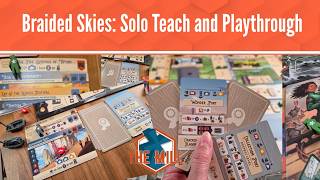
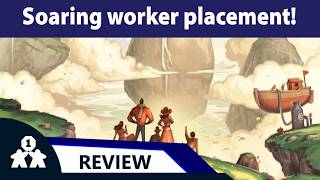
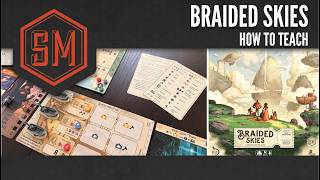
At its core, Braided Skies is a worker placement game, but with an unconventional emphasis. Instead of placing workers once and retrieving them at the end of a round, players control three airships that they actively manage throughout the game, deploying them to board locations and recalling them back to their player mat on turns of their choosing. This constant cycling back and forth has been called "worker juggling" by the designer, and it creates a very different rhythm than traditional worker placement. The three airships can be upgraded with harvesters and crew members that improve their effectiveness, adding a layer of engine building to the placement puzzle. Some action spaces on the board accept any airship, while others are locked to specific ship types, forcing players to think carefully about timing: when should you deploy this ship, and when will your opponent likely recall theirs so you can claim that locked action?
Powerful Recall Turns
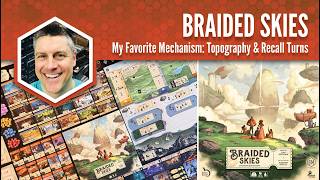
What makes the recall mechanic special is that it is not a weak recovery step but one of the most important parts of each turn. When players bring their airships back to their player mat, they trigger a cascade of abilities from outfitting cards they have built up. The order in which ships return matters enormously, since effects chain together: bringing back one ship might generate a resource that fills a slot needed for the next ship's ability. This has led reviewers to describe recall turns as an order-of-operations puzzle that can feel deeply satisfying to solve. The designer explicitly designed these turns to rival deployment turns in power and interest, and the simultaneous play encouraged during recall phases keeps the game moving even when one player is working through their sequence.
The Braided Skies Experience
A Generous, Abundant Feeling
Braided Skies radiates abundance. Players are constantly gaining resources, building up their airships, moving up progress tracks, and collecting wonder cards. The game is designed so that players frequently receive benefits simply for having things in the right place, without needing to spend or sacrifice. This creates a fundamentally positive emotional experience. Turn-after-turn, there are good options available; the game rarely forces you into a purely defensive corner. Even the act of filling your resource capacity on the player mat, which in many games would feel like a punishment, becomes a satisfying moment of accomplishment. Multiple reviewers have noted this abundance as central to the game's appeal, comparing it favorably to other engine-building designs that focus on generous progression.
Strategic Timing and Decision Complexity
Beneath the surface warmth lies genuine strategic depth. Every turn presents timing decisions: do you deploy another airship, or is now the moment to recall and process what you have built? If you recall early, you trigger your powerful abilities but also free up space for your opponents to place their ships. Should you focus on one track to multiply your wonder card values, or should you try to balance all three tracks? The outfitting cards create the classic optimization puzzle of knowing which combinations unlock your best combos, and the board's dynamic nature, where new action spaces unlock as players progress, means every game offers a slightly different puzzle to solve.
What Makes Braided Skies Stand Out
A Three-Dimensional Topographical Board
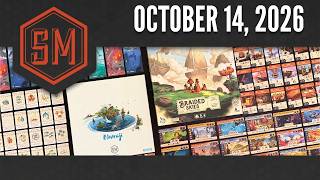
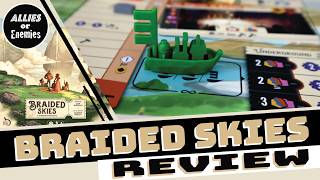
The board is not flat. Using magnetic attachment, Braided Skies features a series of cloud boards that layer atop the base board, creating a literal three-dimensional landscape. As players progress and reveal new regions by diving deeper into the clouds, additional action spaces are permanently added to the board for all players to use. This shared progression mechanic means that the game evolves as it progresses; the action economy available in turn five looks completely different from turn one. The cloud tiles themselves contain story events that add a spark of narrative flavor without bogging down the turn structure. The production here is remarkable, with magnets holding everything securely and trays bookending the board, making setup and teardown smooth despite the complex component density.
Interconnected Progress Tracks
Braided Skies presents three distinct thematic tracks along which players progress: Adventure, Scenic, and Cultural, each representing different kinds of tourism experiences. Moving up a track immediately benefits cards matching that track's symbol, but the trick is that the value multiplier at game's end requires balance. The tracks are deliberately designed so that one track alone does not unlock value in its matching cards; you must develop across multiple tracks to fully exploit your wonder collection. This creates a push-pull decision throughout the game: should you focus narrowly on the track where you are strongest, or should you diversify? Each track also offers unique instant benefits as you climb it, providing reasons to pursue them beyond just endgame scoring.
Potential Drawbacks
Significant Table Footprint
Braided Skies demands space. The base board is large, the three cloud layers add another dimension, and each player needs room for their mat, outfitting cards, and airship tokens. While the game is designed to fit on a standard shelf, casual players accustomed to compact designs may find setup and play space a consideration. Unlike some worker placement games that can be squeezed onto a small table, Braided Skies benefits from generous elbow room.
Meaningful Learning Curve on First Play
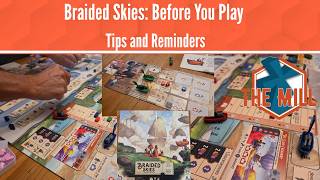
The rulebook is manageable, but Braided Skies carries inherent complexity in its interlocking systems. New players will spend the first game getting a feel for how outfitting cards combo together, which tracks to prioritize, and how to time their recalls. The reference cards help considerably, but the game is not immediately transparent about optimal play sequences. Experienced gamers will relish this depth; casual groups should budget time for a learning game.
If You Enjoy Braided Skies
Braided Skies shares DNA with several beloved designs. If you love the scaling track system seen in Lost Ruins of Arnak, where upgrading your engine feeds back into your scoring, Braided Skies will feel familiar but not derivative. If you appreciate the tourism company theme of Galactic Cruise but want a different mechanical experience, Braided Skies applies similar passenger-preference logic through its three-track system. Players who enjoyed the worker-management puzzle of Tapestry, with its rhythm of small turns punctuated by powerful income turns, will recognize echoes in Braided Skies' balance of deployment and recall. Those who love Concordia's resource management tension, where deciding when to use your reserves creates meaningful pressure, will find similar dilemmas here. Finally, if you have enjoyed any of designer Dan Germaine's previous work, Grand Central Skyport, you already know their design sensibility values both accessibility and depth, which Braided Skies delivers in full measure.
What Reviewers Are Saying
"I could feel like the warmth of this game, and what I mean is it's just a comfortable, fun game. It's just like I can, even though it's a competitive game, this doesn't feel like a high stress competitive game to me. It feels like an enjoyable competitive, and those are two different kinds of things at the table."
— Positively Board Gaming
"So basically you got your your airborne blips or whatever airship you you are the captain you taking uh tourist in the land. But what you need to do, you need to discover like more like different type of lands. Uh you need to get certain specific fuels to fuel your ship cuz to go in certain location you need a specific type of fuel that are represented by the gems."
— Board Stupid
"It's a worker placement game where you dive deep down in the clouds on airships and you are tour guides. So, the stakes are accordingly about discovering adventure and following along those themes of what type of tour guide you are."
— The Mill