




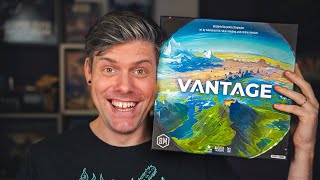


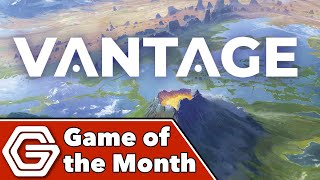


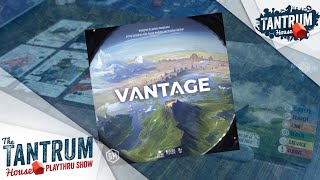









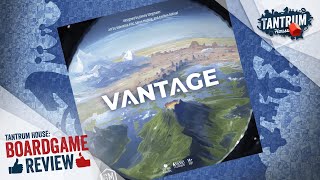


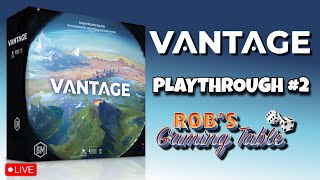
Vantage box art

Vantage

Game ID: GID0375724
Game Info
Year
2025
Players
1-6
Age
14+
Playtime
180 min
Collection
Ratings
Mechanic profile
Percentile rank vs. all games
Vibe profile
How this game feels to play
Description

Vantage is an open-world, co-operative adventure game for 1-6 players that features an entire planet to explore, with players communicating while scattered across the world. With nearly eight hundred interconnected locations on four hundred cards and over nine hundred other discoverable cards, the world is your sandbox.

You begin each game of Vantage on an intergalactic vessel heading towards an uncharted planet. After crashing far from your companions, you have complete freedom as to how you explore, discover, and interact with the planet. You view your location from a first-person perspective, and you can communicate with and support other players, but you are separated by vast distances, so only you can see your current location.

Vantage is not a campaign game, and it is completely self-contained with no expansions — just a few accessories like metal coins.

—description from the publisher

Description

Vantage is an open-world, co-operative adventure game for 1-6 players that features an entire planet to explore, with players communicating while scattered across the world. With nearly eight hundred interconnected locations on four hundred cards and over nine hundred other discoverable cards, the world is your sandbox.

You begin each game of Vantage on an intergalactic vessel heading towards an uncharted planet. After crashing far from your companions, you have complete freedom as to how you explore, discover, and interact with the planet. You view your location from a first-person perspective, and you can communicate with and support other players, but you are separated by vast distances, so only you can see your current location.

Vantage is not a campaign game, and it is completely self-contained with no expansions — just a few accessories like metal coins.

—description from the publisher

Ask a Rules Question
All mentions
Browse transcript mentions, sentiments, pros/cons, mechanics, topics, quotes, and references.
Total mentions: 276
This page: 50
Sentiment: pos 41 · mix 7 · neu 0 · neg 2
Mentions per page
Showing 201–250 of 276
Video zcw9AczDlKo Totally Tabled Discussion at 0:00 sentiment: positive
video_pk 30357 · mention_pk 89374
Totally Tabled - Vantage video thumbnail
Click to watch at 0:00 · YouTube ↗
Overall sentiment (raw)
positive
Pros
  • Very quick and easy to set up (playable in minutes).
  • Strong open-world exploration rewards and replayability.
  • Solo-friendly with a satisfying, emergent feel.
  • High variability due to randomized missions, locations, and characters.
  • Sessions are self-contained and typically 2-3 hours, making it easy to fit into a day.
Cons
  • Multiplayer rules feel less satisfying or less well-integrated than solo play.
  • Some players may find the rulebook/book-reference aspect fiddly without an app.
  • Lacks a campaign backbone, which may disappoint players who want long-form progression.
  • Some may miss traditional Euro-style control and planning due to the emphasis on discovery and risk-reward decisions.
Thematic elements
  • Discovery, exploration, and emergent storytelling driven by player choice.
  • An open-world planet full of locations and adventures to discover, with a randomized setup each session.
  • Emergent, non-linear storytelling where outcomes depend on actions and discoveries.
Comparison games
  • Robinson Crusoe
  • Primal
  • Earthborne Rangers
  • Aridia
  • Frost Punk
  • Mage Knight
  • Voidfall
Mechanics (from transcript analysis)
  • action_selection — At each location you have six actions and typically only one (or two) are feasible, forcing painful but meaningful choices.
  • Dice Rolling — Dice determine the consequences of actions (costs and outcomes) rather than whether an action succeeds.
  • dice_resolution — Dice determine the consequences of actions (costs and outcomes) rather than whether an action succeeds.
  • one_shot_scenarios — Each game is a separate scenario with reset progression, enabling frequent replay without campaign commitments.
  • open_world_exploration — Large, richly populated world with diverse locations and events that reward exploration.
  • randomized_setup — Session setup is randomized: 21 possible missions, 6 characters, and 126 possible starting locations.
Video topics + discussion points
No key topics recorded for this video.
Quotes (from this video)
  • Vantage really is a pure exploration game.
  • This is an open world that's just filled to the gills with stuff.
  • Not a campaign game.
  • One-off scenarios.
  • I love this game. I can't wait to explore it more.
  • I'm a big fan of the dice resolution mechanic.
References (from this video)
No references stored for this video.
Video 9vEHzpGMV0U Tim Chuon Top 5 List at 12:15 sentiment: positive
video_pk 29837 · mention_pk 87576
Tim Chuon - Vantage video thumbnail
Click to watch at 12:15 · YouTube ↗
Overall sentiment (raw)
positive
Pros
  • Very high replayability and variability
  • Fast setup for solo play
  • Accessible but deep for ongoing play
Cons
  • Box lift issues due to many boards and added content
Thematic elements
  • exploration, discovery, and autonomy
  • Open-world, sandbox exploration with mission-based objectives
  • highly emergent, player-driven storytelling
Comparison games
  • Andromeda's Edge
  • Elder Scrolls: Betrayal of the Second Era
Mechanics (from transcript analysis)
  • fast solo setup — Minimal setup for solo play with quick-start boards and dice.
  • mission/objective-based play — Objectives drive progression and morale management, with time pressure.
  • Open-world exploration — Each session can be different with new landscapes, weapons, and NPCs.
Video topics + discussion points
No key topics recorded for this video.
Quotes (from this video)
  • I can't stop playing this game because I'm like, I cannot get over how good solo mode is in this one.
  • The combat system and the character customization is top tier.
  • There's one killer and then there's a group of survivors and plus there are multiple gaming modes.
  • Every time you play this game, it is different.
References (from this video)
No references stored for this video.
Video HhGJ7cikI0U Tabletop Tolson Review at 0:05 sentiment: positive
video_pk 29660 · mention_pk 87116
Tabletop Tolson - Vantage video thumbnail
Click to watch at 0:05 · YouTube ↗
Overall sentiment (raw)
positive
Pros
  • Rich sandbox exploration with a planet-sized world
  • Engaging cooperative storytelling with persistent narrative elements
  • High replay value due to vast card and book systems
Cons
  • Heavy dice RNG leading to potentially harsh outcomes
  • Extensive rulebook and component count can be intimidating
  • Requires active communication and organization to track information across players
Thematic elements
  • Exploration, storytelling, and cooperative problem solving across a persistent world of information
  • Open-world planet with ~800 interconnected locations and a standalone session structure
  • Choose-your-own-adventure style with branching story books and mission/destiny objectives
Comparison games
none
Mechanics (from transcript analysis)
  • Books as resolution mechanisms — Resolution of actions uses various storybooks (location books, book of secrets, book of vantages, depart story) to determine outcomes.
  • card-driven exploration — Locations are cards, double-sided and hidden from other players; you reveal and move via dice and card placement.
  • Challenge dice pool — Eight dice per player plus growth via items; faces include symbols that affect stats.
  • Cooperative but isolated play — Players work toward common goals while resolving challenges individually, with potential token sharing.
  • Descriptive communication — Players describe what they see on their own cards to teammates who cannot see them to coordinate progress.
  • Destiny and mission cards as win conditions — Victory is achieved by completing both mission and/or destiny goals; multiple destinies can be pursued.
  • Limited Communication — Players describe what they see on their own cards to teammates who cannot see them to coordinate progress.
  • Skill tokens and character progression — Characters gain skill tokens used to tackle challenges and upgrade the character.
  • Standalone sessions — Each game is self-contained (2-3 hours) with persistent world information across plays.
Video topics + discussion points
No key topics recorded for this video.
Quotes (from this video)
  • The world is your sandbox.
  • This is an open-world cooperative adventure game featuring an entire planet to explore in a standalone session.
  • Describe what you see on your card.
  • The only persistent element in Vantage from game to game is information.
  • We love exploring. We love the fact that when you take actions, there are results and or consequences that stay with you.
  • I really really like it.
  • This is a 1 to six player game and again every session which is fully complete not a campaign is about 2 to three hours.
  • The intrigue of the unknown is still very enticing to me.
References (from this video)
No references stored for this video.
Video i8CmZQmoGHs Stommyer Games Discussion at 3:43 sentiment: positive
video_pk 29576 · mention_pk 86864
Stommyer Games - Vantage video thumbnail
Click to watch at 3:43 · YouTube ↗
Overall sentiment (raw)
positive
Pros
  • Simple to grasp for two players
  • Flexible, can accommodate a duo or a small group with ease
Cons
  • Limited published material; less data for extensive public analysis
Thematic elements
  • togetherness and cooperative progression
  • Together character-driven journey; collaborative storytelling
  • personal storytelling with a shared character arc
Comparison games
none
Mechanics (from transcript analysis)
  • Cooperative Game — Players share a single character trajectory, cooperating to reach goals.
  • cooperative play — Players share a single character trajectory, cooperating to reach goals.
  • Story-driven progression — Decisions and events shape a collaborative narrative across sessions.
Video topics + discussion points
No key topics recorded for this video.
Quotes (from this video)
  • We played Wingspan Americas last weekend. Small box, big boost of fun, simple rules, lots of player interaction, which I love.
  • If you'd like to play along with me in two weeks for game 90, you can just go pick up these realms in advance.
  • We essentially played a solo game. We only had one character. It was a together character, a custom character that anyone can make.
  • I'm excited about the Express and Endgame features on GameFound and would love to hear your thoughts.
  • I love what Elizabeth did with Wingspan Americas.
  • Thank you for sharing your questions and your curiosity as always.
  • Two players gives a nice dynamic; more players adds pressure to manage more scoring avenues.
  • We’re planning to add around 15 to 20 seats for Design Day if we can manage it.
  • Crowdfunding can deliver innovation when the hook is fresh and the product is genuinely unique.
References (from this video)
No references stored for this video.
Video SRFPVbHWSGU Totally Tabled Top 10 List at 9:37 sentiment: positive
video_pk 29485 · mention_pk 86617
Totally Tabled - Vantage video thumbnail
Click to watch at 9:37 · YouTube ↗
Overall sentiment (raw)
positive
Pros
  • Nostalgic feel; focused on exploration
Cons
  • Limited explicit storytelling; depends on imagination
Thematic elements
  • solo exploration with minimal guidance
  • open-world planetary exploration
  • image-based storytelling with minimal text
Comparison games
none
Mechanics (from transcript analysis)
  • exploration-first gameplay — Exploration is primary, other mechanics streamlined
  • non-linear storytelling — Implied narrative through imagery and cards
  • solo-friendly design — Playable with 1-6 players but tailored for solo
  • Storytelling — Implied narrative through imagery and cards
Video topics + discussion points
No key topics recorded for this video.
Quotes (from this video)
  • This War of Mine is brutal and depressing and sometimes disturbing because the stories presented are based on real events from real wars.
  • Being themed around Lord of the Rings helps, of course. It's so easy to visualize all the locations and the characters as this alternative narrative plays out.
  • Card games rarely feel this thematic.
  • Lands of Gowser features many streamlined mechanisms for making the game simple to set up, to play, and to put away.
  • Sleeping Gods has everything that I want in an adventure game.
References (from this video)
No references stored for this video.
Video th3OFeuJfYg slickerdrips Playthrough at 4:21 sentiment: positive
video_pk 28640 · mention_pk 83997
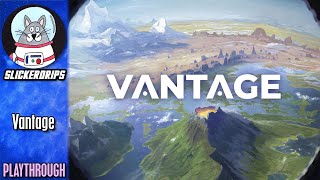
slickerdrips - Vantage video thumbnail
Click to watch at 4:21 · YouTube ↗
Overall sentiment (raw)
positive
Pros
  • Rich world-building and modular story elements
  • Engaging dice/dialogue-driven decision points
  • Solid solo-play options with clear progression
Cons
  • Puzzle-resolution can be opaque and slow on stream
  • Rule density may overwhelm casual viewers
  • Inventory/gear management can feel fiddly without setup
Thematic elements
  • Survival, discovery, interaction with alien sentients, quest-driven progression
  • Uncharted alien planet with a crash site and multiple locales to explore
  • Open-world, story-driven with modular book-based entries guiding actions
Comparison games
  • Uprising: Curse of the Last Emperor
  • Pursuit of Happiness
  • Beyond the Rift
  • Slay the Spire
Mechanics (from transcript analysis)
  • Card-driven actions — Character cards grant unique actions and abilities, with spending and placement rules.
  • Dice pool and dice management — Colored dice are allocated to actions; penalties, boosts, and overflow are tracked.
  • Gear grid and equipment management — Items are placed on a grid; red/green/blue actions interact with equipment and tokens.
  • Narrative Choice — Entries in storybooks dictate outcomes and branching events.
  • Open-world exploration — Players explore a planet with many distinct locations and story hooks.
  • Puzzles and artifact interactions — Puzzles grant powerful items or abilities and drive story entries.
  • Resource tracking and destiny pathways — Health, morale, time, boosts, and destiny influence endgame victory conditions.
  • Story books and book of secrets — Entries in storybooks dictate outcomes and branching events.
Video topics + discussion points
No key topics recorded for this video.
Quotes (from this video)
  • There’s a whole planet to explore.
  • Conquer part of a city. Perform this action on a city location and read this entry in the overpower story book.
  • I’ve done Vantage a lot, but it’s always new in its own way.
  • The book of Vantages is a guide for action and progression.
References (from this video)
No references stored for this video.
Video 3hpR7QOaG40 The Brothers Murph Top 10 List at 1:33 sentiment: positive
video_pk 28178 · mention_pk 82490
The Brothers Murph - Vantage video thumbnail
Click to watch at 1:33 · YouTube ↗
Overall sentiment (raw)
positive
Pros
  • engaging story
  • strong narrative arc
  • generally well received by the group
Cons
  • availability and price can be limiting
  • not ideal for players seeking pure abstract strategy
Thematic elements
  • Story-driven exploration
  • Space exploration
  • story-driven narrative with exploration
Comparison games
none
Mechanics (from transcript analysis)
  • Narrative Choice — narrative choices influence outcomes
  • narrative/scene discovery — events revealed through cards or prompts drive story progression
  • Story-driven exploration — narrative choices influence outcomes
Video topics + discussion points
No key topics recorded for this video.
Quotes (from this video)
  • Way more than I was expecting to.
  • It was the NUMBER ONE RANKED NUMBER ONE.
  • Listen. Oh, mine's going to be hard to beat.
  • Recency bias is a hell of a drug.
  • I love Covenant.
  • Crafting the Cosmos being so low surprised me.
References (from this video)
No references stored for this video.
Video RzGtp7w8Aso TheGameBoyGeek - Hi Quality Hi Energy Board Game Reviews Top 10 List at 11:26 sentiment: positive
video_pk 28203 · mention_pk 82653
TheGameBoyGeek - Hi Quality Hi Energy Board Game Reviews - Vantage video thumbnail
Click to watch at 11:26 · YouTube ↗
Overall sentiment (raw)
positive
Pros
  • Huge, immersive world feel
  • Strong cooperative support between players
  • Beautiful components and design
Cons
  • Longer playtime
  • Best with smaller player counts
  • Can be complex for new players
Thematic elements
  • exploration and shared discovery
  • a vast, Mist-like world explored cooperatively
  • indirect storytelling with player-driven world-building
Comparison games
none
Mechanics (from transcript analysis)
  • check-based resolution — success on checks depends on actions and player inputs.
  • cooperative exploration — players explore a large world together, advancing based on checks.
  • solo/2-player optimization — designed to play best solo or with two players; larger counts possible.
  • Tableau Building — cards in players' tableau can help others perform tasks.
  • tableau-based assistance — cards in players' tableau can help others perform tasks.
Video topics + discussion points
No key topics recorded for this video.
Quotes (from this video)
  • "Where's Waldo? The cooperative game that you can play with kids."
  • "This is one of those games where it's like yes, it feels familiar."
  • "It's a really good cooperative game where you're trying to work together to kind of like place everything there."
References (from this video)
No references stored for this video.
Video VMqE5tu1BCo Stonemaier Games Analysis at 0:05 sentiment: positive
video_pk 27921 · mention_pk 81541
Stonemaier Games - Vantage video thumbnail
Click to watch at 0:05 · YouTube ↗
Overall sentiment (raw)
positive
Pros
  • Clever one-way action selection track that still encourages planning and forward progression
  • Two twists on the track (one-way with section-based progression and two-way dynamics)
  • Integrated wave refill mechanism that adds tiles and is highly visible
  • Mechanics encourage players to slow play and anticipate future needs
  • Wave mechanism is inclusive; younger players can participate by controlling the wave
Cons
none
Thematic elements
  • Coastal foraging and shoreline exploration with a wave-driven replenishment mechanic.
  • A coastal beach with a lighthouse, where players move pawns along the shoreline and collect shell tiles.
  • Abstract-naturalist theme focusing on beach ecosystem and wave dynamics.
Comparison games
none
Mechanics (from transcript analysis)
  • One-way action selection track — Players move along a single-direction track with footprints indicating the number of tiles they can take; movement progresses through sections, not staying put in the same section.
  • Two-way twist within a one-way track — Although the track is conceptually one-way, the section structure creates a two-way dynamic by forcing progression to the next section and allowing strategic choices about where to stop.
  • Wave refill mechanism — A wave token acts as a quasi-player that moves and replenishes shells onto the beach on its turns, providing tile options and integrating the refill into gameplay.
Video topics + discussion points
No key topics recorded for this video.
Quotes (from this video)
  • I really, really like how it's used.
  • The wave is not a player. The wave moves, but the wave kind of acts like a player in that when all tokens are ahead of the wave, it is the wave's turn.
  • It's a brilliant refill mechanism in Santa that I really really appreciated.
  • Also, it's a nice thing to give if you have someone that's really really young, maybe a two or three-year-old who wants to play along with you.
References (from this video)
No references stored for this video.
Video 9qyRLHvgTjQ The Board Game Garden Top 12 List at 16:29 sentiment: positive
video_pk 27685 · mention_pk 80840
The Board Game Garden - Vantage video thumbnail
Click to watch at 16:29 · YouTube ↗
Overall sentiment (raw)
positive
Pros
  • open-world exploration concept
  • highly anticipated due to long development and designer pedigree
Cons
  • open-world / first-person perspective may be unconventional for some
Thematic elements
  • open-world, first-person perspective exploration
  • open planetary exploration
  • story-driven, exploratory
Comparison games
none
Mechanics (from transcript analysis)
  • card-driven / open-world progression — cards drive exploration and story beats
  • Cooperative Game — players explore planets together with a narrative flow
  • cooperative play — players explore planets together with a narrative flow
Video topics + discussion points
No key topics recorded for this video.
Quotes (from this video)
  • my top not 10 but 12 uh most anticipated games of 2025 that I have not played
  • Critter kitchen I cannot wait to get my final copy of this I am so excited
  • I cannot wait to try the solo mode of Critter kitchen
  • it's sounds so much fun it's just so cute
  • I love rolling wrs I love stars and planets and stuff like that
  • Daydream is the ultimate cozy game
  • I have never even seen these games on the table
  • I love you guys so so much
References (from this video)
No references stored for this video.
Video gWTZo0xANOc Board Game Hangover Review at 0:00 sentiment: positive
video_pk 13552 · mention_pk 39614
Board Game Hangover - Vantage video thumbnail
Click to watch at 0:00 · YouTube ↗
Overall sentiment (raw)
positive
Pros
  • Exploration with lots of location variety
  • Huge amount of narrative content and items
  • Items mitigate dice rolls and enable tactical play
  • Easy to set up and learn, approachable
  • Tailorable difficulty through starting resources and memory carryover
  • Strong standalone storytelling that can be played solo
Cons
  • Poor multiplayer experience; not ideal for group play
  • Lack of a concrete end goal or broader strategic objective
  • Feels less like a traditional board game and more like a choose-your-own-adventure
Thematic elements
  • Exploration, storytelling through modular narrative, risk and resource management
  • Space exploration and survival after a crash; landing on various locations
  • Paragraph-based narrative with branching outcomes via story books
Comparison games
  • Earthborne Rangers
  • Sleeping Gods
Mechanics (from transcript analysis)
  • Action selection at landing locations — Choose actions to perform at the current location to progress and trigger events
  • Dice Rolling — Roll dice to resolve actions; failures cost resources
  • dice-based skill checks — Roll dice to resolve actions; failures cost resources
  • Equipment/items cards — Acquire items that mitigate dice risks and alter outcomes
  • Memory carryover between runs — Only memories carry over; new run starts with fresh board but memories affect play
  • Narrative Choice — Read narrative entries that guide exploration and consequences
  • Resource Management — Managing resources; depleting to zero ends the run
  • Resource management and death threshold — Managing resources; depleting to zero ends the run
  • Story books and paragraphs — Read narrative entries that guide exploration and consequences
  • Tailored difficulty/setup — Optional starting resources to customize experience
Video topics + discussion points
No key topics recorded for this video.
Quotes (from this video)
  • Don't go into this as like this is gonna be the crunchy board game
  • It's a sandbox game.
  • the setup is really easy
  • tailored experience to the way you love to play
  • you will always move forward
  • Just enjoy the ride. I think it's the best sandbox board game out there.
References (from this video)
No references stored for this video.
Video IOh6mVuP5Zo The Dice Tower Review at 0:40 sentiment: positive
video_pk 13477 · mention_pk 39443
The Dice Tower - Vantage video thumbnail
Click to watch at 0:40 · YouTube ↗
Overall sentiment (raw)
positive
Pros
  • Infinitely replayable with hundreds of locations and cards that spawn new experiences each game
  • Feels like a time-storage mission while delivering a cohesive story experience instead of a traditional campaign
  • Excellent art direction and components; a consistent thematic look with recognizable elements (stars, hearts, etc.)
  • Mechanics are designed to mitigate bad dice outcomes through items, locations, and narrative structure
  • Book of secrets and book of vantages invite ongoing discovery and hidden content
  • The non-campaign structure shifts emphasis from winning to experiencing and uncovering story beats
Cons
  • Not a traditional campaign or legacy game, which may disappoint players seeking long-form storytelling with a fixed arc
  • Complex and dense rule set; potential learning curve for newcomers
  • Hidden content and Easter eggs can feel overwhelming or opaque until experienced through multiple plays
  • Large content volume may be intimidating to exhaust fully or collector-driven players may worry about missing content
Thematic elements
  • Narrative-driven exploration with a focus on discovery, personal perspective, and evolving puzzles rather than a traditional victory ladder.
  • Space exploration and planetary missions conducted within a self-contained, non-campaign, non-legacy framework; players discover a world through vantage-card storytelling and book-based clues.
  • Slice-of-story experience: a single ‘story’ unfolds over many short sessions, with each play offering a new perspective and new hidden content via the book of secrets and book of vantages.
Comparison games
  • Time Stories
  • Seventh Continent
  • Agricola
  • Caverna
  • Scythe
Mechanics (from transcript analysis)
  • book of secrets and book of vantages — Two books provide lore-based revelations and hidden nuggets; content from these books can dramatically alter the player's approach and discoveries.
  • card actions — Interact with character and equipment cards; actions include mastering, buying, equipping, or engaging with NPCs to unlock benefits or unlock narrative branches.
  • depart actions — Travel between locations via depart actions; players read depart entries to determine the next location and associated narrative cues.
  • dice pool and skill mitigation — A dice pool is rolled based on the chosen action; players may reduce dice by spending colored skill tokens, influencing risk and success chances.
  • dice results and resource flow — Outcomes on dice (stars, hearts, hourglasses) feed into stat changes, potential failures, or redraws; some results can be placed onto terrain slots to mitigate dangers.
  • interconnected locations and items — Hundreds of locations and item cards are interconnected; players explore a web of possibilities with many paths and hidden outcomes.
  • Location actions — Players perform actions at a chosen location (e.g., steer, listen, consult, craft, scavenge, fish) to advance their personal objectives and potentially influence shared state.
  • non-campaign, non-legacy structure — There is no persistent campaign or legacy progression; instead, the game emphasizes a cumulative storytelling experience where each session feels distinct yet connected.
  • terrain and slot mechanics — Terrain types (e.g., purple/orange) interact with symbols; boost cubes and slot placements affect difficulty and what can be resolved on a given action.
Video topics + discussion points
No key topics recorded for this video.
Quotes (from this video)
  • This is not a campaign game. It's not a story game. Sorry, it's not a campaign or a legacy game.
  • Vantage gets a 10 out of 10 from me.
  • It feels infinitely replayable, yet it feels like a time-storage mission every time.
  • There are hundreds of locations. There are hundreds of item cards. There are connectivity between the locations.
  • The book of secrets, the book of vantages, there's so many little hidden nuggets in Easter eggs.
  • This is not going to be a flash in a pan. I think this is going to be a game people are going to play for a long time because it does the impossible.
  • It feels like there's this one overarching story that's happening, and when you play, you're just getting a slice of it as opposed to, you know, playing Agricola or Caverna or something like that.
  • Vantage gets a perfect 10 out of 10 from me. I love this game. It is incredible.
References (from this video)
No references stored for this video.
Video VoueHTR24Us The Brothers Murph Top List at 18:19 sentiment: positive
video_pk 13120 · mention_pk 38355
The Brothers Murph - Vantage video thumbnail
Click to watch at 18:19 · YouTube ↗
Overall sentiment (raw)
positive
Pros
  • highly approachable; great for non-gamers
  • strong narrative potential when played with others
  • compact setup; quick to teach
Cons
  • some players may want more mechanical depth
  • story outcomes can feel variable; less deterministic strategy
Thematic elements
  • minimalist card-driven exploration with mood-driven twists
  • exploration and interaction around a single location card
  • lean, atmospheric storytelling through tiny cards
Comparison games
  • Ark Nova
  • Cascadia
Mechanics (from transcript analysis)
  • exploration on a single-card map — each location shows multiple interaction options; choices direct future cards and outcomes.
  • story-driven replayability — different choices reveal different stories; audience-driven storytelling enhances replay value
  • up-down-left-right navigation — player movement between cards determines encounter results and path to next sites.
Video topics + discussion points
No key topics recorded for this video.
Quotes (from this video)
  • This is the epitome of like first round very short not a lot going on. Last round much much longer.
  • You look bougie. Speak Easy is the new hot Euro game from Vital Lecerda.
  • This is my number one game of the year: Covenant.
References (from this video)
No references stored for this video.
Video hiIpHLx-ANk Board Game Design Lab Discussion at 27:30 sentiment: positive
video_pk 12979 · mention_pk 37979
Board Game Design Lab - Vantage video thumbnail
Click to watch at 27:30 · YouTube ↗
Overall sentiment (raw)
positive
Pros
  • Massive scope and replay variety
  • Endings designed to reflect long playtime and milestones
Cons
  • Pent-up production/loading complexity
  • Potential for fatigue if not playtested in deep stretches
Thematic elements
  • Exploration and mission-driven progression
  • Epic, open-world planetary exploration
  • Narrative arc revealed through play with evolving storytelling
Comparison games
  • Sleeping Gods
  • Gloomhaven
Mechanics (from transcript analysis)
  • Campaign-like journey with branching outcomes — Multiple missions, final destination and end conditions
  • Deck/hand management on a 1300+ card system — Massive card pool with six options per location and branching paths
  • variable end conditions — End can be determined by mission goals, destinations, or time
Video topics + discussion points
No key topics recorded for this video.
Quotes (from this video)
  • it's essentially 1,700 cards and 8 or and 400 of those cards are double-sided
  • you've turned Wingspan not into you built it into more than just a game
  • no zero days
  • the ending has to live up to the X number of hours that somebody just put into it
References (from this video)
No references stored for this video.
Video _Ge4QumTNWs BoardGameGeek Playthrough at 0:00 sentiment: positive
video_pk 12877 · mention_pk 37667
BoardGameGeek - Vantage video thumbnail
Click to watch at 0:00 · YouTube ↗
Overall sentiment (raw)
positive
Pros
  • accessible shell-themed aesthetic with appealing components
  • strong 2-4 player scaling and interaction
  • diverse objective tiles and lighthouse bonuses encourage varied strategy
  • clear tactile feedback from bag placement and tile drafting
Cons
  • scoring can be fiddly and requires careful tracking
  • board space and bag management can feel tight on higher player counts
Thematic elements
  • shell collection, habitat observation, and tidal cycles
  • Santael, a Florida island beach environment with shells washing ashore
  • Array
Comparison games
  • Wingspan
Mechanics (from transcript analysis)
  • Bag Building — players draft shells into their bags, organizing resources for scoring.
  • board/bag placement with openings — tiles must fit into openings; holes must be kept open to continue placement.
  • endgame sequencing via waves — the wave determines how many tiles appear per section and shapes the mid-game shifts.
  • lighthouse bonus tiles — randomized lighthouse tiles grant end-game scoring bonuses and synergy opportunities.
  • set collection / pattern scoring — points come from patterns and unique sets of shells (purple echinoderms, blue valves, orange snails, etc.).
  • tile drafting / bag-building — players draft shells into their bags, organizing resources for scoring.
  • Tile Placement — tiles must fit into openings; holes must be kept open to continue placement.
  • wilds and special tiles — crab and diamond wilds can be used to access flexible placements and scoring bonuses.
Video topics + discussion points
No key topics recorded for this video.
Quotes (from this video)
  • It's like Tetris. You can slot in.
  • We fill every single section as you're passing along the beach.
  • The wave is doing the endgame, and the lighthouse bonuses are huge.
References (from this video)
No references stored for this video.
Video T5KH8nwiX4A slickerdrips Playthrough at 0:00 sentiment: positive
video_pk 12929 · mention_pk 37837
slickerdrips - Vantage video thumbnail
Click to watch at 0:00 · YouTube ↗
Overall sentiment (raw)
positive
Pros
  • Immersive narrative
  • Flexible exploration
  • Multiple mission paths
  • Interesting decision-making
Cons
  • Complex rule interactions
  • Potential for frustrating dice rolls
  • Unclear endgame conditions
Thematic elements
  • Space exploration and rescue mission
  • Uncharted alien planet
  • Choose-your-own-adventure style exploration
Comparison games
none
Mechanics (from transcript analysis)
  • Dice Rolling — Challenge dice used for actions with reroll mechanics
  • Narrative decision-making — Player makes choices that advance story and mission
  • Resource Management — Managing boost cubes, health, morale, and skill tokens
Video topics + discussion points
No key topics recorded for this video.
Quotes (from this video)
  • This is my game plan at the moment.
  • We rescued the Traveler. We won a difficult mission.
  • It's cool... we're in this completely different thing on this completely different mission.
References (from this video)
No references stored for this video.
Video X2HhvTKNlNI BoardGameGeek Top List at 9:09 sentiment: positive
video_pk 12853 · mention_pk 37556
BoardGameGeek - Vantage video thumbnail
Click to watch at 9:09 · YouTube ↗
Overall sentiment (raw)
positive
Pros
  • Eight years in development
  • Theater of the mind experience
  • Replayable
  • Much more contained than Seventh Continent
  • 1000 cards
  • All content included
Cons
  • Similar to Seventh Continent which becomes sprawly
Thematic elements
  • Crash landing and exploration
  • Alien planet
  • Cooperative survival exploration
Comparison games
  • Seventh Continent
  • Breath of the Wild
Mechanics (from transcript analysis)
  • communication — Players convey information to find each other
  • exploration — Open-world exploration inspired by Breath of the Wild
  • Mission-based — Different missions with different objectives
  • Resource Management — Manage resources based on challenges
  • Vantage Point System — Players can only see from their vantage point
Video topics + discussion points
No key topics recorded for this video.
Quotes (from this video)
  • It's hitting people's hands now
  • Really captured people
  • This is one of the greatest games ever made. I don't care what anybody says
  • This is a big sandbox and just go play in it
  • There's something so compelling about this game
  • I think board games are art
  • Fight me I don't care. Best party game ever probably
  • It creates so much laughter. It delivers so hard, man
References (from this video)
No references stored for this video.
Video U5gXlEzrYAc BoardGameCo Discussion at 8:32 sentiment: mixed
video_pk 12804 · mention_pk 37364
BoardGameCo - Vantage video thumbnail
Click to watch at 8:32 · YouTube ↗
Overall sentiment (raw)
mixed
Pros
  • exploratory feel
  • solo and multiplayer support
Cons
  • divisive among players
Thematic elements
Comparison games
none
Mechanics (from transcript analysis)
Mechanics unknown.
Video topics + discussion points
No key topics recorded for this video.
Quotes (from this video)
  • I don't have time to play them all.
  • There are none of those [on my shelf] this month because I looked around and it made me sad.
  • The newest stuff is usually the easiest to go.
  • I might do a full video on this at some point.
  • These are basically all in the passing through category.
References (from this video)
No references stored for this video.
Video rujLg6Xp5WQ Stonemaier Games Top List at 0:51 sentiment: positive
video_pk 12595 · mention_pk 36732
Stonemaier Games - Vantage video thumbnail
Click to watch at 0:51 · YouTube ↗
Overall sentiment (raw)
positive
Pros
  • Encourages communication and cooperation through information asymmetry
  • Tension between progress and resource costs creates meaningful choices
Cons
  • Relies on active table talk; may slow pace for some groups
Thematic elements
  • Cooperative exploration under resource pressures
  • First-person exploration of a location with limited visibility to others
  • Immersive, information-asymmetry driven
Comparison games
  • Origin Story
Mechanics (from transcript analysis)
  • Action success with resource costs — Actions always succeed; the cost comes in time, morale, and health.
  • First-person location perspective — Players see their location from a first-person viewpoint, not a shared top-down map.
  • Limited information / table talk emphasis — Seeing different information drives communication and cooperative decisions.
Video topics + discussion points
No key topics recorded for this video.
Quotes (from this video)
  • Actions always succeed in Vantage; the challenge is how much time, morale, and health you lose along the way.
  • the limited information of I can see something that you can't see and how that encourages communication and cooperation.
  • one player is playing a card and that card has instructions that the other player must follow or you lose.
  • if you roll seven bells on your turn, you just instantly win.
References (from this video)
No references stored for this video.
Video ma8LY3nU4bA Board Game Hangover Discussion at 6:49 sentiment: positive
video_pk 11830 · mention_pk 34639
Board Game Hangover - Vantage video thumbnail
Click to watch at 6:49 · YouTube ↗
Overall sentiment (raw)
positive
Pros
  • strong solo experience
  • engaging storytelling
Cons
  • niche appeal
  • not for all players
Thematic elements
  • indie sci-fi exploration
  • space frontier storytelling
  • story-driven
Comparison games
none
Mechanics (from transcript analysis)
  • engine_building — Builds an autonomous engine to drive progress.
  • solo_mode — Designed with strong solo play experience.
Video topics + discussion points
No key topics recorded for this video.
Quotes (from this video)
  • I'm down to 150 games. Thank you for watching.
  • Bye-bye eclipse and remix stays.
  • This is one game. It all stays. We're not going to take it out right now.
  • My number one game of all time stays obvious.
  • I love it. Love it.
References (from this video)
No references stored for this video.
Video 9MVXAdEclwc Stonemaier Games Discussion at 27:32 sentiment: positive
video_pk 11496 · mention_pk 33811
Stonemaier Games - Vantage video thumbnail
Click to watch at 27:32 · YouTube ↗
Overall sentiment (raw)
positive
Pros
  • Promising design space with ongoing support and promos
  • Flexibility to integrate with other Stillmire titles via realms
Cons
  • Details and pricing not finalized in video; subject to October 15 reveal
Thematic elements
  • Strategic tableau development and tactical choices across multiple realms.
  • Engine-driven design space (engine-building vibes) with modular, evolving play.
  • In-development product discussions and expansion planning.
Comparison games
none
Mechanics (from transcript analysis)
  • Compound Scoring — Scores derived from themed realms and evolving play patterns.
  • Engine Building — Players build an engine through layered interactions and choices.
  • engine-building — Players build an engine through layered interactions and choices.
  • realm-based scoring — Scores derived from themed realms and evolving play patterns.
Video topics + discussion points
No key topics recorded for this video.
Quotes (from this video)
  • six packs of wingspan that fans designed and Elizabeth vetted
  • we printed 5,000 of each of these packs
  • time is really the key for expansion design
  • Rolling Realms is designed around not having any interaction
References (from this video)
No references stored for this video.
Video GaNkWNYgFyQ Getting Games Review at 0:38 sentiment: positive
video_pk 11047 · mention_pk 32512
Getting Games - Vantage video thumbnail
Click to watch at 0:38 · YouTube ↗
Overall sentiment (raw)
positive
Pros
  • Impressive component quality and scale (1,700+ cards) with strong production values
  • High degree of exploration and open-ended storytelling
  • Diverse, flavorful actions with thematic support
  • Flexible end conditions that encourage continued play and storytelling
  • Memorable emergent moments and strong replay potential
Cons
  • Lack of tension at higher player counts (e.g., five players) due to larger dice pools and absorption via cards
  • Setup and teardown can be lengthy with many cards to manage
  • Turns can be long or bogged down by think/spell-check moments at critical junctures
  • Dependence on discovery and spoilers can lead to downtime or analysis paralysis in some games
Thematic elements
  • Exploration, cooperation, and emergent storytelling within a harsh alien environment.
  • Planet crash landing on an alien world; exploration with limited shared visibility and discovery.
  • Emergent, player-driven narratives shaped by local discoveries and interactions.
Comparison games
  • Seventh Continent
  • Lands of Galsier
Mechanics (from transcript analysis)
  • Destinies and missions with endgame variability — Random mission cards and destiny cards guide goals; completing destinies can end the game, but players can also choose to continue until other conditions are met.
  • Location actions with thematic naming — Six location actions with color-coded names that tie to thematic tasks, giving flavor beyond generic terms.
  • Massive card-driven payload and itemization — Over 1,700 cards (plus spoiler packs) featuring spells, equipment, and other effects that feed into actions and storytelling.
  • Purple books and skill checks with mitigation — Skill checks use dice equal to the difficulty; spending skill tokens can reduce the number of dice, and checks always succeed but incur costs (morale, time, health).
  • Vantage standees and hidden perspective — Each player describes their own vantage of the scene while others cannot see their cards, creating asymmetric information and collaborative storytelling.
Video topics + discussion points
No key topics recorded for this video.
Quotes (from this video)
  • This game is astonishing in the number of options.
  • It doesn't have a win or loss condition; you just do stuff.
  • End the game whenever you want to.
  • By the end, the scope of things that happened was incredible.
References (from this video)
No references stored for this video.
Video rj3krBN4qZ4 The Dice Tower Top List at 10:51 sentiment: positive
video_pk 10819 · mention_pk 31946
The Dice Tower - Vantage video thumbnail
Click to watch at 10:51 · YouTube ↗
Overall sentiment (raw)
positive
Pros
  • vast content and high replayability
  • beautiful artwork and a strong sense of discovery
Cons
  • complexity can be intimidating for new players
  • the breadth of content may overwhelm some groups
Thematic elements
  • adventure-focused with exploration, discovery, and commerce
  • planetary exploration with social interaction and adventuring
  • open-ended, sandbox-like adventures with variable goals
Comparison games
  • Gloomhaven
  • Too Many Bones
  • Pillars of Eternity-inspired RPGs
Mechanics (from transcript analysis)
  • Character progression — build a personal arc through exploration, tests, and side activities.
  • exploration and encounters — players explore a shared planet, meeting sentient beings and undertaking tasks.
  • variable goals — each playthrough can yield a different concluding objective.
Video topics + discussion points
No key topics recorded for this video.
Quotes (from this video)
  • This is incredibly impressive and players can work together to try to solve these cases.
  • There are thousands of cases; it scales in complexity and replayability.
  • There are so many scenarios so that every game doesn't feel the same.
  • This one is back to being really unique because this is based in the entire Dungeons and Dragons world.
  • Two versions of it. There's retail and the miniatures, and they both play the exact same, which is what I love.
References (from this video)
No references stored for this video.
Video I7eIfX2wRBc slickerdrips Top List at 15:25 sentiment: positive
video_pk 10677 · mention_pk 31517
slickerdrips - Vantage video thumbnail
Click to watch at 15:25 · YouTube ↗
Overall sentiment (raw)
positive
Pros
  • vast world with a ton of exploration
  • high replay potential through varied gear and actions
  • beautiful components and design
Cons
  • large footprint and setup may deter shorter sessions
Thematic elements
  • discovery and progression via a gear grid
  • planetary exploration after crash-landing
  • exploration-driven, open-world feel
Comparison games
  • None explicitly named
Mechanics (from transcript analysis)
  • dice- and card-based checks — dice determine outcomes with resource-like tracks
  • gear grid and actions — use cards and gear to train, move, and purchase items
Video topics + discussion points
No key topics recorded for this video.
Quotes (from this video)
  • It's got a really cool dice system for the players
  • I absolutely love it
  • There is an absolutely like huge world in there
  • The solo mode is really easy to run
  • it's the most exciting spreadsheet you will find
References (from this video)
No references stored for this video.
Video tk_y44tug04 Before You Play Playthrough sentiment: positive
video_pk 10629 · mention_pk 31308
Overall sentiment (raw)
positive
Pros
  • Highly replayable with 21 different missions
  • Over 1000 unique cards
  • Unique exploration mechanics
  • Asymmetric character abilities
Cons
  • Complex rule system
  • Potential for long play sessions (2-3 hours)
  • High complexity in action resolution
Thematic elements
  • Exploration and survival
  • Uncharted alien planet after spaceship crash
  • Open-world card-based adventure
Comparison games
none
Mechanics (from transcript analysis)
  • Card-based exploration — Players navigate through different locations using location cards and actions
  • Dice Rolling — Challenge dice used for actions and resolving events
  • Resource Management — Managing time, morale, and health tokens
Video topics + discussion points
No key topics recorded for this video.
Quotes (from this video)
  • We have about over a thousand unique cards in the game
  • The chances of you going down the exact same route that we'll be going down is very rare
References (from this video)
No references stored for this video.
Video n1Alg8I02Aw Tantrum House Playthrough at 1:50 sentiment: positive
video_pk 10593 · mention_pk 31241
Tantrum House - Vantage video thumbnail
Click to watch at 1:50 · YouTube ↗
Overall sentiment (raw)
positive
Pros
  • Nostalgic resonance with choose-your-own-adventure and Pokémon-era influences
  • Cooperative play that emphasizes teamwork and shared goals
  • Deep, narratively flavored decisions with quests/destinies and loyalty mechanics
  • Rich, thematic components (animal loyalty, runes, artifacts) that invite immersion
  • Replay potential via multiple vantage points and varied location cards
Cons
  • Complex rule set and heavy reading load, which can slow started play (glasses incident noted in video)
  • Text-heavy cards and potentially small print can challenge readability during play
  • Long playtime and potential for downtime can affect pacing in larger groups
  • Some UI aspects (marking visited locations, tracking loyalties) may feel opaque without a clean tracker
Thematic elements
  • Exploration, animal companionship, mission-driven discovery
  • A remote, jungle/desert/archipelago-like planet with diverse biomes and ruins; players explore to recruit loyal animal companions.
  • Open-world, emergent storytelling driven by individual location cards, quests, and destinies
Comparison games
  • Pokémon (influence and creature collection vibe)
  • Dune (desert/animal encounters and exotic locales referenced in narration)
  • Indiana Jones (adventure/archaeological puzzle vibes)
  • Zork (text-adventure-style discovery and puzzle elements)
Mechanics (from transcript analysis)
  • Action selection from location cards — Each location card presents several actions, but players can perform only one action per turn from that card.
  • Cooperative Game — All players work together to complete a mission and advance the group objective.
  • cooperative play — All players work together to complete a mission and advance the group objective.
  • Dice-based resolution with challenge dice — A pool of challenge dice is rolled; tokens can be spent to modify results; failures move to a penalty pool or require re-rolls.
  • Grid placement around a central animal card — Loayal animals are placed in a 3x3 grid around a location, representing proximity and progression toward loyalty.
  • Quest and destiny systems — Quests (found on quest cards) and destinies (longer-term goals) guide narrative direction and endgame possibilities.
  • Resource Management — Players manage boosts, morale, time, hearts, and other resources to advance actions and loyalties.
  • resource management and tokens — Players manage boosts, morale, time, hearts, and other resources to advance actions and loyalties.
  • Rune and artifact elements — Runic icons and special tokens influence actions and future opportunities, adding puzzle-like layers to exploration.
Video topics + discussion points
No key topics recorded for this video.
Quotes (from this video)
  • I grew up with choose your own adventure novels and Pokémon as formative influences. And this is really hitting all of that nostalgia for me.
  • This game is an open-world mission-driven game.
  • We are cooperative. We're all working together to complete the mission.
  • The dice are just determining how far our counters go down, but the entry in the book is always the same no matter what you rolled.
  • We found our four loyal animals. We just need to make them loyal.
References (from this video)
No references stored for this video.
Video btZncfi13OM BoardGameGeek Top List at 10:41 sentiment: positive
video_pk 10624 · mention_pk 31298
BoardGameGeek - Vantage video thumbnail
Click to watch at 10:41 · YouTube ↗
Overall sentiment (raw)
positive
Pros
  • unique, intriguing mechanic
  • lots of components and discovery
Cons
  • mystery may not land for all players
Thematic elements
  • cooperative isolation and information visibility
  • alien planet vantage perspective
  • story-lite, vantage-based exploration
Comparison games
none
Mechanics (from transcript analysis)
  • hidden information / perspective — view from a landing vantage while others see differently
  • shared information communication — team coordination based on what you can see
Video topics + discussion points
No key topics recorded for this video.
Quotes (from this video)
  • I really love this idea of designer diaries.
  • There are designer diaries actually at this point pretty much constantly on board game geek.
  • There's tons and tons of reviews coming out on BG. People are asking questions.
References (from this video)
No references stored for this video.
Video RsMAXeMN3d4 Board Game Hangover Top List at 6:18 sentiment: positive
video_pk 10545 · mention_pk 30989
Board Game Hangover - Vantage video thumbnail
Click to watch at 6:18 · YouTube ↗
Overall sentiment (raw)
positive
Pros
  • unique exploration experience
  • story progression per turn
  • rich, immersive theme for solo or group play
Cons
  • no fixed end condition may fatigue some players
Thematic elements
  • unknown / exploratory storytelling
  • exploration logbook
Comparison games
none
Mechanics (from transcript analysis)
  • exploration / variable action — each turn offers a few actions, you reveal books, roll dice for risks, and advance story cards
Video topics + discussion points
No key topics recorded for this video.
Quotes (from this video)
  • The perfect filler game
  • This is the best version yet and gorgeous
  • it's a simple party game where we all play together as a team
  • it's the perfect intro to deck-building
References (from this video)
No references stored for this video.
Video dzEhLZz3lfc Rahdo Runs Through Top List at 56:36 sentiment: positive
video_pk 10231 · mention_pk 30239
Rahdo Runs Through - Vantage video thumbnail
Click to watch at 56:36 · YouTube ↗
Overall sentiment (raw)
positive
Pros
  • Legendary designer Jamie Stegmaier
  • Cooperative gameplay
  • Open-world exploration theme
  • Strong production quality
  • Mysterious secrets
Cons
none
Thematic elements
  • open world exploration
  • science fiction
  • first-person perspective
  • planet exploration
Comparison games
  • Charterstone
Mechanics (from transcript analysis)
Mechanics unknown.
Video topics + discussion points
No key topics recorded for this video.
Quotes (from this video)
  • I'm not here to talk about that I'm here to talk about games
  • catch-up games has been on fire
  • I love his Cooperative design sensibilities
  • how does this game not already exist
  • I want more games that tell in 2025 a positive story about how we can work in unison with nature
  • 2025 might be the year of co-ops
  • pure Feld simple Elegance that leads to deep challenging decisions
  • Coming of age is by far my number one most anticipated game
References (from this video)
No references stored for this video.
Video s3htrl_xJtU Tantrum House Top List at 25:41 sentiment: positive
video_pk 10084 · mention_pk 29704
Tantrum House - Vantage video thumbnail
Click to watch at 25:41 · YouTube ↗
Overall sentiment (raw)
positive
Pros
  • Exploration-focused gameplay
  • Simple to play and set up
  • Variable play time based on player choice
  • Focus on journey over destination
  • Flexible player count from 1-6 players
  • Streamlined and efficient gameplay
  • Great table presence
  • All players participate in shared exploration
Cons
  • Play time varies greatly depending on exploration level
Thematic elements
  • Exploration of a crash landing with individual perspectives
  • Alien planet
  • Narrative exploration and discovery
Comparison games
none
Mechanics (from transcript analysis)
  • communication — Players explain to other people what they're looking at
  • exploration — Players explore a planet that is crash-landed on
  • Hidden Information/Vantage Point — Each player has their own vantage point they're looking at that no one else can see
  • Mission-based — Players try to complete missions while exploring
Video topics + discussion points
No key topics recorded for this video.
Quotes (from this video)
  • I love cards that score off of other cards and trying to create combos and synergies
  • if I turn this, then this wheel's turning
  • I love tile lane games
  • that is definitely a different kind of theme that you don't see in board games
  • We're big fans of The Crew
  • is something better going to come or or do I take what's here
  • There hasn't been any deduction games that I know of. Um, I mean, there probably are. Our Gen Con release, but this is the one that really stood out to me
  • it's more about the journey than the destination
  • pleasantly surprised with how I much I enjoyed uh this two-player fighting game
References (from this video)
No references stored for this video.
Video VKghhL--slE Stonemaier Games Discussion at 6:43 sentiment: positive
video_pk 9974 · mention_pk 29382
Stonemaier Games - Vantage video thumbnail
Click to watch at 6:43 · YouTube ↗
Overall sentiment (raw)
positive
Pros
  • Non-linear, persistent-world feel without requiring the same group each time
Cons
  • Players can feel lost when first unlocking map areas
Thematic elements
  • Exploration and persistent knowledge in an evolving world
  • segments of knowledge accumulation per session
Comparison games
  • Tapestry
  • Origin Story
Mechanics (from transcript analysis)
  • Independent sessions with persistent world knowledge — Each game is standalone but builds cumulative context about the world.
Video topics + discussion points
No key topics recorded for this video.
Quotes (from this video)
  • I'm really not a patient person.
  • The heart of the matter, as it turned out, was that testers weren't getting enough options for tapestry cards.
  • We are open to reprinting pretty much anything if there's demand and interest in it.
  • Patience and presence at the gaming table matter as much as the games themselves.
  • I want more positivity in my life and less hate bait.
References (from this video)
No references stored for this video.
Video aNkQ_67F9jk Rolls in the Family Discussion at 1:21 sentiment: mixed
video_pk 9848 · mention_pk 29011
Rolls in the Family - Vantage video thumbnail
Click to watch at 1:21 · YouTube ↗
Overall sentiment (raw)
mixed
Pros
  • Standalone sessions with replayability
  • Accessible to new groups
  • Unique exploration experience
  • Potentially family-friendly and kid-friendly
  • Different from other games in the collection
Cons
  • Polarizing reception
  • Not driven by heavy mechanisms; may not appeal to mechanism-driven players
  • Unclear long-term campaign or progression
  • Content maturity considerations for younger players
Thematic elements
  • Exploration, discovery, and survival on an alien world
  • A mysterious planet to explore, in a standalone session
  • standalone exploratory sessions with potential world-memory effects across plays
Comparison games
  • Seventh Continent
Mechanics (from transcript analysis)
  • Cooperative Game — players coordinate actions to achieve objectives
  • cooperative play — players coordinate actions to achieve objectives
  • dice mechanics — dice-based actions or resolution used to interact with the world
  • exploration — open-world, location-based exploration with discovery and problem solving
  • non-linear/objective discovery — uncover objectives and potential larger goals through exploration
  • standalone-session design — each play is self-contained with potential incremental knowledge about the planet
Video topics + discussion points
No key topics recorded for this video.
Quotes (from this video)
  • Um, the strength of it is just a standalone session. Like there's no campaign here.
  • This could be a very fun type of game to play with a kid.
  • It's unlike anything I have in my collection.
  • It's been getting a lot of hype. I think it's going to be polarizing as far as whether people like this style of game.
References (from this video)
No references stored for this video.
Video jzSsS-TKwYs Tabletop Turtle Top List at 6:12 sentiment: negative
video_pk 9915 · mention_pk 29167
Tabletop Turtle - Vantage video thumbnail
Click to watch at 6:12 · YouTube ↗
Overall sentiment (raw)
negative
Pros
none
Cons
  • mechanics feel vapid and lacking agency
  • story moments feel rare
Thematic elements
  • narrative exploration with dice placement
  • story-driven with matchless agency
Comparison games
  • Kingdom Death Monster
Mechanics (from transcript analysis)
  • Dice Placement — dice-driven encounters with skill checks
Video topics + discussion points
No key topics recorded for this video.
Quotes (from this video)
  • This is obviously an S tier game.
  • I'm combining a few Clank games here, but they're all A tier.
  • I hate Kingdom Death Monster. I hate it.
  • This is an easy A tier game.
  • This is an S tier game.
  • Don't yuck yums.
References (from this video)
No references stored for this video.
Video rkl3EOldMR8 Stonemaier Games Discussion at 28:08 sentiment: positive
video_pk 9120 · mention_pk 26874
Stonemaier Games - Vantage video thumbnail
Click to watch at 28:08 · YouTube ↗
Overall sentiment (raw)
positive
Pros
  • distinct action economy that feels fresh
  • strong interconnection between actions
Cons
  • expansions unlikely; ownership of the core may limit future add-ons
Thematic elements
  • interface-driven action with a first-person perspective
  • Planet-spanning web of interconnected systems
  • systematic/world-building
Comparison games
  • Rolling Realms
Mechanics (from transcript analysis)
  • action_system — Unique action system used to perform tasks and progress on the planet web.
Video topics + discussion points
No key topics recorded for this video.
Quotes (from this video)
  • World Wonders is a polyomino game where you're placing mostly flat tiles, but every now and then you're placing a big chunky wonder and it has just a really good set of mechanisms.
  • Fairy Ring was a really really neat twist on a drafting game where you're drafting cards like in seven wonders, but you were also moving a fairy around the table onto all the stacks of cards that other players have played.
  • I love the joy of browsing without buying.
  • It's unlike anything else we've ever played and we love it.
References (from this video)
No references stored for this video.
Video wCd-ffJaX6Y The Broken Meeple Review at 1:32 sentiment: mixed
video_pk 8989 · mention_pk 26504
The Broken Meeple - Vantage video thumbnail
Click to watch at 1:32 · YouTube ↗
Overall sentiment (raw)
mixed
Pros
  • Simple rules and accessible for newcomers
  • High variety of cards, locations, and story elements
  • Open-world exploration feel within a single-session structure
  • Solo play is viable and engaging
Cons
  • Rulebook editing and layout could be improved
  • Theme/context sometimes clashes with outcomes
  • Destiny missions can be long and grindy in multiplayer
  • Component quality is average and artwork not standout
  • Pacing and game length can vary widely in multiplayer
Thematic elements
  • Survival, discovery, and narrative-driven exploration on an alien world.
  • An expansive open-world planet with modular, card-driven storytelling and exploration.
  • Story-driven, card-driven narrative with a strong emphasis on exploration and world-building.
Comparison games
  • Seventh Continent
  • Sleeping Gods
  • Lands of Gausia
  • Near and Far
Mechanics (from transcript analysis)
  • Card-based items and locations with dice slots — Cards have dice slots and boost slots; dice must be placed to mitigate penalties and gain bonuses.
  • Destiny vs mission victory conditions — Multiple win paths (mission victory, destiny victory, or epic victory); destiny paths can be lengthy.
  • Dice Placement — Cards have dice slots and boost slots; dice must be placed to mitigate penalties and gain bonuses.
  • Dice pool and skill checks — Challenge dice are used to resolve checks; tokens can reduce difficulty.
  • Hidden Victory Points — Multiple win paths (mission victory, destiny victory, or epic victory); destiny paths can be lengthy.
  • Open-world exploration with one action per location — Players move between locations and perform a single action there before moving on.
  • Resource Management — Track time, morale, and health; refresh mechanics affect card usefulness and ability to continue checks.
  • Resource management and stat tracking — Track time, morale, and health; refresh mechanics affect card usefulness and ability to continue checks.
Video topics + discussion points
No key topics recorded for this video.
Quotes (from this video)
  • This is open world exploratory, you go into this world, you have a little mission. It's a bunch of cards
  • Don't pay £80 for this though.
  • Two to three hours on it. It can take longer than 3 hours if you play a five to six player game.
  • For the price you pay for the box, you're getting mainly the variety aspect.
References (from this video)
No references stored for this video.
Video a66rQr_23ys Stonemaier Games Discussion at 2:44 sentiment: positive
video_pk 8252 · mention_pk 24181
Stonemaier Games - Vantage video thumbnail
Click to watch at 2:44 · YouTube ↗
Overall sentiment (raw)
positive
Pros
  • Solid core design, well integrated with newsletter-style world-building
  • Engages players with environmental dynamics
Cons
  • Learning curve and potential ambiguity without playthroughs
Thematic elements
  • Forecasting and ecosystem dynamics
  • Environmental systems and weather-driven world shaping
  • Mechanics-first with thematic framing
Comparison games
none
Mechanics (from transcript analysis)
  • unknown — Not explicitly detailed in the transcript; discussed in relation to weather/environment systems
Video topics + discussion points
No key topics recorded for this video.
Quotes (from this video)
  • Origin Story and Vantage again this past weekend and they are so so great.
  • It was the best game of Flip Seven that I've ever had.
  • I played Dave the Diver for about an hour last night and had a lot of fun with it.
  • I've played Point Salad, but I have not played Point City.
  • I run a board gaming club at my school in which I have been playing Obsession and Brass Lancashire.
References (from this video)
No references stored for this video.
Video Q-v8QNJzjnE Board Game Hangover Top List at 4:43 sentiment: positive
video_pk 8176 · mention_pk 24022
Board Game Hangover - Vantage video thumbnail
Click to watch at 4:43 · YouTube ↗
Overall sentiment (raw)
positive
Pros
  • Pre-order / preorder possibility noted
  • Studio pedigree (Stonemaier-analogue)
Cons
  • Limited info in transcript
Thematic elements
  • Strategic planning with possible bidding or resource optimization
  • Unknown strategic framework, likely Euro-style
  • Mechanics-forward, with light theme
Comparison games
none
Mechanics (from transcript analysis)
  • unknown — Unspecified mechanics discussed; used for strategic decision-making
Video topics + discussion points
No key topics recorded for this video.
Quotes (from this video)
  • we have only 20 minutes to research and buy games
  • you will be able to write in the comments which game we should buy
  • it's accessible and not that expensive
  • it looks like a lot of fun
  • real time betting
  • it's a betting game where the horses run and you're betting in real time
References (from this video)
No references stored for this video.
Video 4dBAH4__gVA The Dice Tower Top 10 List at 1:22:03 sentiment: mixed
video_pk 8099 · mention_pk 23829
The Dice Tower - Vantage video thumbnail
Click to watch at 1:22:03 · YouTube ↗
Overall sentiment (raw)
mixed
Pros
  • Huge scope and depth; deep strategy
  • Thematic weight and long-term planning
Cons
  • Contested opinions on accessibility and balance
  • Can be polarizing due to its heavy design
Thematic elements
Comparison games
  • River of Gold
  • Lords of Water Deep
  • Kingdoms
Mechanics (from transcript analysis)
  • Hidden/deck-building and modular actions — Players build a personal tableau that evolves, unlocking new options as the game progresses.
  • Resource management and worker placement-like decisions — High interactivity and tension as players invest in actions that influence others.
  • Variable board/modules — Different map layouts or modules impact strategy and end-game scoring.
Video topics + discussion points
No key topics recorded for this video.
Quotes (from this video)
  • Would you say that the main message behind this game is that only suckers take the bus?
  • It's a masterpiece of a game.
  • This is a big game actually. A roll and write, Tend.
  • Aridia is a masterpiece of a game.
References (from this video)
No references stored for this video.
Video hcusoF2kXrA Board Gaming Ramblings Review at 0:07 sentiment: mixed
video_pk 7932 · mention_pk 23337
Board Gaming Ramblings - Vantage video thumbnail
Click to watch at 0:07 · YouTube ↗
Overall sentiment (raw)
mixed
Pros
  • Accessible to learn, simple setup in practice
  • Strong solo mode and six-player potential
  • Clear emphasis on exploration and player storytelling
  • Multiple win paths beyond fixed scoring
Cons
  • Ambiguous win conditions may frustrate players seeking clear goals
  • No campaign or campaign-like persistence between games
  • Pacing can be slow and open-ended for some groups
Thematic elements
  • Exploration through shifting viewpoints and personal interpretation; non-linear goals
  • Aboard a spaceship orbiting a planet; landing across a diverse range of locations on the planet
  • Emergent, player-driven, minimal fixed narrative
Comparison games
  • Seven Continent
Mechanics (from transcript analysis)
  • Card-driven outcomes and placement — Each action reveals a card with cost and outcome, which may require placing a die result on a card to track progress; cards provide resources or effects
  • Dice-based action resolution — On your turn you perform a single action by rolling dice tied to your character, potentially paying skills to roll more dice; higher dice costs more resources
  • Exploration and discovery loop — The planet features many landing locations (around 120) to explore; the journey itself constitutes the experience
  • Mission and Destiny objectives — At game start you receive a mission; players can also pursue destinies; multiple victory paths and a non-fixed end condition
  • Open information localised cards — In multiplayer you view others' cards through a display or book; you can hide information and view only your own card to plan actions
  • Resource Management — Resources such as time, health, and morale are spent; hitting zero ends the game; actions either succeed and cost resources or fail with consequences
Video topics + discussion points
No key topics recorded for this video.
Quotes (from this video)
  • This is a very unique game.
  • You win if you have fun.
  • the journey is kind of your destination.
  • There are no points; you win by fun and enjoy the journey.
  • The game play is very basic.
  • This is a weird game.
References (from this video)
No references stored for this video.
Video NDmQDFN3rw8 Tantrum House Review at 0:32 sentiment: positive
video_pk 7332 · mention_pk 21652
Tantrum House - Vantage video thumbnail
Click to watch at 0:32 · YouTube ↗
Overall sentiment (raw)
positive
Pros
  • Strong open-world, exploration-driven design with a cohesive mission structure that supports both variety and a sense of forward momentum.
  • Meaningful asymmetry and character upgrade options significantly enhance replayability and provide distinct paths through the game world.
  • Cooperative play is well-supported by shared information mechanics and the ability for players to contribute tokens and support actions for teammates.
  • High-quality components and well-designed location cards contribute to ease of play and the clarity of what each choice represents on the board.
  • Setup is relatively efficient for a heavy game, and the sweet spot in player count tends to be 2–4, reducing downtime while preserving strategic depth.
Cons
  • Downtime can become substantial at higher player counts, hampering pacing and potentially diminishing engagement during long sessions.
  • The sheer volume of cards (and their organization) can be cumbersome to set up, manage, and store, especially in multi-session play or large tables.
  • Because many location cards offer one-action-per-card options, there is potential for 'FOMO' as players weigh which path to pursue and may regret not choosing alternate options.
  • Teaching the game and learning the rules can be a non-trivial barrier for newcomers, given the cooperative complexity and the interaction between dice, tokens, and story outcomes.
  • The game is not campaign-based, which some players may see as both a relief and a drawback depending on preferred play styles; it requires deliberate time investment in single sessions rather than building a long-running arc.
Thematic elements
  • cooperation, exploration, problem solving, and adaptive storytelling in a procedurally generated world
  • Crash-landed on an alien planet with multiple biomes to explore and a shared goal that unfolds through player-driven discovery
  • story prompts delivered via color-coded books read aloud by players, driving the outcomes of actions
Comparison games
  • Tales of Arthurian Knights
  • Tales of Arabian Nights
  • Western Legends
  • Seventh Continent
  • Sleeping Gods
  • Time Stories
  • Lord of the Rings: Journeys of Middle Earth
Mechanics (from transcript analysis)
  • asymmetry with upgrades — Each character has unique starting traits and upgrade paths that shape playstyle over time. Upgrades unlock new options and can alter how challenges are approached, providing a sense of progression within single sessions and across multiple plays.
  • Cooperative action economy — On a given turn, players collectively pursue a shared objective by taking one primary action each, with other players able to contribute in supportive ways (sharing information, providing resources, or allocating tokens) to influence outcomes. This creates a sense of joint problem solving rather than a strict turn-by-turn individual pursuit.
  • destiny cards and mission structure — A randomly generated main mission at setup, plus optional destiny cards that add longer-term goals. This framework supports varying story arcs and increases replayability by altering objectives across sessions.
  • dice resolution and card-slot placement — Players roll a pool of challenge dice to determine the tier of effort required to complete a chosen action. The outcome can be mitigated by spending matching skill tokens, and any excess dice that cannot be placed on available slots are activated later, integrating a tactile puzzle aspect into action resolution.
  • location- and card-driven actions — Locations present multiple action choices, but the base rule often restricts a card to a single action per game, which forces players to prioritize, manage risk, and weigh the benefits of immediate gains versus future possibilities.
  • open-world exploration with non-linear progression — The game emphasizes exploration across a diverse planetary map, allowing players to pursue different routes, encounter a range of locations, and improvise paths toward mission completion rather than following a fixed script.
  • puzzle-like dice management — Rolling challenge dice and then assigning them to slots creates a logical puzzle: which dice to place where to optimize results, and which actions to prioritize given current resources and board state.
  • skill tokens and mitigation — Skill tokens tied to action types function as a resource that can reduce the number of dice rolled for a given action. Other players may also spend tokens to support a teammate, reinforcing the cooperative aspect and encouraging coordinated planning.
  • storybook-driven outcomes — After resolving dice, a designated reader consults a color-coded story book to determine the narrative result of the action. The reader then feeds back the consequences to the players, tying mechanical resolution to short, digestible narrative segments rather than lengthy prose.
Video topics + discussion points
No key topics recorded for this video.
Quotes (from this video)
  • Vantage is an open-world mission-driven board game for one to six players that takes about two to three hours to play.
  • You'll always be successful with your action. It just may cost more depending on your role.
  • Two to four players is probably the sweet spot for us. Two to three is actually probably even a little sweeter for this game.
  • I think there's like 800 cards. Did he say? Wow. Lots of cards.
  • Open world but with rails; it's open world but with guided choice that keeps the game moving.
  • This is probably risen to the top on how it has put this open world into a board game.
References (from this video)
No references stored for this video.
Video Q9_Z1LyCgpY Board Game Hangover Top List at 3:38 sentiment: positive
video_pk 7027 · mention_pk 20833
Board Game Hangover - Vantage video thumbnail
Click to watch at 3:38 · YouTube ↗
Overall sentiment (raw)
positive
Pros
  • Intriguing exploration mechanic
  • Story-driven
Cons
  • Limited public info
Thematic elements
  • story-based exploration
  • Exploration/story-driven
  • semi-campaign narrative
Comparison games
  • Seventh Continent
Mechanics (from transcript analysis)
  • Card Play — Card-driven actions during exploration.
  • exploration — Exploratory storytelling with hidden information.
Video topics + discussion points
No key topics recorded for this video.
Quotes (from this video)
  • the coolest name on this list guaranteed
  • Blood Bath nice can it get cooler than that
  • let's go five just give it five
  • this is going to be the five for me
References (from this video)
No references stored for this video.
Video oOwYM9OA_AQ Board Game Hangover Top List at 0:14 sentiment: positive
video_pk 5905 · mention_pk 17496
Board Game Hangover - Vantage video thumbnail
Click to watch at 0:14 · YouTube ↗
Overall sentiment (raw)
positive
Pros
  • strong exploration and sense of wonder
  • rich setting with many discoveries
  • high thematic immersion and interaction
Cons
  • heavy randomness can overshadow strategy
  • not a brain-burning or highly strategic experience
Thematic elements
  • mystery and exploration on an unfamiliar world
  • A mysterious planet where a crash landing launches exploration.
  • choose-your-own-adventure with book passages and skill checks
Comparison games
  • Teroscape (franchise)
Mechanics (from transcript analysis)
  • dice-based random outcomes — Skill checks and progression are influenced by dice rolls, introducing randomness into story moments.
  • storytelling/adventure progression — Players encounter location-based passages and resolve events via skill checks driven by dice.
Video topics + discussion points
No key topics recorded for this video.
Quotes (from this video)
  • the best thing about this game is the exploration and sense of wonder
  • it's a choose your own adventure game and not by any means a strategic game
  • the board is full of life, crawling with ants
  • we love Mindbug and we love King of Tokyo
  • the combination just works
References (from this video)
No references stored for this video.
Video 4aoqvHi0s-A The Dice Tower Top List at 25:10 sentiment: mixed
video_pk 5804 · mention_pk 17148
The Dice Tower - Vantage video thumbnail
Click to watch at 25:10 · YouTube ↗
Overall sentiment (raw)
mixed
Pros
  • Strong, characterful composition
  • Landscape invites exploration
Cons
  • Some viewers felt it blends into the backdrop of the game’s art
Thematic elements
Comparison games
  • Thesaurus
Mechanics (from transcript analysis)
Mechanics unknown.
Video topics + discussion points
No key topics recorded for this video.
Quotes (from this video)
  • This is my favorite cover of the year.
  • Echoes of Time will win because of that bold, cinematic look.
  • Deep Regrets is definitely my call here.
  • I hate that Star Wars Battle of Hoth cover.
References (from this video)
No references stored for this video.
Video ahSjPUyvsIo BoardGameGeek Top List at 2:21 sentiment: positive
video_pk 5634 · mention_pk 16712
BoardGameGeek - Vantage video thumbnail
Click to watch at 2:21 · YouTube ↗
Overall sentiment (raw)
positive
Pros
  • Strong emphasis on exploration and emergent storytelling
  • Accessible, with fairly light rules
  • Campaign-like variability gives high replay potential
Cons
  • Specific publisher/designer/year not stated in the transcript
  • Some players may crave more explicit endgame structure or tighter rules
Thematic elements
  • Exploration, discovery, teamwork in an unknown world.
  • A cooperative mission on a wild, alien planet with multiple locations.
  • Open-ended story-driven exploration with changing quests
Comparison games
  • Lost Ruins of Varnac
Mechanics (from transcript analysis)
  • Cooperative Game — All players work together to accomplish a mission or quest.
  • cooperative play — All players work together to accomplish a mission or quest.
  • Dice allocation — Players allocate dice to character cards and items, paying costs with morale, time, or health.
  • story prompts — Prompts drive the narrative and quest objectives, varying from game to game.
Video topics + discussion points
No key topics recorded for this video.
Quotes (from this video)
  • it's really about exploring around
  • this is a cooperative game, you and all your teammates crash landing onto a planet
  • it's really about enjoying the kind of stories that emerge as you explore these different parts of the world
  • Flip 7 is a really simple push your luck game, round after round
  • The Old King's Crown... it's the hottest game right now. People are playing this a bunch
  • Lost Ruins of Varnac, which is also from CGE in that you're trying to find a way to keep that round going
  • It's war on steroids. Like, there's a million things you can do to augment what you have played
  • it's just silly fun
References (from this video)
No references stored for this video.
Video 5x8MOcZEeWs Rob's Gaming Table Playthrough at 4:34 sentiment: positive
video_pk 5497 · mention_pk 16373
Rob's Gaming Table - Vantage video thumbnail
Click to watch at 4:34 · YouTube ↗
Overall sentiment (raw)
positive
Pros
  • High replayability driven by randomness, multiple win conditions, and emergent exploration
  • Strong sense of progression through engine-building and vehicle upgrades
  • Cooperative exploration and shared decision-making with meaningful player interaction
  • Dense world-building with many discovery opportunities and side-quests
Cons
  • Rule complexity and potential initial confusion for new players
  • Significant information management: tracking tokens, tests, and card states
  • Limited official expansion support may reduce long-term variety
Thematic elements
  • survival, exploration, destiny vs mission, personal goals
  • Uncharted planet with roaming cities, seas, mountains, and mysterious ruins
  • open-ended, emergent storytelling with a game-in-a-game layering
Comparison games
  • Seventh Continent
  • Gwent (The Witcher)
  • Earthborne Rangers
  • Groundhog Day (film)
Mechanics (from transcript analysis)
  • Deck/locations and engine building — Players acquire location and crew cards; placement creates engine effects and adjacency bonuses that power future tests.
  • Destinies, missions and intrinsic motivation — Win conditions can be tied to missions, destinies, or personal objectives, enabling multiple play styles and goals.
  • Dice pool and action resolution — Eight base dice in the pool plus two per player are rolled to resolve location and encounter tests; outcomes drive progression and risk.
  • Endgame and tempo control — Players can decide when to end; epic victories can be pursued via destiny upgrades or full-grid achievements.
  • Exploration and map navigation — A spherical, wrap-around map structure with loose directional cues promotes non-linear exploration and discovery.
  • Game within a game (artifact/secret packs) — Secret packs and hidden goals introduce sub-games and branching paths that shape long-term strategy.
  • Resource and token economy — Time, health, morale, boosts, and various tokens drive risk management, healing, and engine-building tempo.
  • Upgrading and crafting — Items, weapons, and gear can be upgraded or crafted to unlock new actions and enhancements for the grid.
Video topics + discussion points
No key topics recorded for this video.
Quotes (from this video)
  • The game is a game within a game
  • Embrace random doubles
  • End the game when you want
  • Groundhog Day vibes meet board game design
  • Seventh Continent level of replayability
References (from this video)
No references stored for this video.
Video eKem41ganGk Might I Suggest A Game Top List at 23:34 sentiment: positive
video_pk 5449 · mention_pk 16243
Might I Suggest A Game - Vantage video thumbnail
Click to watch at 23:34 · YouTube ↗
Overall sentiment (raw)
positive
Pros
  • immersive world, strong storytelling, low combat focus
Cons
  • late arrivals to the table may require longer sessions
Thematic elements
  • story-driven exploration and lore
  • open-world sci-fi planet exploration
  • cooperative storytelling with a vast universe
Comparison games
none
Mechanics (from transcript analysis)
  • Open-world exploration — visit locations, interact with inhabitants, uncover lore
  • story progression — choose-your-own-path with ongoing narrative arcs
Video topics + discussion points
No key topics recorded for this video.
Quotes (from this video)
  • The Emerald Flame was an amazing experience.
  • I love a good cooperative game, but I also love a good competition every once in a while.
  • This game has just the right amount of moving parts… to really benefit people that can think a few turns ahead.
  • Vantage is like Breath of the Wild, but in board game form.
References (from this video)
No references stored for this video.
Video AdLxZju6SJU Watch It Played Top List at 0:33 sentiment: positive
video_pk 5364 · mention_pk 15936
Watch It Played - Vantage video thumbnail
Click to watch at 0:33 · YouTube ↗
Overall sentiment (raw)
positive
Pros
  • unique open-world exploration
  • strong emphasis on cooperation and communication
  • thematic depth
Cons
  • potentially long play sessions
  • learning curve may be steep for new players
Thematic elements
  • exploration and discovery through cooperative play
  • an open world planet waiting to be explored
  • non-linear, player-driven discovery
Comparison games
  • Spirit Island
  • Unmatched Adventures: Teenage Mutant Ninja Turtles
Mechanics (from transcript analysis)
  • card-driven exploration — cards drive where and how players explore and interact with the planet
  • Cooperative Game — players work together to explore a shared world and connect with teammates across distances
  • cooperative play — players work together to explore a shared world and connect with teammates across distances
  • informal fog of war / limited visibility — each player can only see their current location and communications are essential
Video topics + discussion points
No key topics recorded for this video.
Quotes (from this video)
  • hours of epic exploration and a world waiting to be discovered from the comfort of our own home planet
  • cooperative fight against superpowered villains
  • This is currently the number one ranked game on Board Game Geek
References (from this video)
No references stored for this video.
Video Bp_hxK-MIQw BoardGameGeek Playthrough at 0:00 sentiment: mixed
video_pk 5235 · mention_pk 15501
BoardGameGeek - Vantage video thumbnail
Click to watch at 0:00 · YouTube ↗
Overall sentiment (raw)
mixed
Pros
  • Strong open-world wander mechanic that encourages emergent storytelling
  • Cooperative play with meaningful choices and shared resources
  • Flexible goals and multiple victory conditions that support replayability
  • Unique dice-slot and boost-cube resource system adds tactical depth
Cons
  • Hidden vantage information can hinder coordination and lead to confusion for new players
  • Complex rules and lots of components can create a steep learning curve
  • Certain sequences can feel like dead ends or loops if players don’t align quickly
  • Potentially long play sessions with multiple players, which may deter casual play
Thematic elements
  • Exploration, cooperation, emergent storytelling on a hostile yet fascinating world
  • An alien planet with multiple regions explored cooperatively, where each player reads their own vantage card to describe their local view.
  • player-driven, emergent narrative shaped by individual vantage descriptions and encounters
Comparison games
  • Arkham Horror
  • Seventh Continent
  • Black Orchestra
Mechanics (from transcript analysis)
  • Cooperative Game — Players work together to survive and pursue optional victory conditions, balancing health, morale, and time.
  • cooperative play — Players work together to survive and pursue optional victory conditions, balancing health, morale, and time.
  • Dice pool with skill checks and penalties — Actions require rolling dice with health, morale, and time penalties; players can mitigate dice via tokens and boosts.
  • Dice Rolling — Actions require rolling dice with health, morale, and time penalties; players can mitigate dice via tokens and boosts.
  • Dice slots and boost cubes — Cards provide slots to place dice (for costs or mitigation) and boost cubes as currency for special abilities.
  • Inventory grid and card adjacency — Cards are placed in a 3x3 grid; adjacency can influence synergies, crafting, and resource management.
  • Open-world exploration with player-chosen goals — A highly non-linear planet map where players decide when to finish and which goals to pursue (mission, destiny, epic victory).
  • Vantage cards as hidden local information — Each player communicates what their vantage card shows without sharing others’, creating a(separator) information asymmetry.
Video topics + discussion points
No key topics recorded for this video.
Quotes (from this video)
  • The Vantage overarching rule is always do what's thematic. Always do what makes sense for the planet and seems like it's in the spirit of the adventure.
  • One advantage… advantage. You're always going to succeed.
  • Don't look at each other's vantage cards.
  • Vantage is a sci-fi co-op open world exploration game where we get to decide essentially what the goals are and how long we play.
  • We are wandering to find new stuff.
References (from this video)
No references stored for this video.
Video kVk74A9b6v0 TheGameBoyGeek - Hi Quality Hi Energy Board Game Reviews Review at 0:18 sentiment: positive
video_pk 5231 · mention_pk 15488
TheGameBoyGeek - Hi Quality Hi Energy Board Game Reviews - Vantage video thumbnail
Click to watch at 0:18 · YouTube ↗
Overall sentiment (raw)
positive
Pros
  • world feels alive and reactive
  • freedom with purpose and meaningful objectives
  • shared yet personal journeys within a cooperative framework
  • thrill of discovery and open-ended exploration
  • immersive, narrative-driven experience
Cons
  • open-ended pace may not appeal to all players
  • unpredictable session length can be challenging for planning
  • heavy narrative reliance may deter players seeking tight, predictable mechanics
Thematic elements
  • Exploration, cooperative storytelling, personal and shared journeys
  • Massive interconnected open-world fantasy exploration
  • story-driven with storybooks and script-based encounters
Comparison games
  • Sleeping Gods
  • Time Stories
  • Seventh Continent
  • Above and Below
  • Near and Far
Mechanics (from transcript analysis)
  • Area Movement — perform actions from your current location, triggering related events and tests
  • card action — execute actions on personal or shared cards to modify outcomes or dice results
  • depart action — move to a new location using its own book and trigger new sequences
  • dice-based tests — roll dice to resolve tests and assign results to cards, with time, health, and morale consequences
  • location action — perform actions from your current location, triggering related events and tests
  • six action categories — move, look, engage, help, take, and overpower, each prompting a test and a dice roll
  • storybook prompts — story prompts read aloud by other players to drive unfolding events
Video topics + discussion points
No key topics recorded for this video.
Quotes (from this video)
  • The world is alive and reactive with exploration at every turn
  • Freedom with purpose—there's no single path, but meaningful goals guide you
  • Shared yet personal journeys let you carve out your own path while contributing to the team
  • Open-ended pace and unpredictable session length may not appeal to everyone
  • This is an immersive experience—almost a Blue Planet of games
References (from this video)
No references stored for this video.
Video 1nF2R1yz2ZY Tabletop Turtle Review at 0:29 sentiment: negative
video_pk 5135 · mention_pk 15242
Tabletop Turtle - Vantage video thumbnail
Click to watch at 0:29 · YouTube ↗
Overall sentiment (raw)
negative
Pros
  • Evocative, detail-rich card art with hidden details
  • Some clever, quirky situational moments that land occasionally
  • Ambitious attempts at town-building and narrative fragments
Cons
  • Illusion of choice with little real agency or meaningful decision-making
  • Exploration reduced to watching scenes play out rather than interactive discovery
  • No true failure state or consequence, removing tension and learning opportunities
  • Cooperation feels hollow or ceremonial rather than collaborative
  • Cozy aesthetic read as sterile and emotionally distant rather than warm
  • Side-quests feel disconnected and lack a cohesive overarching narrative
  • Long playtime with mechanically vapid core actions
Thematic elements
  • Exploration, discovery, and a gentle storytelling vibe with a critique of cozy-game pretensions
  • Exploratory scenes revealed through location cards in a stylized, cozy-adventure frame
  • Fragmented, card-driven snippets that aim for charm but often feel hollow
Comparison games
  • Peak
  • King's Quest
  • Monkey Island
  • Dragon's Lair
  • Leisure Suit Larry
Mechanics (from transcript analysis)
  • card-driven exploration — Move by selecting a compass direction on a current location card and flip to reveal a new scene
  • Cooperation via shared goals and items — Limited cooperative interaction through exchanging equipment and triggering effects when dice match symbols
  • Dice employment and placement — Roll dice and place them on cards; unplaceable dice go to a penalty zone causing damage
  • Guaranteed success (no-failure mechanic) — All actions succeed by design, removing traditional challenged outcomes
  • Roguelike labeling vs. actual play — Publisher markets as roguelike, but the play largely lacks roguelike tension or failure-driven progression
  • Single-action-per-location constraint — Choosing an action on a card ends further interaction on that location, limiting exploration
  • Time tokens / symbol slots — Use time symbols to activate actions; filling slots mitigates negative effects and enables progress
Video topics + discussion points
No key topics recorded for this video.
Quotes (from this video)
  • Vantage is exploration with the illusion of choice.
  • The game simply strips away what little agency I had left, leaving the experience to be less about discovery and more about rolling dice.
  • Vantage isn't cozy.
  • Every action succeeds no matter what.
  • Cooperation is nothing more than a check box on the back of the box.
References (from this video)
No references stored for this video.
Transcript Navigation
Showing 201–250 of 276
Game Deep Dive