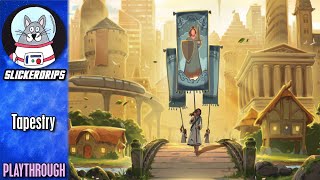
Tapestry box art

Tapestry

Game ID: GID0315127
Game Info
Year
2019
Players
1-5
Age
12+
Playtime
120 min
Collection
Ratings
Expansions & Family
Mechanic profile
Percentile rank vs. all games
Vibe profile
How this game feels to play
Description

Tapestry is a two-hour game for 1-5 players designed by Jamey Stegmaier.

Create the civilization with the most storied history, starting at the beginning of humankind and reaching into the future. The paths you choose will vary greatly from real-world events or people — your civilization is unique!

In Tapestry, you start from nothing and advance on any of the four advancement tracks (science, technology, exploration, and military) to earn progressively better benefits. You can focus on a specific track or take a more balanced approach. You will also improve your income, build your capital city, leverage your asymmetric abilities, earn victory points, and gain tapestry cards that will tell the story of your civilization.

—description from the publisher

Description

Tapestry is a two-hour game for 1-5 players designed by Jamey Stegmaier.

Create the civilization with the most storied history, starting at the beginning of humankind and reaching into the future. The paths you choose will vary greatly from real-world events or people — your civilization is unique!

In Tapestry, you start from nothing and advance on any of the four advancement tracks (science, technology, exploration, and military) to earn progressively better benefits. You can focus on a specific track or take a more balanced approach. You will also improve your income, build your capital city, leverage your asymmetric abilities, earn victory points, and gain tapestry cards that will tell the story of your civilization.

—description from the publisher

Ask a Rules Question
All mentions
Browse transcript mentions, sentiments, pros/cons, mechanics, topics, quotes, and references.
Total mentions: 228
This page: 28
Sentiment: pos 24 · mix 2 · neu 0 · neg 1
Mentions per page
Showing 201–228 of 228
Video NG4StBtpijc Our Family Plays Games Discussion at 21:13 sentiment: positive
video_pk 9390 · mention_pk 27705
Our Family Plays Games - Tapestry video thumbnail
Click to watch at 21:13 · YouTube ↗
Overall sentiment (raw)
positive
Pros
  • large depth and variability
  • interesting tech tree and path-to-victory decisions
Cons
  • heavy for some players
  • high variability can be polarizing
Thematic elements
  • omnipotent growth and tech progression
  • civilization development
  • epic, strategic
Comparison games
  • Curious Cargo
  • Public Market
Mechanics (from transcript analysis)
  • engine-building — players develop civilizations via tech tokens and advancements
  • variable setup — different paths to victory through unique player boards
Video topics + discussion points
No key topics recorded for this video.
Quotes (from this video)
  • we celebrate women's history month by looking at some of the women in board game design
  • gatekeeping and systemic racism in board gaming that we all need to overcome
  • we need less games that are about cis white maleness we need more feminism we need more racial diversity
  • acceptance and being a good human is saying that you're adequate and you're welcomed
References (from this video)
No references stored for this video.
Video Bi5izcgrOAA Before You Play Review
video_pk 9264 · mention_pk 166616
Pros
none
Cons
none
Thematic elements
none
Comparison games
none
Mechanics (from transcript analysis)
Mechanics unknown.
Video topics + discussion points
No key topics recorded for this video.
Quotes (from this video)
  • this expansion also comes with five new landmark cards
  • this expansion introduces a new replacement die
  • there is no limit to the number of them that you can have
  • it opens up the decision space quite a bit more
  • this expansion adds quite a bit more to the experience of the gameplay
  • I personally like it
References (from this video)
No references stored for this video.
Video D4tFuBQXQm8 BoardGameBollocks Review at 0:16 sentiment: positive
video_pk 9317 · mention_pk 27487
BoardGameBollocks - Tapestry video thumbnail
Click to watch at 0:16 · YouTube ↗
Overall sentiment (raw)
positive
Pros
  • Stunning production and component quality that raises the bar for Euro games.
  • Simple core rules that mask deep strategic depth and large decision space.
  • High replayability due to numerous tapestry cards, tracks interactions, and varied strategies.
  • Complementary track design (opposing tracks enhancing depth and synergy between actions).
  • Thematic flavor and artwork that support a strong aesthetic experience.
Cons
  • Tapestry cards sometimes feel secondary to the main track mechanics, reducing their perceived centrality.
  • Board and tapestry card interplay can feel incongruent at times, with thematic progression not always aligning cleanly with card effects.
  • Conquest mechanics can be slow to materialize and may discourage aggressive play in some runs.
  • Insert quality and storage can be awkward; labeling or better organization would help packing away.
Thematic elements
  • Civilization development, exploration, technology, and conquest.
  • A civilization-building arc spanning ancient to spacefaring eras with territory tiles, landmarks, and capital city development.
  • Track-driven engine-building with tapestry cards providing thematic flavor and branching decisions.
Comparison games
  • Tokaido
  • Francis Strait
  • Archipelago
  • Amerigo
  • Terra Mystica
  • The Gallerist
  • Viticulture
Mechanics (from transcript analysis)
  • Capital city grid and landmarks — Fill a sudoku-like capital city grid with buildings and landmarks to score points and unlock effects.
  • Conquest and outposts — Conquer adjacent areas, place outposts, and roll conquest dice for rewards; combat considerations introduce timing dynamics.
  • Income — Five income phases with civilization abilities, card plays, and upgrades that generate income and ongoing benefits.
  • Income phase sequencing — Five income phases with civilization abilities, card plays, and upgrades that generate income and ongoing benefits.
  • Resource Management — Manage workers, food, coins, and culture as costs and incomes on each action.
  • tapestry cards — Play tapestry cards to gain bonuses and influence track progression; cards provide varied effects and artwork.
  • Technology and upgrades — Upgrade tech cards to unlock higher space benefits and points, often tied to tier advancement.
  • Tile Placement — Place territory tiles adjacent to controlled areas to gain bonuses and explore new areas.
  • Tile placement / territory expansion — Place territory tiles adjacent to controlled areas to gain bonuses and explore new areas.
  • Track Advancement — Players move a marker up one of four tracks (exploration, science, technology, military) to gain benefits and unlock landmarks.
Video topics + discussion points
No key topics recorded for this video.
Quotes (from this video)
  • it looks absolutely bloody gorgeous
  • the simple rule set hides a labyrinthine style of depth
  • an infinite number of combinations between different tracks
  • four out of five
  • stunning production
References (from this video)
No references stored for this video.
Video -aePfst7YPg Sir Thecos Discussion at 2:16 sentiment: positive
video_pk 8953 · mention_pk 26432
Sir Thecos - Tapestry video thumbnail
Click to watch at 2:16 · YouTube ↗
Overall sentiment (raw)
positive
Pros
  • Elegant, simple core rules with deep strategic choices
  • High production value and component quality
  • Strong expansion content and rebalanced civilizations
  • Robust solo/automa support
  • Large variety of asymmetrical civilizations for replayability
Cons
  • Expansions add complexity and require more rules; learning curve increases
  • First printing had misprints and insert fit issues in some versions
  • Insertion storage can be fiddly to fit all expansions in a single insert
Thematic elements
  • Civilizational progress through technology, culture, and infrastructure
  • Civilization-building across multiple ages on a shared map with asymmetric paths
  • Player-driven development with modular era cards and landmarks
Comparison games
none
Mechanics (from transcript analysis)
  • Asymmetric civilizations — Each civilization provides unique powers and scoring opportunities.
  • Automa solo mode — Automaton rules to allow solo play with bot-like opponents.
  • Construction and upgrades — Build structures on your mat and upgrade to improve efficiency.
  • Exploration and region tiles — Explore tiles to reveal new regions and opportunities on the map.
  • Resource Management — Gather income and spend resources to build and upgrade.
  • Resource management and income — Gather income and spend resources to build and upgrade.
  • Tapestry cards (inventions) — Draw and play tapestry/invention cards to gain immediate or ongoing benefits.
  • Tile Placement — Place landmarks and buildings on your civilization mat to gain bonuses and progress.
  • Track Advancement — Advance on four tracks (and a potential fifth with expansions) to gain resources and points.
  • Track-based progression — Advance on four tracks (and a potential fifth with expansions) to gain resources and points.
Video topics + discussion points
No key topics recorded for this video.
Quotes (from this video)
  • this unboxing might be a little bit different than most but i will do my best to not hurt myself
  • the rules are not very long but i mean the game is quite simple
  • it's a very elegant game because the rules are really simple but the strategy behind that is not
  • the production value here of this game is through the roof crazy
  • wow this is amazing
References (from this video)
No references stored for this video.
Video XSwFapXewrc Stonemaier Games Top List at 6:24 sentiment: positive
video_pk 8975 · mention_pk 26468
Stonemaier Games - Tapestry video thumbnail
Click to watch at 6:24 · YouTube ↗
Overall sentiment (raw)
positive
Pros
  • Subtle self-balancing mechanism through timing choice
  • Interesting strategic decisions about when to take income
  • Era advancement bonuses help catch-up players
Cons
none
Thematic elements
  • Building a civilization through history
  • Civilization building across eras
  • Civilization engine building
Comparison games
none
Mechanics (from transcript analysis)
  • Era Advancement Bonuses — Players who advance into new eras first among their neighbors gain bonus resources, providing catch-up mechanism for those taking fewer turns
  • Flexible Income Turn Timing — Players choose when to take their limited income turns. Taking them early means fewer turns before income, putting the player at disadvantage
Video topics + discussion points
No key topics recorded for this video.
Quotes (from this video)
  • Balance, perfect balance, I think is kind of boring in games.
  • I like games that have a card that might feel better than a different card either circumstantially or always.
  • As long as you have a fair shot at getting that card over just a random draw, that's the key.
  • Self-balancing mechanisms make sure that games remain balanced while you play.
  • Games that use the players to selfbalance it, especially if there's a lot of direct interaction in the game.
  • If you pull one lever up, something else is going to go down.
  • There's a way that the game kind of gives you an interesting choice and a little way of catching up if you are falling behind.
References (from this video)
No references stored for this video.
Video 2Gam_GOos9Q Foster the Meeple Playthrough at 0:00 sentiment: positive
video_pk 8562 · mention_pk 25233
Foster the Meeple - Tapestry video thumbnail
Click to watch at 0:00 · YouTube ↗
Overall sentiment (raw)
positive
Pros
  • exceptional component quality and production value
  • tight engine-building with meaningful interlock between tracks
  • strong three-player gameplay with good interaction; scalable design
  • the asymmetry adds depth and replayability across games
  • endgame scoring provides satisfying, multi-path routes to victory
Cons
  • scoring and track interaction can be complex to track during play
  • a few players may experience decision overwhelm with many options
  • the base game can feel slower without expansions for some groups
  • some players prefer heavier interaction than the base setup allows
Thematic elements
  • Civilization-building, societal progress, and era advancement
  • Civilization-style development on a modular, ever-expanding board
  • Engine-building with asymmetrical civilizations and era-by-era progression
Comparison games
  • Scythe
  • Red Rising
Mechanics (from transcript analysis)
  • asymmetry — Different civ boards (e.g., Merry Makers vs Militants) grant distinct abilities and upgrade paths.
  • End-game/era scoring — Scoring is driven by map completion (rows/columns), completed advancements, and conquests.
  • Global objectives and communal buildings — Three global objectives and shared landmarks reward early or efficient plays.
  • Positive Player Interaction — Three global objectives and shared landmarks reward early or efficient plays.
  • Resource Management — Management of resources (Baymax-style tokens, mushrooms, yellows, browns, reds, etc.) to pay costs and gain effects.
  • Tapestry cards and upgrades — Card-driven effects upgrade techs and trigger cascading bonuses across turns.
  • Tile Placement — Placement of buildings and tiles on income mats generates points and access to bonuses.
  • Tile/Building placement — Placement of buildings and tiles on income mats generates points and access to bonuses.
  • Track Advancement — Players move along thematic tracks (Exploration, Technology, Military, Science) to unlock bonuses and resources.
Video topics + discussion points
No key topics recorded for this video.
Quotes (from this video)
  • Tapestry is one of my favorite games of all time.
  • I love this game. It's one of my favorite games.
  • The components are incredible.
References (from this video)
No references stored for this video.
Video a66rQr_23ys Stonemaier Games Discussion at 57:14 sentiment: positive
video_pk 8252 · mention_pk 102782
Stonemaier Games - Tapestry video thumbnail
Click to watch at 57:14 · YouTube ↗
Overall sentiment (raw)
positive
Pros
  • Easy entry point for new players
  • Good fit for casual gatherings
Cons
  • Mechanics may feel familiar to other social games
Thematic elements
  • Strategy-lite with social interaction
  • Multiplayer party-style game with a strong twist on card usage
  • Casual, quick to learn
Comparison games
none
Mechanics (from transcript analysis)
  • novel action/tactor system — A quick-to-teach mechanic with dynamic decisions.
Video topics + discussion points
No key topics recorded for this video.
Quotes (from this video)
  • Origin Story and Vantage again this past weekend and they are so so great.
  • It was the best game of Flip Seven that I've ever had.
  • I played Dave the Diver for about an hour last night and had a lot of fun with it.
  • I've played Point Salad, but I have not played Point City.
  • I run a board gaming club at my school in which I have been playing Obsession and Brass Lancashire.
References (from this video)
No references stored for this video.
Video Ul5HpBuVL9Q Going Analog Discussion at 8:48 sentiment: positive
video_pk 7849 · mention_pk 23163
Going Analog - Tapestry video thumbnail
Click to watch at 8:48 · YouTube ↗
Overall sentiment (raw)
positive
Pros
  • rich, flexible engine
  • highly asymmetric play
Cons
  • rules and setup can be dense for newcomers
Thematic elements
  • engine-building and progression
  • tech-tree empire-building across ages
  • sandbox-style, with varied paths
Comparison games
none
Mechanics (from transcript analysis)
  • engine-building — develop a personal tableau of technologies and capabilities
  • tile placement / area control elements — placing tiles to unlock abilities and scoring opportunities
Video topics + discussion points
No key topics recorded for this video.
Quotes (from this video)
  • "this is a very welcoming and very friendly community"
  • "no bs and no tolerance when it comes to toxicity"
  • "you should actually say to you welcome back because you were on season one episode two"
  • "we really want to create and what we strive to do is create a welcoming inclusive space for everybody"
  • "it's a very welcoming awesome group"
References (from this video)
No references stored for this video.
Video ak5pEJ8PC58 The Cardboard Herald Top List at 0:00 sentiment: positive
video_pk 7351 · mention_pk 21720
The Cardboard Herald - Tapestry video thumbnail
Click to watch at 0:00 · YouTube ↗
Overall sentiment (raw)
positive
Pros
  • Strong resource engine that rewards long-term planning
  • Clear path to victory through tracks and landmarks
  • Asynchronous play supports varied tempo and strategy
  • Tapestry cards create meaningful synergies with civilization builds
  • Expansion content adds variety and new strategic options
Cons
  • Complex for newcomers due to multiple interacting systems
  • Landmark fitting can be challenging in tight capitals
  • Expansion interactions may add complexity for casual players
Thematic elements
  • Civilization progression and urban development through tracks and landmarks
  • Civilization-building across eras with a capital city planning focus
  • Abstract engine-building with historical progression; not strongly narrative
Comparison games
none
Mechanics (from transcript analysis)
  • Advancement tracks — Investing in tracks to gain benefits and unlock landmarks; synergy with your civilization.
  • Asynchronous rounds / age advancement — Round structure where players pass into the next age; tempo control is key.
  • Capital placement — Strategic placement of your capital to maximize space and resource flow.
  • Combat: Dice — Conquest action involves dice and can yield points or resources, influencing risk-reward decisions.
  • Conquest action and dice — Conquest action involves dice and can yield points or resources, influencing risk-reward decisions.
  • expansion interaction — Expansions add new landmarks and shapes, increasing strategic breadth.
  • Income — Optional income turns that can be taken when passing to the next age, affecting tempo.
  • Income turns — Optional income turns that can be taken when passing to the next age, affecting tempo.
  • Landmarks — Large scoring cards that require proper space in your capital and provide major scoring when placed.
  • Resource Management — Gaining and spending resources to advance tracks and build landmarks.
  • tapestry cards — Hand of tapestry cards that can synergize with your civilization and shape your strategy.
  • Track Advancement — Investing in tracks to gain benefits and unlock landmarks; synergy with your civilization.
Video topics + discussion points
No key topics recorded for this video.
Quotes (from this video)
  • Resources are king
  • Anticipate your landmarks
  • Drawing into additional tapestries
  • The name of the game is tapestry
  • It's going to pay off dividends
References (from this video)
No references stored for this video.
Video a088HzJ6vxI slickerdrips Playthrough at 0:00 sentiment: positive
video_pk 7361 · mention_pk 21782
slickerdrips - Tapestry video thumbnail
Click to watch at 0:00 · YouTube ↗
Overall sentiment (raw)
positive
Pros
  • Deep multi-age engine-building with multiple scoring vectors
  • Strong solo and AI opponent design with time traveler mechanics
  • Rich palette of expansions adding variety and new strategies
  • High potential for narrative-driven play and long-term planning
Cons
  • Steep learning curve and heavy setup
  • Can be long to play, especially with expansions and optimal play
  • Complex to teach for new players, requiring careful pacing
Thematic elements
  • Civilization development with technology, arts, exploration, and construction of landmarks
  • Civilization-building across multiple ages in a stylized, evolving world
  • Emergent, player-driven progression through five ages with dynamic AI opponents
Comparison games
none
Mechanics (from transcript analysis)
  • Advancement turns — Players typically perform an advancement turn by paying resources to move along a track and trigger space effects, often including landmark bonuses.
  • Automa AI / time travelers — Solo mode uses an automa deck to provide a competitive AI with distinct behaviors (Ottoma and Time Travelers) that impact track progression and landmarks.
  • Dice Rolling — Outcomes for advancing or exploring rely on dice or random draws, with certain cards providing modifiers or options.
  • Dice/terrain randomness — Outcomes for advancing or exploring rely on dice or random draws, with certain cards providing modifiers or options.
  • Engine-building across five tracks — Five tracks (Military, Science, Exploration, Technology, Arts) are advanced by paying resources, with track-specific bonuses and optional landmark rewards.
  • Income — On income turns players gain resources, draw tapestry cards, and may place a masterpieces card that can trigger additional effects.
  • Income turns and tapestry cards — On income turns players gain resources, draw tapestry cards, and may place a masterpieces card that can trigger additional effects.
  • Landmarks and buildings — Buildings and landmarks are placed to meet objectives (e.g., complete rows/columns) and provide immediate benefits and end-game scoring.
  • Masterpiece cards and tapestry deck — Masterpiece cards interact with income turns, offering ongoing or end-of-game bonuses, and they can be used to gain extra resources.
  • Multi-Use Cards — Masterpiece cards interact with income turns, offering ongoing or end-of-game bonuses, and they can be used to gain extra resources.
  • Resource Management — Resources are primarily Food, Population, Money, and Military; these are spent to advance on tracks, build, and activate spaces.
  • Tile Placement — Players place outposts and landmarks on a board to unlock resources and scoring opportunities; terrain adjacency matters.
  • Tile placement / capital city grid — Players place outposts and landmarks on a board to unlock resources and scoring opportunities; terrain adjacency matters.
  • Track Advancement — Players typically perform an advancement turn by paying resources to move along a track and trigger space effects, often including landmark bonuses.
Video topics + discussion points
No key topics recorded for this video.
Quotes (from this video)
  • The main thing you'll be doing in the game is an advance turn.
  • I'm going to spend, let's say, a food this time to move again.
  • I think I'm going to try being at least a little bit arty.
  • Ecstatic visions, I'd be better off getting the charm benefit if it's the second one played.
  • Fantastic. I usually love getting to the end of science more than anything.
  • A fun civ to play against I think the Elder Ones.
References (from this video)
No references stored for this video.
Video sSVNaApBDEk The Cardboard Herald Review at 0:42 sentiment: mixed
video_pk 7283 · mention_pk 21520
The Cardboard Herald - Tapestry video thumbnail
Click to watch at 0:42 · YouTube ↗
Overall sentiment (raw)
mixed
Pros
  • Huge amount of variety and interaction
  • Strong solo mode
  • Builds on core mechanics without breaking thematic feel
Cons
  • Balance concerns persist or are exacerbated by new dynamics
  • Adds significant setup and storage overhead
  • Does not directly address some core base-game balance issues
Thematic elements
  • Strategy, empire-building, technological advancement with new civic and tapestry dynamics.
  • Tapestry's expansion adds new civs and buildings to the base game, expanding late-ancient to early-industrial thematic arc.
  • Procedural strategy with modular civic and building effects that steer early-game direction.
Comparison games
  • Tapestry (base game)
Mechanics (from transcript analysis)
  • Automa and solo mode enhancements — Adds new solo opponents and automa scenarios to deepen solo play.
  • Building drafting — New buildings drafted at the start of the game, providing a secondary focus and shaping early game strategy in your capital.
  • Cosmetic and organizational upgrades — New tokens, a bag for tiles, and other visual upgrades to improve play experience and accessibility.
  • Sieves and tapestries expansion — Introduces more sieves and tapestry cards for increased interaction and strategic variability.
  • Trap-style cards — New cards that can be played in response to conquering but with alternate effects that reward different plays.
Video topics + discussion points
No key topics recorded for this video.
Quotes (from this video)
  • the best things that tapestry has going for it is the huge amount of variety and interaction and things
  • i really like it
  • the most dramatic update is several new trap style cards that can be played in response to conquering but have the alternate effects from running away to capitalizing on defeat to flat out out trapping a trap i'm a big fan
  • this is a more stuff expansion and nothing in here is going to change how you feel about tapestry
  • if you're like me and you really do like the game and you love seeing all the different potentials of the sieves and the interaction of all the different variables in the game in spite of its faults
  • it's worth diving into
  • nothing about this really feels essential
References (from this video)
No references stored for this video.
Video -KPGzU1rMU8 Sir Thecos Top List at 16:04 sentiment: positive
video_pk 6642 · mention_pk 19755
Sir Thecos - Tapestry video thumbnail
Click to watch at 16:04 · YouTube ↗
Overall sentiment (raw)
positive
Pros
  • S-tier; highly regarded by the author
Cons
none
Thematic elements
Comparison games
none
Mechanics (from transcript analysis)
Mechanics unknown.
Video topics + discussion points
No key topics recorded for this video.
Quotes (from this video)
  • one of the best two-player games ever
  • it's not amazing it's just fun
  • it's an amazing deduction game it's really hard to get
References (from this video)
No references stored for this video.
Video E3XFbbImy50 BoardGameCo Playthrough at 0:00 sentiment: positive
video_pk 6361 · mention_pk 18786
BoardGameCo - Tapestry video thumbnail
Click to watch at 0:00 · YouTube ↗
Overall sentiment (raw)
positive
Pros
  • Expansions add variety and new mechanics, increasing strategic options
  • Asymmetric civilizations and advanced boards create unique playstyles
  • Vibrant art and components, with accessible visual cues for tracking on the board
  • Multiple scoring vectors (tiles, tracks, tapestry cards) encourage diverse tactics
Cons
  • Rule complexity and the sheer volume of expansions can be overwhelming
  • High decision density may lead to analysis paralysis for new players
  • Risk of misreading or forgetting interactions due to numerous card types and rules
Thematic elements
  • Civilization development across multiple ages with tech and culture progression
  • Civilization-building on a modular board with multiple civilizations and advanced boards
  • abstract 4X flair with civic and cultural growth
Comparison games
none
Mechanics (from transcript analysis)
  • area_control_and_conquest — Conquer or influence centers/regions, sometimes triggering immediate scoring or benefits
  • card_drafting — Draft tapestry cards that provide private goals, upgrades, or special abilities
  • dice_and_random_events — Conquest dice and specialized events introduce variability and risk-reward decisions
  • resource_management — Manage resources gathered on income turns to fund actions, upgrades, and tile placements
  • tile_placement — Place income buildings, landmarks, and tiles on your city grid to gain resources and points; adjacency and terrain matching provide scoring
  • track_advancement — Advance on multiple tracks (including an added fifth track via expansions) to gain bonuses, cards, and victory points
Video topics + discussion points
No key topics recorded for this video.
Quotes (from this video)
  • I love placing tiles.
  • This is basically every single thing you could possibly have for Tapestry.
  • It's a lot to take in.
  • I want it all.
  • The art is nice.
References (from this video)
No references stored for this video.
Video Z1Z-7G5mnAs Sir Thecos Top List at 2:17 sentiment: positive
video_pk 6391 · mention_pk 18881
Sir Thecos - Tapestry video thumbnail
Click to watch at 2:17 · YouTube ↗
Overall sentiment (raw)
positive
Pros
  • Amazing game
  • Playable on Board Game Arena
Cons
  • Expensive
  • Unavailable with expansions on BGA
Thematic elements
  • History and civilization
  • Civilization building
  • Strategic civilization game
Comparison games
none
Mechanics (from transcript analysis)
  • civilization building — Build civilizations over time
Video topics + discussion points
No key topics recorded for this video.
Quotes (from this video)
  • I rank like games pretty much like how I feel right now about them right it's possible that next month I will rank the games way differently
  • Stonespine Architects definitely an a rank game for me um really amazing
  • I just absolutely love this one of my most favorite puzzly polyomino games
  • Château Burgundy is still in my top three games has been for a few years
  • I do not like auction games but I absolutely love Modern Art this is amazing
  • My City is like an amazing entry level deck builder but you can also play with people who like to play games a lot
  • Slay the Spire could be one of my games of the year wow this game is amazing
  • Fallout is really messed up by its winning condition
  • Pop-Up Pirate it's funny but is it a good game no it's not really a game right
  • I like vegetable themed games it sounds very specific but that's the way it is
References (from this video)
No references stored for this video.
Video j2vkr97YPHo The Dice Tower Top List at 52:14 sentiment: positive
video_pk 6150 · mention_pk 18215
The Dice Tower - Tapestry video thumbnail
Click to watch at 52:14 · YouTube ↗
Overall sentiment (raw)
positive
Pros
  • beautiful production
  • expansions add meaningful variety
Cons
  • balance and complexity concerns with factions
Thematic elements
  • civilization-building with track-based progression
  • a broad civilization-progress tapestry across tracks and eras
  • epic, modular expansion-driven evolution
Comparison games
none
Mechanics (from transcript analysis)
  • Card Drafting — players draft and play cards to shape their path
  • card drafting / tableau building — players draft and play cards to shape their path
  • tile/track-based civilization development — players advance on multiple tracks and build its civilization through cards
  • Track Advancement — players advance on multiple tracks and build its civilization through cards
Video topics + discussion points
No key topics recorded for this video.
Quotes (from this video)
  • This is almost the perfect filler to me. This is Batswana.
  • It's a 20 minute knife fight.
  • You can play it with just about anybody.
  • This is one of the most punchy games in the series.
References (from this video)
No references stored for this video.
Video ypicpPAlSEg Broken Meeple Top 10 List at 8:56 sentiment: negative
video_pk 6010 · mention_pk 17829
Broken Meeple - Tapestry video thumbnail
Click to watch at 8:56 · YouTube ↗
Overall sentiment (raw)
negative
Pros
  • Rich variety of civilizations and playstyles
  • Beautiful components and aspirational production
Cons
  • Severe balance issues across factions
  • Overproduced and seen as a bait-and-switch by some players
  • Complex to teach and set up; perceived as lengthy
Thematic elements
  • Civilization development and progression through tracks
  • Civilization-building across eras
  • Factions with divergent paths; progress-based storytelling
Comparison games
  • Wingspan
  • Scythe
Mechanics (from transcript analysis)
  • Card Drafting — Multiple civilizations with asymmetric abilities; cards influence development paths.
  • Card drafting / civilization cards — Multiple civilizations with asymmetric abilities; cards influence development paths.
  • Civilization track progression — Four main tracks representing various domains (military, economy, science, culture) that players level up to score.
  • Tile/board development and action selection — Terrain tiles and structures shape actions and scoring; players place/activate to progress.
  • Track Advancement — Four main tracks representing various domains (military, economy, science, culture) that players level up to score.
Video topics + discussion points
No key topics recorded for this video.
Quotes (from this video)
  • Different Strokes, different folks
  • Marketing front with board games, they know what they're doing on that front
  • Wingspan easily my number one favorite Stone Mare game
  • this game was the biggest BG bait and switch I've ever seen
  • the five mechs in the base game are wildly imbalanced
  • I want Africa Birds; I want to see if they can do Arctic Circle and Antarctica Birds
References (from this video)
No references stored for this video.
Video 3SG-6QpJZ1s Stonemaier Games Discussion at 4:46 sentiment: positive
video_pk 5171 · mention_pk 15315
Stonemaier Games - Tapestry video thumbnail
Click to watch at 4:46 · YouTube ↗
Overall sentiment (raw)
positive
Pros
  • Data-driven balance patches based on player data
  • Collected 10,000+ player data points for balance adjustments
  • Revised civilization box based on years of gameplay data
  • Long-term support and evolution of the game
Cons
none
Thematic elements
  • Civilization
  • History
Comparison games
none
Mechanics (from transcript analysis)
Mechanics unknown.
Video topics + discussion points
No key topics recorded for this video.
Quotes (from this video)
  • The one thing I've realized from playing on board game arena is that I'm out of practice on scoring games. So I would say to game developers, make sure scoring is streamlined and not too convoluted.
  • Musical immersion and satisfying feedback for interacting with the game. Fun game vs fun video game actions may not even have any actual utility, but they still feel good.
  • Don't forget to design catchup mechanisms. The way Mario Kart World weighs its items based on racer position is such an enjoyable simple catch-up mechanism.
  • Video games reward you for completing tough challenges with meaningful unlocks. Trek 12 is my favorite example of this.
  • Video games stay fresh through patches, updates, and community content.
  • Video games let you tailor the challenge to your comfort zone from casual mode to insane mode.
  • Video games excel at simultaneous engagement. Everyone's playing all the time. Imagine Mario Kart where each player races one at a time instead of all at the same time.
  • There are few things that are more intimidating than a 20 plus page rule book. Video games drop you into the action quickly and teach you as you play.
  • Board games often withhold feedback until the final score tally. Video games give you constant feedback loops. Mid-game checkpoints and milestones could help players better understand how they're doing.
  • I am much more of a tabletop game player than a digital game player. But I over the last few years, especially in researching Vantage, I researched a lot of video games.
References (from this video)
No references stored for this video.
Video 3SG-6QpJZ1s Stonemaier Games Discussion at 7:48 sentiment: positive
video_pk 5171 · mention_pk 15324
Stonemaier Games - Tapestry video thumbnail
Click to watch at 7:48 · YouTube ↗
Overall sentiment (raw)
positive
Pros
  • One-page intro rule book (plus reference guide)
  • Player-friendly approach to onboarding
  • Four-page rule book with efficient teaching
Cons
none
Thematic elements
none
Comparison games
none
Mechanics (from transcript analysis)
Mechanics unknown.
Video topics + discussion points
No key topics recorded for this video.
Quotes (from this video)
  • The one thing I've realized from playing on board game arena is that I'm out of practice on scoring games. So I would say to game developers, make sure scoring is streamlined and not too convoluted.
  • Musical immersion and satisfying feedback for interacting with the game. Fun game vs fun video game actions may not even have any actual utility, but they still feel good.
  • Don't forget to design catchup mechanisms. The way Mario Kart World weighs its items based on racer position is such an enjoyable simple catch-up mechanism.
  • Video games reward you for completing tough challenges with meaningful unlocks. Trek 12 is my favorite example of this.
  • Video games stay fresh through patches, updates, and community content.
  • Video games let you tailor the challenge to your comfort zone from casual mode to insane mode.
  • Video games excel at simultaneous engagement. Everyone's playing all the time. Imagine Mario Kart where each player races one at a time instead of all at the same time.
  • There are few things that are more intimidating than a 20 plus page rule book. Video games drop you into the action quickly and teach you as you play.
  • Board games often withhold feedback until the final score tally. Video games give you constant feedback loops. Mid-game checkpoints and milestones could help players better understand how they're doing.
  • I am much more of a tabletop game player than a digital game player. But I over the last few years, especially in researching Vantage, I researched a lot of video games.
References (from this video)
No references stored for this video.
Video poYTa8gmPJw Foster the Meeple Discussion at 27:37 sentiment: positive
video_pk 5095 · mention_pk 15110
Foster the Meeple - Tapestry video thumbnail
Click to watch at 27:37 · YouTube ↗
Overall sentiment (raw)
positive
Pros
  • Rich, expansive fantasy of civilization building
  • Highly replayable with variable setups
Cons
  • Can be heavy and long; not ideal for short sessions
Thematic elements
  • tech_tree-like progression and empire-building
  • A civilization-building canvas; grand strategy
  • grand strategy with modular board
Comparison games
  • Wingspan
Mechanics (from transcript analysis)
  • Engine Building — players develop their civilizations and advance through different tracks
  • solo/competitive engine-building — players develop their civilizations and advance through different tracks
Video topics + discussion points
No key topics recorded for this video.
Quotes (from this video)
  • snacking during board gaming is like almost as essential as like the games themselves
  • this is the best thing we ever decided to do
  • Rhino Hero Super Battle Run over here is a big boy
  • it's the best game ever
References (from this video)
No references stored for this video.
Video zJVJ8Zg6imA The Broken Meeple Review at 0:39 sentiment: mixed
video_pk 4914 · mention_pk 14582
The Broken Meeple - Tapestry video thumbnail
Click to watch at 0:39 · YouTube ↗
Overall sentiment (raw)
mixed
Pros
  • Production quality is superb: durable components, impressive buildings, and linen-finished cards.
  • Solid solo mode with a clean AI framework that scales with player count.
  • Multiple viable paths and a lot of replay potential through different civilizations and tapestry cards.
  • The box and insert design make organization straightforward and the storage tidy.
  • The game plays smoothly and has a relatively intuitive basic flow once learned.
Cons
  • Downtime increases markedly with more players; five-player games can feel slow and laborious.
  • Balance swings and randomness are prominent due to tapestry cards and dice outcomes, which can overwhelm strategic planning.
  • Thematic integration is weak; the game is more mechanical than evocative, which can dampen immersion for theme-focused players.
  • Some civilizations feel underpowered or overly powerful even after published balance tweaks; the errata attempted to address this but did not fully balance.
  • The production value drives cost, with a retail price around 60–70 pounds; some players may feel value does not match price for the gameplay delivered.
  • The rules and iconography can be dense, leading to a non-trivial initial learning curve, especially for solo automata.
Thematic elements
  • Civilization progression via technology, exploration, military/science development, and urban/landmark expansion; the theme is acknowledged as weakly integrated.
  • Global civilization development through four tracks with a linked map and city-building elements.
  • Euro-style tableau-builder with occasional storytelling flavor through tapestry cards; not a strong narrative focus.
Comparison games
  • Viticulture
  • Nations
  • Gaia Project
  • Maracaibo
  • Scythe
  • Fruity Aces (referenced)
Mechanics (from transcript analysis)
  • City-block/area planning — The map is divided into zones; players must orient tiles to align terrain indicators and maximize placement efficiency.
  • Dice-driven progression (science track dice) — Some tracks use dice (e.g., green d12) to determine level-up opportunities, introducing an element of stochastic progression.
  • End-game scoring — Victory points are scattered across tracks and landmarks; the player with the most VP at the end wins after the fifth income turn.
  • Four development tracks — Military, science, technology, and exploration tracks determine actions, bonuses, and progress; leveling increases future options.
  • Global map with outposts — Outposts are placed on a hex-based map to claim locations and gain end-of-round bonuses; area control-like tension arises from competition for space.
  • Income turns — Players alternate actions until resources are spent; then they take income turns to gather resources and refresh options for the next round.
  • Landmark buildings — Landmark buildings unlock as you hit certain thresholds and can be placed on the map to grant income and strategic options.
  • Resource Management — Multiple resources must be managed to pay costs for actions and to fund income turns and upgrades.
  • Solo mode with automata — Solo play features Shadow Empire and an opposing automaton (Tom/factory-like rules) that tracks progress and adjusts the challenge.
  • tapestry cards — A deck of tapestry cards provides round-specific effects and potential engine-building synergies; cards vary in power and timing.
  • Technology cards — Technology cards level up tracks and offer ongoing or one-shot benefits; progress can be sped up via choices and resources.
  • Tile/city-building on a grid — Players place small buildings on a boxed map grid, filling rows and columns to unlock rewards and landmarks.
Video topics + discussion points
No key topics recorded for this video.
Quotes (from this video)
  • not a thematic game in the slightest
  • this is hard to call a civilization game as much as it says on the box
  • I think I'm gonna give this one a six out of ten
  • production quality this thing is sound
  • not cheap this is going like a 60 to 70 pound game
  • solo mode is pretty smooth once you get the hang of how the automata work
References (from this video)
No references stored for this video.
Video _NuBG4yaE2g Foster the Meeple Top List at 0:24 sentiment: positive
video_pk 4698 · mention_pk 13708
Foster the Meeple - Tapestry video thumbnail
Click to watch at 0:24 · YouTube ↗
Overall sentiment (raw)
very_positive
Pros
  • Beautiful production
  • Deep gameplay mechanics
  • Excellent asymmetrical design
  • Many expansions available
  • Continues to reveal depth
  • Stonemaier games quality
Cons
  • People expected full civilization game
  • Some balance concerns in early releases
  • Complex interactions take many plays to master
Thematic elements
  • civilization building
  • history
  • track racing
Comparison games
  • Civilization games
Mechanics (from transcript analysis)
Mechanics unknown.
Video topics + discussion points
No key topics recorded for this video.
Quotes (from this video)
  • I do think it's a masterpiece of a board game
  • We have played villainous so much so much that we now see all of the flaws within it
  • The more I play tapestry The More I Love It
  • You can play Shakespeare versus a T-Rex and there's something hilarious about that
  • I very much enjoy it and I think it's going to sit right where it needs to be
  • Every time I play it I get so angry at it because there is an element of luck but it's a masterpiece
  • It's probably the best produced board game I've ever seen
References (from this video)
No references stored for this video.
Video PFwuqgUF74o Board Game Coffee Top List at 1:35 sentiment: positive
video_pk 3060 · mention_pk 8930
Board Game Coffee - Tapestry video thumbnail
Click to watch at 1:35 · YouTube ↗
Overall sentiment (raw)
positive
Pros
  • Excellent civilization building experience
  • Pre-painted miniatures included in base game
  • Multiple asymmetric civilization paths
  • Works great with different group sizes
  • Made immediate impact on reviewers' lists upon release
Cons
  • Some balance issues between civilizations
  • Certain civilizations appear overpowered
  • Can result in large score swings (120 to 350+ points)
Thematic elements
  • Cultural and technological achievements
  • Civilization building across eras and generations
  • Tableau-building with civilization progression
Comparison games
none
Mechanics (from transcript analysis)
  • Asymmetric Victory Paths — Different civilizations benefit from different strategies and play styles
  • Civilization Selection — Each player starts with a unique civilization determining optimal play strategies
  • Era Progression — Game moves through multiple eras with bonuses for tapestry cards
  • Tapestry Card Playing — Players play cards representing technological or cultural achievements between eras
Video topics + discussion points
No key topics recorded for this video.
Quotes (from this video)
  • if you enjoy deck combat games like like Magic the Gathering or anything like that but you don't want the effort of building your own custom deck each time and you just want to kind of level the playing field try out key Forge
  • tapestry is one of the newer games on the list and honestly it made it on the list as soon as I played it
  • I love the theme I loved having these giant robots going through this 3d city the table presence is amazing
  • it's like reverse settlers of catan because basically you're the spirits of these of the island
  • we have yet to lose but it always feels like you're gonna lose it's always one of those like it starts off well we're doing great then all things are going really bad
  • the story in this game is just amazing
  • anything these two do you tell Ian is just gold
  • we're getting into the part of the list where like every game is my favorite
  • do not judge a game by its box cover
  • I'll play mysterium any time of the day
References (from this video)
No references stored for this video.
Video i4Xm8j2I6rg BoardGameCo Review at 2:13 sentiment: positive
video_pk 1636 · mention_pk 4759
BoardGameCo - Tapestry video thumbnail
Click to watch at 2:13 · YouTube ↗
Overall sentiment (raw)
mixed_to_positive
Pros
  • Deep engine-building with strong expansions
  • High replayability with new factions
Cons
  • Expansions are nearly essential for full experience
  • Can be heavy for casual players
Thematic elements
  • civilization development with expansions shaping the arc
  • Civ-building across historical epochs
  • expansion-driven, aspirational
Comparison games
  • Dominion-inspired civilization builders
  • Airlines & Sea
Mechanics (from transcript analysis)
  • engine-building / tableau-building — Players acquire and place unique actions to advance civilization across eras.
  • Tile/board exploration across ages — Core decisions revolve around where to place tiles and how to leverage expansions.
Video topics + discussion points
No key topics recorded for this video.
Quotes (from this video)
  • The Crew is back.
  • it's mostly Astronauts. Like, it's basically Astronauts with a rethe.
  • 2026 has just begun, which means there's plenty of times for things to get better.
  • Zenith is absolutely amazing.
  • I will burn Mountain Ghost Legacy down to hold on to this one.
References (from this video)
No references stored for this video.
Video LHeRAdHHs6s Foster the Meeple Top List at 4:47 sentiment: positive
video_pk 1634 · mention_pk 4722
Foster the Meeple - Tapestry video thumbnail
Click to watch at 4:47 · YouTube ↗
Overall sentiment (raw)
positive
Pros
  • Jamie's love for it grew this year
  • played more this year
Cons
  • fell off top 50 despite increased play
Thematic elements
  • history
  • civilization building
Comparison games
none
Mechanics (from transcript analysis)
  • civilization building
Video topics + discussion points
No key topics recorded for this video.
Quotes (from this video)
  • we're products of what we've played
  • objectively most games are good
  • the longer I'm in this hobby the more I have identified that I love very heavy strategic War based games
  • people play games differently
  • I just wish people would be a little bit more cognizant of what the people around the table are doing to the game
  • every year there's a new card game that comes out that we just go head over heels for
  • the odds that I'm going to get a chance to play this game are probably pretty limited
  • I would argue none of them are like something I'm like itching to get out and play
  • it's all about betting the right amount of hands and trying to screw other people over
  • how do you compete with new content constantly being released
References (from this video)
No references stored for this video.
Video iomnPdsg8NE Paula Deming Discussion at 1:59 sentiment: positive
video_pk 1427 · mention_pk 4146
Paula Deming - Tapestry video thumbnail
Click to watch at 1:59 · YouTube ↗
Overall sentiment (raw)
positive
Pros
  • Deep strategic depth suitable for heavier game nights.
  • Allows players to pursue distinct engine-building routes.
Cons
  • Steep learning curve for new players.
  • Long playtime can deter casual groups.
Thematic elements
  • Development of culture, technology, and infrastructure across ages
  • Civilization-building across historical epochs with multiple paths to victory
Comparison games
  • Cascadia
Mechanics (from transcript analysis)
  • Engine Building — Players advance on a set of tracks that grant resources and abilities to push future actions.
  • engine-building — Players advance on a set of tracks that grant resources and abilities to push future actions.
  • long-term strategy with variable objectives — Objective cards and civilization choices shape end-game scoring and strategy over the full game.
  • Multi-track progression — Several simultaneous tracks allow for diverse growth and decision tension as the civilization grows.
Video topics + discussion points
No key topics recorded for this video.
Quotes (from this video)
  • let's play Cascadia
  • I lost by one point
  • good news I cleared myself a shame let's play Cascadia
  • hey I'm bringing tapestry to teach everyone Uncle Jack never played board games is what he would have wanted
  • I will not back any kickstarters until I've played all the games I already own
References (from this video)
No references stored for this video.
Video qKCgnGbZfCU Board Game Quest Playthrough at 12:28 sentiment: positive
video_pk 1032 · mention_pk 2913
Board Game Quest - Tapestry video thumbnail
Click to watch at 12:28 · YouTube ↗
Overall sentiment (raw)
positive
Pros
  • Adds depth to two-player play through expansion with new civs and landmarks
  • Dynamic tapestry cards introduce new interaction (trap cards, surrender, etc.)
  • Landmarks provide clear, varying goals and scoring opportunities
Cons
  • Complex, with many rules and interaction points; could be overwhelming for new players
  • Two-player game might shorten downtime but requires tight planning; can be politicized by players' banter
Thematic elements
  • Civilization development, technology progression, space exploration
  • Civilization-building on a stylized map with space exploration elements
  • Sandbox progression with branching paths via tapestry cards and landmarks
Comparison games
  • 18xx (train games)
  • Chesapeake
  • 1846
  • 1882
Mechanics (from transcript analysis)
  • Area Control — Conquer spaces using resources and dice, affecting scoring.
  • conquest / territory control — Conquer spaces using resources and dice, affecting scoring.
  • income rounds / resource management — Players gain resources each round and manage through spending.
  • landmarks and conditions — Landmarks grant bonuses when certain iconographic patterns are met.
  • Resource Management — Players gain resources each round and manage through spending.
  • tapestry cards (with traps and alliances) — Deck of tapestry cards provide various bonuses, traps, and interactions.
  • technology tracks — Tech cards upgrade on a track and influence actions.
  • Tile Placement — Players place tiles to build districts on a capital city map.
  • tile placement / district building — Players place tiles to build districts on a capital city map.
  • Track Advancement — Tech cards upgrade on a track and influence actions.
Video topics + discussion points
No key topics recorded for this video.
Quotes (from this video)
  • landmarks brand new landmarks
  • the aliens like to explore space
  • there's sort of new traps i would call them
  • you get bonus points
  • surrender basically is you play it like you would a trap
References (from this video)
No references stored for this video.
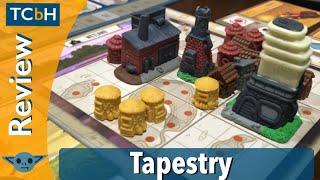
Video tYVRPc71Rjg The Cardboard Herald Review at 0:14 sentiment: positive
video_pk 845 · mention_pk 2412
The Cardboard Herald - Tapestry video thumbnail
Click to watch at 0:14 · YouTube ↗
Overall sentiment (raw)
positive
Pros
  • beautiful, immersive components
  • diverse civilizations and tapestry card variety increases replayability
  • engine-building with many synergistic, meaningful actions
  • actions feel intuitive once learned and offer many choices
  • non-confrontational yet competitive gameplay
  • robust solo mode
  • easy to teach relative to its depth
Cons
  • potential for bad luck with tapestry draws
  • steep learning curve and potential for overwhelm due to depth
  • some buildings/trophies feel cosmetic and not impactful
  • solo mode initially challenging to grasp
Thematic elements
  • Civilization progression; tapestry-driven narrative shaping each era
  • Civilization-building across four eras culminating in a fifth era and a capital full of income buildings
  • emergent, combinatorial; evolving player stories
Comparison games
none
Mechanics (from transcript analysis)
  • combat/territory conquest — Conquest of territories using dice outcomes; limited towers per space
  • dice and randomness — Dice influence outcomes and resource generation
  • Dice Rolling — Dice influence outcomes and resource generation
  • era advancement — Four eras; advancing by playing tapestry cards and moving up tracks
  • Resource Management — Resources are spent to move up tracks with escalating costs
  • resource management and cost curves — Resources are spent to move up tracks with escalating costs
  • solo mode — Dedicated solo variant with its own flow
  • tapestry cards — Cards that alter eras and provide immediate or delayed effects
  • territory/tiles and capital board — Placing tiles and income buildings on the capital board with space constraints
  • Tile Placement — Placing tiles and income buildings on the capital board with space constraints
  • Track Advancement — Four eras; advancing by playing tapestry cards and moving up tracks
  • track-driven actions — Each track provides specific actions and costs; driving multiple paths
Video topics + discussion points
No key topics recorded for this video.
Quotes (from this video)
  • on paper this game is pretty straightforward
  • tapestry is loaded with choices but always always your turn is basically one of five choices
  • the symbology becomes quickly intuitive
  • best of all it has a really big game impact in a more medium weight shell
  • the solo mode in this game is at first kind of a bear to wrap your brain around
  • this has invaded my sleep I've had a blast playing it again and again
References (from this video)
No references stored for this video.
Video viexalX40Is Our Family Plays Games Discussion at 18:52 sentiment: positive
video_pk 394 · mention_pk 1181
Our Family Plays Games - Tapestry video thumbnail
Click to watch at 18:52 · YouTube ↗
Overall sentiment (raw)
positive
Pros
  • ambitious design with broad strategic depth
  • high production value
  • multiple viable strategic paths
Cons
  • high complexity and heavy weight
Thematic elements
  • civilization building with engine-like growth
  • Civ progression across a tapestry of ages
  • player-driven evolution of empire
Comparison games
  • Through the Ages
Mechanics (from transcript analysis)
  • engine-building — players develop a civilization engine across multiple tracks
  • Tile Placement — map and empire growth via tiles
  • Variable player powers — each player chooses diverse abilities and paths
Video topics + discussion points
No key topics recorded for this video.
Quotes (from this video)
  • there are four pillars to making our hobby more user friendly
  • genuine respect is essential to any truly user-friendly hobby
  • individual humility is crucial to embracing differences and learning
  • accountability means allowing trusted peers to speak honestly about shortcomings
  • love is the bedrock upon which all pillars rest; love in action is essential
  • we want people to try out our games because shipping is expensive, so we ship from the US
  • the board game hobby is welcoming, and growing together makes it feel like family
References (from this video)
No references stored for this video.
Transcript Navigation
Showing 201–228 of 228
Game Deep Dive